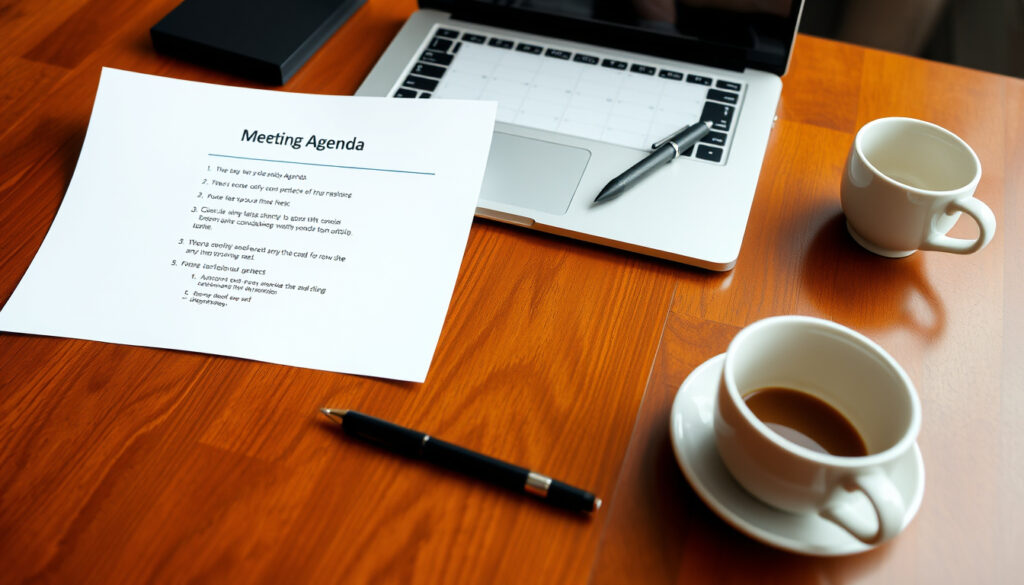
How to Write a Meeting Agenda: Format, Examples and Tips
Most meetings don’t go wrong in the room; they go wrong the day before, when nobody has agreed what the meeting is actually for. A written agenda fixes that, and planning one saves real participant time by clarifying topics, objectives, and time frames, notes MIT Human Resources (workplace learning guidance). Here’s the simple format, the 4 P’s and 5 P’s models, and a step-by-step method you can use from a first team sync to a formal board meeting.
Recommended agenda lead time: 24–48 hours before the meeting ·
Common agenda planning models: 4 P’s and 5 P’s ·
Minimum basic agenda items: 3 — objective, topics, and time allocations ·
Steps in a common agenda-writing method: 5 steps
Quick snapshot
- A basic agenda should identify the meeting title, date, start time, and duration (Microsoft Word (productivity software guidance)).
- Whether the 4 P’s or 5 P’s counts as the official framework depends on the training source.
- There is no single standard number of agenda items that fits every meeting type.
- Set a realistic time frame for every item, then leave buffer time for unexpected questions (Atlassian (team collaboration software)).
- After the meeting, reuse the same item list as the minutes skeleton: record one decision or action item next to every agenda line.
Six fields make up a complete agenda, and one pattern holds: every field exists to move the group toward a decision.
| Field | What it carries |
|---|---|
| Meeting date and time | Shown in the agenda header |
| Core objective | One sentence in the title |
| Three essential items | Objective, topics, and time allocations |
| 4 P’s model | Purpose, Product, People, Process |
| 5 P’s model | Purpose, Product, People, Process, Pitfalls |
| Agenda vs minutes | Agenda sets the plan; minutes record what happened |
The pattern: every agenda field either answers a logistics question or carries the group toward a decision — nothing else earns space on the page.
How to write a simple agenda for a meeting?
Start with the decision the meeting must produce, then build every other line from that decision. This is the agenda-as-contract approach: attendees see the point of the meeting before they arrive, and the document itself keeps the conversation honest.
How do you set a clear meeting objective?
- Write the desired outcome as one sentence, for example: “By the end of this meeting, we will approve the Q3 marketing budget.”
- Use that sentence as the agenda title so the purpose is visible in the calendar invite.
- Ask attendees for agenda input before the meeting so items reflect real work, not guesses.
- Delete any topic that doesn’t serve the outcome, or park it for a later meeting.
MIT Human Resources (workplace learning guidance) frames a useful agenda around the desired outcome, priority, time, responsible person, and discussion method for each item. That fits on one page, and one page is the right goal for most team meetings.
- Name the decision the meeting must make.
- List the topics in the order they need discussion.
- Add a time allocation to every topic.
- Assign one owner to lead or present each item.
- Close with decisions, action items, owners, and deadlines.
That structure matches the guidance from Atlassian (team collaboration software): each agenda item should have a clear topic or title, an assigned leader, and a time allocation.
An agenda is a pre-meeting contract. Every item earns its place by moving the group toward the stated decision — if it can’t, it doesn’t belong in the meeting.
The pattern: the objective isn’t just the first line of the agenda; it’s the filter every other line has to pass through.
What is the format of a meeting agenda?
A meeting agenda has two parts: a header that answers the logistics, and a body that orders the discussion.
What should the agenda header include?
- Meeting title, date, start time, and duration.
- Format: in person, virtual, or hybrid — with the room or video link named.
- Attendees, plus any presenters and their speaking responsibilities.
Microsoft Word (productivity software guidance) recommends stating whether the meeting is in person, virtual, or hybrid, identifying the location or platform, and listing expected participants and presenters in the header. The body then lists items in discussion order, with an owner and a time allocation on every line.
- List agenda items in the order they will be discussed.
- State the owner and time allocation for each item.
- Leave room for decisions or notes next to each item.
- Attach only the pre-reading documents that relate directly to the items.
- End with a next-steps line: decisions, actions, owners, deadlines.
Keep the file shareable: Word’s export options save a finished agenda as a PDF, and if a colleague sends a read-only copy, you can convert an agenda PDF to an editable Word file instead of retyping it. That keeps the agenda useful after the meeting, when it becomes the minutes.
One page respects everyone’s attention span; a multi-page pack suits formal boards. Match the length to the decision, not to habit.
The implication: a predictable format is a feature. When the structure is familiar, the discussion gets more oxygen.
What are the 5 P’s of a meeting agenda?
The P’s are a memory hook used in facilitation training to design agendas around outcomes rather than habits.
What are the four P’s of a meeting agenda?
- Purpose: why the meeting is needed.
- Product: the output or decision the meeting must produce.
- People: the participants required to reach that product.
- Process: how the meeting will run — order of items, discussion methods, time limits.
- Pitfalls (added in the 5 P’s version): risks or obstacles that could block the outcome.
The 4 P’s version uses Purpose, Product, People, and Process. The 5 P’s version adds Pitfalls. Which one a team treats as standard depends on the training source they follow; the substance is the same, and the fifth P is the one most often skipped.
- Purpose becomes the objective line.
- Product becomes the decision at the end of the agenda.
- People becomes the attendee list.
- Process becomes the topic order and time boxes.
- Pitfalls becomes a two-line risk note or a parking lot.
Pitfalls is the first P teams cut, and it’s the one that prevents tangents. A two-line note on what could derail the meeting keeps the group honest once the clock is running.
The trade-off: the 4 P’s are quicker to remember; the 5 P’s catch problems before they burn the budget. Pick one, write it on the agenda, and hold the room to it.
What are 5 things you would include in a meeting agenda?
Five lines cover almost every meeting, from a 15-minute stand-up to a quarterly planning session.
Which three items should a meeting agenda include?
- Objective: the decision or outcome the meeting must reach.
- An ordered list of topics or discussion points.
- A time allocation for every topic.
- The person responsible for leading or presenting each item.
- Decisions, action items, and next steps.
Strip it down and three items are essential: objective, topics, and time allocations. Everything else — owners, formats, pre-reading — makes those three work better. For a first meeting agenda, add introductions, purpose, and ground rules so the group starts with shared expectations.
The pattern: five items on the page, but only one test — does this line help the group reach the stated outcome?
What are some examples of good meeting agendas?
The best way to judge an agenda is to read it like an attendee: can you see the decision, your part in it, and how long it will take?
What is a simple meeting agenda sample?
- Objective: approve the Q3 marketing budget.
- Review spend vs. plan — 10 min, owner: Alex.
- Discuss allocation options — 20 min, owner: Priya.
- Decide and assign next steps — 15 min, all.
- Parking lot for off-topic ideas.
A good example shows who owns each item and what “done” looks like. If a line can’t state its output — a decision, a recommendation, or an update — it’s not ready for the agenda. The parking lot captures off-topic ideas without derailing the meeting.
How is an agenda different from meeting minutes?
- Agenda: what the meeting will discuss, and who leads each part.
- Minutes: what was decided, and who does what next.
Agenda sets the plan; minutes record what happened. Keep them linked: use the same item order from the agenda as the skeleton for the minutes, then write the decision or action item next to each line. That turns one document into the other with almost no extra work.
Why this matters: when the agenda and minutes share a structure, follow-up becomes a checklist instead of a hunt through old notes.
What are the 5 simple rules for successful meetings?
An agenda helps even when the meeting runs off plan — the rules below keep the plan alive in the room.
What are three things that make a meeting successful?
- Clear purpose: the meeting exists to produce one outcome.
- Prepared participants: the agenda went out in advance and people read it.
- Defined next steps: every item closes with an action, an owner, and a deadline.
Three success factors, one agenda rule: each one maps to a line on the page. Purpose becomes the objective; preparation becomes the 24–48 hour lead time; next steps become the last section.
What are the four questions to lead a meeting?
- Why are we here? (purpose)
- What must we produce? (outcome)
- Who needs to be in the room? (people)
- How will we work? (process)
Those four questions collapse into the 4 P’s — Purpose, Product, People, Process — and they make a useful opening check before the agenda goes out.
What is a good opening question for a meeting?
- Ask the group to restate the outcome in their own words.
- Ask which part of the agenda is most urgent for them.
- Ask what would make the meeting a success for their team.
A good opening question connects attendees to the meeting outcome rather than the weather. It forces the first few minutes to work for the agenda.
The pattern: successful meetings follow a cheat sheet that already exists — the agenda. The rules only work if the document reached the attendees before the meeting did.
How to create a meeting agenda template step by step
You can build a reusable template in five steps, then fill it in for any meeting. Word’s meeting-agenda templates follow the same loop: pick a template, replace the placeholder text, add key discussion points, then save, share, or export the result as a PDF.
- Start with the outcome — write the decision the meeting must produce and use it as the agenda title.
- Build the item list — order topics by importance, then add a time limit and an owner to every item.
- Run the P’s check — Purpose, Product, People, Process, Pitfalls; cut anything that doesn’t serve the outcome.
- Fix the logistics — date, time, location or video link, attendee list, and buffer time; for Irish teams, that includes checking working days and scheduling meetings around Irish bank holidays before you send the invite.
- Close with follow-up — end the agenda with decisions, action items, owners, and deadlines; after the meeting, reuse the list as the minutes.
For board and committee meetings, add a compliance check. The Australian Charities and Not-for-profits Commission (charity regulator) publishes a meeting-agenda template for charities, assigning suggested items to responsible governing-body members — but the template is an example: you have to check it against your organization’s governing document and applicable legislation.
Format changes the plan too. The Consumer Financial Protection Bureau (U.S. consumer protection agency) offers separate agenda resources for in-person and virtual convenings, so treat the two formats as different documents, not copy-paste versions of each other.
For a board or committee, “we used a template” is not a compliance answer. The template is a starting point; the governing document is the test.
The implication: the same five steps build a one-page team agenda or a formal board pack — the stakes change, the structure doesn’t.
Confirmed facts vs. what’s unclear
Most agenda guidance converges on the same core: a clear objective, ordered topics, time boxes, and named owners. The open questions are about which framework counts as standard, not about whether the structure works.
Confirmed facts
- The 5 P’s model is Purpose, Product, People, Process, and Pitfalls.
- A simple agenda should include the meeting objective, ordered topics, and time allocations.
- An agenda should define next steps and action items for each relevant item (Atlassian (team collaboration software)).
What’s unclear
- Whether the 4 P’s or 5 P’s is the official framework depends on the training source.
- There’s no single standard number of agenda items for every meeting type.
- The right level of detail shifts with team norms and governance requirements.
The pattern: the framework arguments are cosmetic; the discipline of naming a decision, a time, and an owner is what actually changes meetings.
What the experts say
A closing action-items section should record tasks, deadlines, and responsible people.
MIT Human Resources (workplace learning guidance)
An agenda should state whether the meeting is in person, virtual, or hybrid, and identify the location or platform.
Microsoft Word (productivity software guidance)
The common thread: structure is the point. Every expert source reduces a meeting to the same formula — a clear topic, a clear time, a clear owner.
A meeting agenda is not paperwork; it’s the cheapest productivity tool most teams own. The decision-first structure — objective in the title, time-boxed items with owners, and a next-steps line — turns a vague calendar block into a meeting people can prepare for. For meeting owners, the choice is clear: send a one-page agenda that ends with named action items, or keep paying for meetings where the real decisions happen in the hallway afterward.
word.cloud.microsoft, word.cloud.microsoft, word.cloud.microsoft, canva.com
Frequently asked questions
What is a meeting agenda template?
A meeting agenda template is a reusable document shell with the standard fields already laid out: title, date, time, objective, ordered topics with time allocations and owners, and a next-steps section. You fill in the specifics for each meeting instead of building the structure from scratch.
How do I create a meeting agenda template in Word?
Start from Word’s meeting-agenda templates, replace the placeholder text with your meeting’s details, add key discussion points and pre-reading materials, then save it as a reusable .docx or export it as a PDF. Once it’s saved, duplicate the file for each new meeting.
How long should a meeting agenda be?
For a working team meeting, one page is the right size. Boards and committees often need more detail, but if the agenda runs long, the items are probably too vague or too numerous. Tighten the items rather than the font.
Should I send the meeting agenda before the meeting?
Yes. Send it 24–48 hours before the meeting so attendees can prepare and add items. A shared online document works well because everyone sees updates; a PDF works when you want a fixed version.
What is a parking lot on a meeting agenda?
A parking lot is a named section near the bottom of the agenda where the group captures off-topic ideas, questions, or follow-ups that don’t belong in the current discussion. It protects the time boxes without losing the ideas.
How do I turn a meeting agenda into minutes?
Keep the same item list and, under each item, write the decision reached, the action items assigned, the owners, and the deadlines. The agenda already carries the structure; minutes just add the outcomes.
The FAQ pattern: a useful agenda answers the practical questions before they get asked — decision, time, owners, and follow-up.
More related posts
 Ireland Extreme Heat Weather Forecast: Records & Outlook
 Home Workout Without Equipment – 30-Min Full Body Routines
 Best Exercises for Energy: Boost Your Vitality Naturally
 Colin Farrell Net Worth (2026): $80 Million Salary, Homes & Biography
 AFL Grand Final 2025: Tickets, Time, and Snoop Dogg
 Mother’s Day 2026: UK & US Dates Explained
 Weather New York City – Warm Start to Chilly Shift Ahead
 Hard Rock Hotel Tenerife – Amenities Prices Reviews 2025
