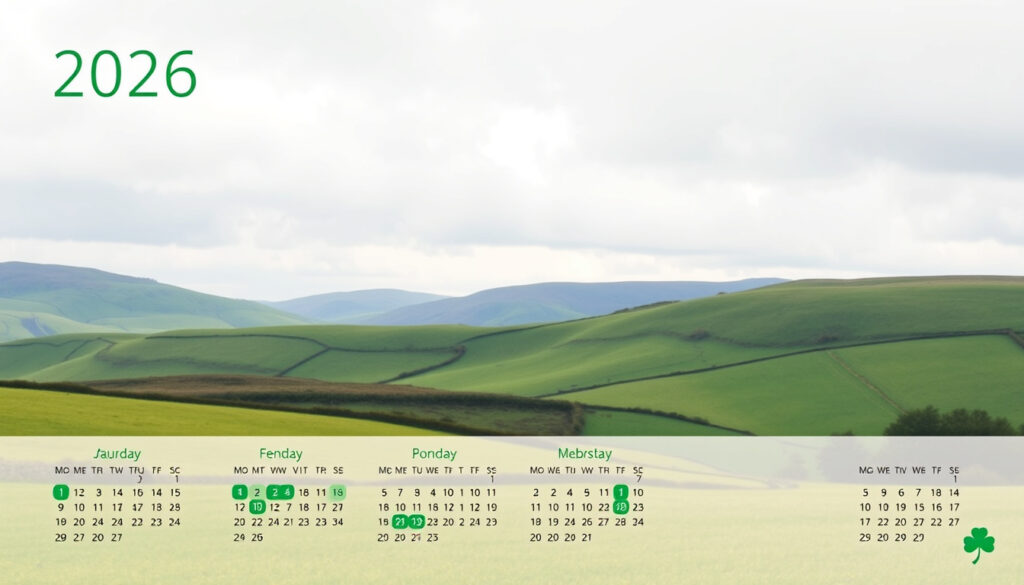
Ireland 2026 Bank Holidays: Complete List and Dates
There’s a quiet change in the Irish calendar that’s easy to miss until you try to book a week off: 2026 is a 10-holiday year, and St Brigid’s Day is the reason February finally has a Monday worth protecting. The dates below come straight from Citizens Information (official state guide), so you can plan work, school runs, or site shutdowns without the guesswork — and the calendar has settled into a new rhythm with construction workers having a second set of dates to watch.
Total public holidays in 2026: 10 · New permanent holiday: St. Brigid’s Day (2 February) · First holiday: New Year’s Day (1 January) · Last scheduled holiday: St. Stephen’s Day (26 December) · CIF construction holidays: To be confirmed (typically 2–3 extra days)
Quick snapshot
- 10 public holidays in the Republic of Ireland for 2026 (Extra.ie (Irish news outlet))
- St Brigid’s Day has been a permanent bank holiday since 2023 (The Irish Times (national newspaper))
- St Patrick’s Day lands on Tuesday 17 March 2026 (Ireland.com (official tourism site))
- CIF 2026 holiday schedule — not published in the sources reviewed here (BPFI (banking and payments federation))
- CIF 2026 pay rates — not announced yet; official figures come from the CIF or your employer (BPFI (banking and payments federation))
- Substitute-day treatment for Saturday 26 December — the banking calendar lists 28–29 December (BPFI (banking and payments federation))
- St Brigid’s Day has been a bank holiday since 2023 (Discover Ireland (national tourism authority))
- The 2026 St Brigid’s Day weekend is set for 31 January–2 February (Discover Ireland, national tourism authority) (Discover Ireland (national tourism authority))
- National holiday calendars list 2 February 2026 as the observance date (timeanddate (holiday calendar))
- CIF pay rates for 2026 — expected from the CIF’s annual agreement; watch its official channels (Cliffs of Moher Experience (tourist attraction operator))
- Employers should confirm substitute days for the Christmas weekend with their own payroll schedules (Cliffs of Moher Experience (tourist attraction operator))
- The St Brigid’s Day weekend is already a booked tourism slot: the Cliffs of Moher Experience scheduled programming for 31 January–2 February 2026 (Cliffs of Moher Experience (tourist attraction operator))
One table condenses the whole year into the numbers that matter for payroll and planning: the statutory dates are fixed, one holiday is newly permanent, and a small set of construction-specific details is still pending.
| Fact | 2026 detail |
|---|---|
| Total public holidays 2026 | 10 |
| New holiday added | St. Brigid’s Day (2 February) |
| First holiday | New Year’s Day (1 January) |
| Last holiday | St. Stephen’s Day (26 December; substitute days may apply on 28–29 December) |
| St. Patrick’s Day | Tuesday 17 March |
| Easter Monday | Monday 6 April |
| May Day | Monday 4 May |
| June Bank Holiday | Monday 1 June |
| August Bank Holiday | Monday 3 August |
| October Bank Holiday | Monday 26 October |
| CIF holiday count (typical) | 2–3 additional days |
| Labourer min hourly rate (2025 est.) | ≈€15.00 (planning estimate, unconfirmed) |
What are the Bank Holidays in Ireland in 2026?
The 2026 date list at a glance
Monday dates: 6 of 10 · Weekend falls: 1 (St Stephen’s Day) · Long-weekend window: Oct 24–26
Six of the ten dates fall on a Monday, which is the quiet pattern worth noticing before you start booking.
| Date | Day | Holiday |
|---|---|---|
| Thursday | New Year’s Day | |
| Monday | St. Brigid’s Day | |
| Tuesday | St. Patrick’s Day | |
| Monday | Easter Monday | |
| Monday | May Day (first Monday in May) | |
| Monday | June Bank Holiday | |
| Monday | August Bank Holiday | |
| Monday | October Bank Holiday | |
| Friday | Christmas Day | |
| Saturday | St. Stephen’s Day |
The list matches the official 2026 calendar published by Ireland.com (official tourism site), and Extra.ie (Irish news outlet) also flags 26 October as the Halloween/October bank holiday.
Weekend falls and substitute days
- St Stephen’s Day 2026 lands on a Saturday, which triggers a substitute-day arrangement; BPFI’s 2025–2027 banking calendar lists Monday 28 and Tuesday 29 December as the additional Christmas-period dates (BPFI, banking and payments federation).
- Christmas Day falls on Friday 25 December, so no substitute is needed for that date.
- The payroll takeaway: the December banking window effectively runs from 25 to 29 December, even though only two of those days are statutory holidays.
The pattern: the final week of December carries more holiday weight than the calendar shows at first glance, and that is exactly where payroll mix-ups happen.
How many bank holidays are there in 2026?
The count: 10, up from 9
2026 count: 10 · Pre-2023 baseline: 9 · Change: +1 (St Brigid’s Day)
The jump from nine to ten happened in 2023, when St Brigid’s Day joined the permanent list. The Irish Times (national newspaper) notes it has been a bank holiday since then. The practical effect: school calendars, annual leave schemes, and payroll forecasting all shifted to a 10-holiday template, and 2026 is the first full year where that template is fully settled.
Republic vs Northern Ireland
- Northern Ireland runs a different set of holidays; for 2026, Ireland.com (official tourism site) lists 4 May, 25 May, and 31 August as the main bank holidays there.
- In the Republic, Easter Monday carries the statutory April holiday; Good Friday is handled separately by many employers, including construction.
What this means for planners: a national “bank holiday” list only exists inside each jurisdiction — borrowing another region’s calendar is how missed deadlines happen.
Is Ireland getting an extra bank holiday?
St Brigid’s Day and the February rule
In 2026, the February break is not a one-off: 1 February falls on a Sunday, so the holiday shifts to Monday 2 February.
The rule, set out by Citizens Information (official state guide), is that St Brigid’s Day falls on the first Monday in February — except when 1 February itself is a Friday, in which case the holiday stays on 1 February.
The Department of Foreign Affairs (government department) describes St Brigid’s Day as observed on 1 February, marking the beginning of spring, while Discover Ireland (national tourism authority) flags the 2026 bank-holiday weekend as running from 31 January to 2 February.
How the 2026 date was set
- IrishCentral (Irish heritage outlet) notes that in 2026 St Brigid’s Day is observed on Monday 2 February because that is the first Monday after 1 February.
- The Office of Public Works (state works agency) celebrates Lá Fhéile Bríde at its locations nationwide on 1 February.
- Trips.ie (travel and culture site) lists the 2026 date as St Brigid’s Day (Imbolc), tying the holiday to the old spring festival.
- timeanddate (holiday calendar) likewise confirms 2 February 2026 as the national holiday date.
The catch for 2026 planners: the official day is the first Monday, not the saint’s feast date — so anyone circling 1 February on a calendar will be a day early.
What are the CIF holidays in Ireland in 2026?
What CIF holidays are
- CIF holidays are additional days off negotiated through the Construction Industry Federation for construction workers, stacking on top of the statutory public-holiday list.
- They commonly include Good Friday, Easter Tuesday, and sometimes a Christmas shutdown period; the exact mix varies by year and employer.
- None of these dates appear on the standard public-holiday calendar, which is why construction payroll can surprise people who plan around the 10 statutory days.
A Saturday St Stephen’s Day in 2026 means December payroll keeps moving after Christmas — a statutory day plus substitute days can turn the year’s last pay run into the heaviest one.
Typical days and the 2026 caveat
Typical extra days: 2–3 · Peak window: Easter week · 2026 status: Unconfirmed
If the recent pattern repeats, the extra days cluster around Easter and the Christmas shutdown — but nothing is fixed until the CIF publishes its 2026 list.
| Typical CIF day | 2026 calendar position | Status |
|---|---|---|
| Good Friday | Friday 3 April | Typical, unconfirmed |
| Easter Tuesday | Tuesday 7 April | Typical, unconfirmed |
| Christmas shutdown | Between Christmas and New Year | Varies by employer |
Good Friday sits two days before Easter Monday (6 April in 2026), so a site observing CIF days can effectively shut down from that Friday through Easter Tuesday.
The implication: the statutory 10-date calendar understates the real year on a construction site — the CIF list is where paid days off multiply, and it can catch out anyone who plans around the standard list alone.
What are the CIF pay rates for construction workers in 2026?
What’s known now
- The Construction Industry Federation publishes annual pay rates for construction workers in Ireland; rates vary by role, experience, and region.
- The 2026 rates are not confirmed in the publicly available sources reviewed here; the CIF’s annual agreement is the only authoritative reference.
- For planning purposes, the 2025 minimum hourly rate for a general labourer was approximately €15.00 — treat that as an estimate, not a 2026 figure.
The CIF announcement is the real pay event of 2026: a €1-an-hour rise on a 40-hour week moves a labourer’s weekly wage by €40 per worker before PRSI — budget for it before the rates land.
Where to check when rates land
- The CIF’s official website and its annual wage agreement are the definitive sources for published rates.
- Site managers and estimators usually circulate the new rates as soon as the CIF agreement is signed.
- If a site operates under a union agreement, a union representative or regional CIF branch typically relays the schedule first.
Why it matters: the gap between the statutory calendar and the CIF calendar is where most December payroll questions start — and in 2026, with a Saturday St Stephen’s Day, that gap is wider than usual.
Timeline signal
The change took two years to land and is now permanent; the sequence explains why 2026 calendars look different from pre-2023 ones.
| Period | What happened |
|---|---|
| 2022 | Legislation added St Brigid’s Day to the permanent public-holiday list. |
| February 2023 | First observance of St Brigid’s Day as a public holiday. |
| Late 2025 (target) | Construction Industry Federation expected to confirm its 2026 holiday schedule and pay rates. |
| 2026 | Full year with 10 public holidays, including St Brigid’s Day on Monday 2 February. |
What to watch: if the CIF announcement slips into 2026, payroll teams will work from the 2025 agreement until the new one is signed — and December substitute days will be negotiated site by site.
Confirmed facts and what’s still unclear
Confirmed facts
- Ireland has 10 public holidays in 2026, confirmed across state, tourism, and banking calendars (Extra.ie, Irish news outlet)
- St Brigid’s Day has been a permanent public holiday since 2023.
- The 2026 dates align across official and banking calendars, including the 28–29 December substitute window flagged for the banking sector.
What’s unclear
- CIF holiday schedule for 2026 — not published in the sources reviewed here.
- CIF pay rates for 2026 — not yet announced; the CIF’s official channels are the reference.
- Substitute-day treatment for Saturday 26 December — banks follow the 28–29 December pattern; other employers can apply their own agreements.
- The €15 labourer figure is a planning estimate, not an official 2026 rate.
The distinction matters because a construction rota built only on the 10 statutory dates will miss up to three additional paid shutdown days — and the December substitute days can add a further surprise.
The key voices
“St Brigid’s Day marks the beginning of spring in the Irish calendar.”
Department of Foreign Affairs (gov.ie (government department))
“The 2026 St Brigid’s Day bank-holiday weekend runs from 31 January to 2 February.”
Discover Ireland (national tourism authority)
Two voices set the tone for 2026: the state’s framing of St Brigid’s Day as the start of spring, and the tourism sector’s treatment of the February weekend as a real break.
The 2026 takeaway
For 2026, the only real calendar debate happens on construction sites, not around kitchen tables. The 10 statutory dates are settled, and St Brigid’s Day is a permanent part of them; the open questions are the CIF schedule and the pay rates that turn an extra day off into a payroll line. For employers running 2026 rosters, the choice is clear: lock in the statutory dates now, treat the CIF calendar as a second compulsory list — or risk paying holiday premium on days you never planned for.
Frequently asked questions
What is the difference between a bank holiday and a public holiday in Ireland?
In everyday usage they’re treated as the same thing — the 10 dates on the 2026 public-holiday list. Strictly, “bank holiday” reflects the banking sector’s closure, while public holidays are set by employment legislation and apply to employees generally.
Are all public holidays in Ireland paid for employees?
Employees generally get paid benefit on public holidays — a day off, an extra day of annual leave, or an additional day’s pay — depending on their work pattern before the holiday, as outlined by Citizens Information (official state guide).
What happens if a public holiday falls on a weekend in Ireland?
A substitute day is generally arranged. In 2026, St Stephen’s Day falls on Saturday 26 December, and the banking calendar flags 28 and 29 December as the additional Christmas-period dates (BPFI, banking and payments federation).
Do Northern Ireland and the Republic of Ireland share the same bank holidays?
No. Northern Ireland runs its own separate calendar — for 2026 that includes 4 May, 25 May, and 31 August — while the Republic’s 10 holidays are the ones detailed above. The two lists overlap on some dates but are not the same.
How are public holidays in Ireland determined?
Public holidays in the Republic are set by employment legislation — the Organisation of Working Time Act 1997 and later amendments. St Brigid’s Day was added to the permanent list in 2023, bringing the total to 10.
Are Good Friday and Easter Monday both public holidays in Ireland?
Easter Monday is a statutory public holiday in the Republic. Good Friday is not, although many businesses close on it; in construction it commonly counts as a CIF holiday, and Easter Tuesday is sometimes added too.
Do construction workers get extra holidays beyond the standard public holidays?
Yes. Under Construction Industry Federation practice, construction workers commonly get additional days such as Good Friday, Easter Tuesday, and sometimes a Christmas shutdown. The exact 2026 list needs confirmation from the CIF or your employer.
Employers planning 2026 rosters should lock in the statutory dates now and treat the CIF calendar as a second compulsory list — the December substitute window and the CIF schedule are the two details most likely to change a planned roster.
More related posts
 Sandos Papagayo Beach Resort: 2026 All-Inclusive Review
 Places to Visit in Dublin for Free: Top No-Cost Attractions
 PSG vs Inter Milan: 5-0 UCL Final Result & Highlights
 Northern Sound Death Notices: Cavan, Monaghan, Leitrim, Longford
 Latest Man Utd News: Ederson Transfer Confirmed, Hojlund Departs
 Man Utd vs Fiorentina: TV channel, kick-off, live stream, result
 Champo Pitta Growth Serum Review: Does It Work
 Celtic News and Rumors: Transfers, Fan Favorites & Club Facts
