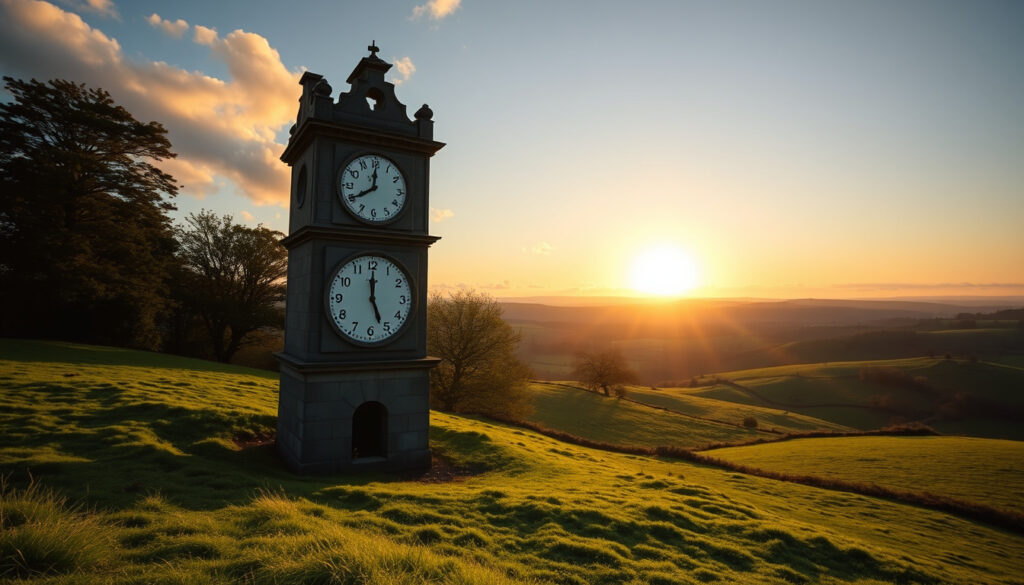
Daylight Saving Time Ireland: Dates, Summer Confusion, Longest Day
Anyone who’s tried to schedule a call with someone in Ireland while living in Brazil already knows the confusion that time differences can cause. It’s not just about the clocks changing twice a year — it’s also about understanding that Ireland’s summer starts on May 1st in local tradition, even though the meteorological calendar says June. This guide lays out the exact dates for daylight saving time changes from 2025 through 2027, explains the three different definitions of summer in Ireland, and shows how the time gap with Brazil shifts throughout the year.
Clocks change to daylight saving time (2026): March 29 ·
Clocks change back to standard time (2026): October 25 ·
Time difference from Brasília during DST: 4 hours ahead ·
Time difference from Brasília during winter: 3 hours ahead ·
Longest day (summer solstice) in 2026: June 21 ·
Ireland time zone: UTC/GMT +0 (winter), +1 (summer)
Quick snapshot
- Ireland observes DST every year since 1916 (RTÉ, Ireland’s national broadcaster)
- Clocks forward last Sunday March, back last Sunday October (RTÉ)
- March 29, 2026: DST starts (RTÉ)
- June 21, 2026: Summer solstice (Royal Museums Greenwich)
- Next clock change: March 30, 2025 (RTÉ)
- EU decision on abolishing DST still pending (RTÉ)
| Label | Value |
|---|---|
| Current time in Dublin (example) | 09:41 UTC |
| DST status (2026) | Active from March 29 to October 25 |
| Time difference to Brasília (DST) | +4 hours |
| Time difference to Brasília (standard) | +3 hours |
| Longest day 2026 | June 21 |
| Number of time zones in Ireland | 1 |
The table above confirms that Ireland operates on a single time zone with a seasonal shift, making the Brazil comparison straightforward once you know the DST status.
Does Ireland Observe Daylight Saving Time?
Yes, Ireland observes daylight saving time every year, a practice it has followed since 1916. During summer, clocks move forward by one hour to Irish Summer Time (IST, UTC+1); in winter, they revert to Greenwich Mean Time (UTC+0). The system is regulated by EU directives and Irish law, meaning the dates are fixed to the last Sunday of March and the last Sunday of October.
What is daylight saving time?
Daylight saving time shifts an hour of daylight from morning to evening. In Ireland, the effect is most noticeable in summer, when sunset can occur after 9 PM. The practice is not universal: Brazil abolished DST in 2019 and remains on standard time year-round, which is a key fact for anyone comparing time zones between the two countries.
Why do clocks change in Ireland?
The rationale for DST includes energy savings, more daylight for outdoor activities, and alignment with neighboring countries. Under the EU’s Summer Time Directive, all member states observe the same changeover dates. However, a European Commission review opened in 2018 may still abolish seasonal clock changes — no final decision has been made.
For Brazilian travelers and remote workers, Ireland’s DST means a shifting time gap: 3 hours during Irish winter, but 4 hours during Irish summer. Missing the switch means showing up an hour early or late to calls.
When Do the Clocks Change in Ireland?
Ireland changes its clocks twice a year: forward one hour in spring, back one hour in autumn. The exact times are 01:00 UTC when moving forward and 02:00 local summer time when falling back.
Daylight saving time start dates (2025, 2026, 2027)
- 2025: March 30 — clocks forward at 01:00 UTC → 02:00 IST (RTÉ)
- 2026: March 29 — clocks forward at 01:00 UTC → 02:00 IST (RTÉ)
- 2027: March 28 — projected clocks forward
Daylight saving time end dates (2025, 2026, 2027)
- 2025: October 26 — clocks back at 02:00 IST → 01:00 UTC
- 2026: October 25 — clocks back at 02:00 IST → 01:00 UTC (Worlddata.info)
- 2027: October 31 — projected clocks back
What time do clocks change?
In spring, clocks spring forward at 01:00 UTC (the moment the last Sunday of March begins). In autumn, they fall back at 02:00 Irish Summer Time, which becomes 01:00 UTC. This is consistent across all member states of the EU.
When Does Summer Officially Start and End in Ireland?
This is where confusion often arises, especially for visitors from countries with only one definition of summer. Ireland actually recognizes three different summer starts, depending on which calendar you follow.
Meteorological summer vs astronomical summer
Meteorological summer in Ireland runs from June 1 to August 31, based on annual temperature cycles. The Irish meteorological service Met Éireann uses this definition for climate records. Astronomical summer begins with the summer solstice, which in 2026 falls on June 21 at 9:24 AM IST (Royal Museums Greenwich).
Why May 1st is considered summer start in Ireland
Irish tradition holds that summer starts on May 1st, known as Bealtaine (or Beltane in older English). This Celtic festival dates back to pre-Christian Ireland, marking the halfway point between spring equinox and summer solstice. Today, it’s still observed with festivals, fires, and cultural events — the Hill of Uisneach hosts a Bealtaine fire festival each year.
How this differs from other countries
In many countries, summer is either meteorological (June–August) or astronomical (solstice to equinox). Ireland’s triple definition — meteorological, astronomical, and traditional — means that by one calendar, summer has already started when many others are still in spring. This is particularly confusing for Brazilian visitors, where summer runs December–February in the southern hemisphere.
A Brazilian traveler arriving in Ireland on May 1st might hear locals say “summer has started,” yet the meteorological summer is still a month away. Understanding which calendar someone is using is the only way to avoid confusion.
What Is the Longest Day of the Year in Ireland?
The summer solstice delivers the longest day of the year in Ireland, and it’s a notably long one — Dublin gets roughly 17 hours of daylight.
Summer solstice date and time (2025, 2026)
- 2025: June 21 (exact time varies by source)
- 2026: June 21, at 9:24 AM IST (08:24 UTC) — confirmed by Royal Museums Greenwich
Daylight hours in Dublin on the solstice
On June 21, sunrise in Dublin is around 4:56 AM and sunset around 9:56 PM, yielding about 17 hours of daylight. This is among the longest days of any major city in Europe, comparable to Edinburgh but significantly longer than what Brazilians experience in Rio de Janeiro or São Paulo even during their own summer.
Cultural significance in Ireland
The solstice has deep pagan and cultural roots. The Hill of Uisneach, considered the sacred center of Ireland, hosts a solstice celebration with bonfires and storytelling. Newgrange, a 5,000-year-old passage tomb, is aligned to capture the sunrise on the winter solstice — the summer counterpart also draws visitors.
Daylight Saving Time Dates for 2025, 2026, and 2027
Four seasonal clock changes, one clear pattern: the formula is consistent, but the exact dates shift by up to seven days depending on when the last Sunday of March and October fall.
| Year | DST starts (forward) | DST ends (back) | Summer solstice |
|---|---|---|---|
| 2025 | March 30 | October 26 | June 21 |
| 2026 | March 29 | October 25 | June 21 |
| 2027 | March 28 | October 31 | June 21 |
This table shows that the summer solstice consistently falls on June 21 across all three years, providing a fixed reference point for planning around DST shifts.
Impact on time difference with Brazil
Brazil does not observe DST as of 2019 (Wikipedia). This means the time difference between Ireland and Brazil shifts seasonally: 3 hours during Irish winter, and 4 hours during Irish summer. For example, when it is 12:00 PM in Brasília during Irish summer, it’s 4:00 PM in Dublin; during Irish winter, it’s 3:00 PM. This shift is small but can be critical for scheduling calls across the two countries.
Future of DST in the EU
The European Commission proposed abolishing seasonal clock changes in 2018, following a public consultation where 84% of respondents opposed the practice. However, member states have not reached a consensus on whether to remain on permanent summer or permanent winter time, so the directive remains unchanged as of early 2025.
Timeline: Key dates in Ireland’s 2026 daylight saving year
- March 29, 2026 — Clocks go forward 1 hour (01:00 UTC → 02:00 IST). DST begins.
- May 1, 2026 — Traditional start of summer (Bealtaine / Beltane).
- June 21, 2026 — Summer solstice. Longest day of the year in Ireland.
- October 25, 2026 — Clocks go back 1 hour (02:00 IST → 01:00 UTC). DST ends.
- March 28, 2027 — Next DST start (projected).
- October 31, 2027 — Next DST end (projected).
jump2eu.com, telescoper.blog, sunrisesunsettime.org, future.fandom.com, daylight-savings.com, connectbrazil.com, holidays-info.com
For precise dates and a handy reference, consult Irelands 2026 clock change schedule to stay ahead of the switch.
Frequently asked questions
Does Ireland change clocks for daylight saving time?
Yes, Ireland observes daylight saving time. Clocks go forward one hour in spring (last Sunday of March) and back one hour in autumn (last Sunday of October), regulated by EU directives and Irish law.
When do clocks go forward in Ireland 2026?
Clocks go forward on March 29, 2026, at 01:00 UTC (becoming 02:00 IST).
When do clocks go back in Ireland 2026?
Clocks go back on October 25, 2026, at 02:00 IST (becoming 01:00 UTC).
What is the current time in Ireland?
The current time depends on the season. Ireland uses GMT (UTC+0) in winter and IST (UTC+1) during daylight saving time. You can check current time on timeanddate.com.
How many hours ahead is Ireland from Brazil?
During Irish summer (DST), Ireland is 4 hours ahead of Brasília. During Irish winter (standard time), it is 3 hours ahead. Brazil does not observe daylight saving time.
Why does Ireland start summer on May 1st?
May 1st is Bealtaine, a traditional Celtic festival marking the beginning of summer. It coexists with meteorological summer (June 1) and astronomical summer (solstice around June 21), creating three overlapping definitions.
What is the longest day in Ireland?
The longest day is the summer solstice, around June 21. Dublin gets approximately 17 hours of daylight on that day.
Related reading
More related posts
 Cast of The Usual Suspects: Full Guide to Actors and Roles
 Woman of the Dead: Netflix Guide to Seasons & Setting
 Dr Melaxin Peel Shot Review: Does It Work? Side Effects & Safety
 Tide Times Dunmore East: Today’s High Tide, Low Tide Chart
 Strictly Come Dancing Time Tonight: BBC One Schedule
 Ebon Moss-Bachrach Movies and TV Shows: Complete List
 Radio Kerry Death Notices & Latest News
 Our Lady’s Hospital Navan: Visiting Hours, Age Limit & More
