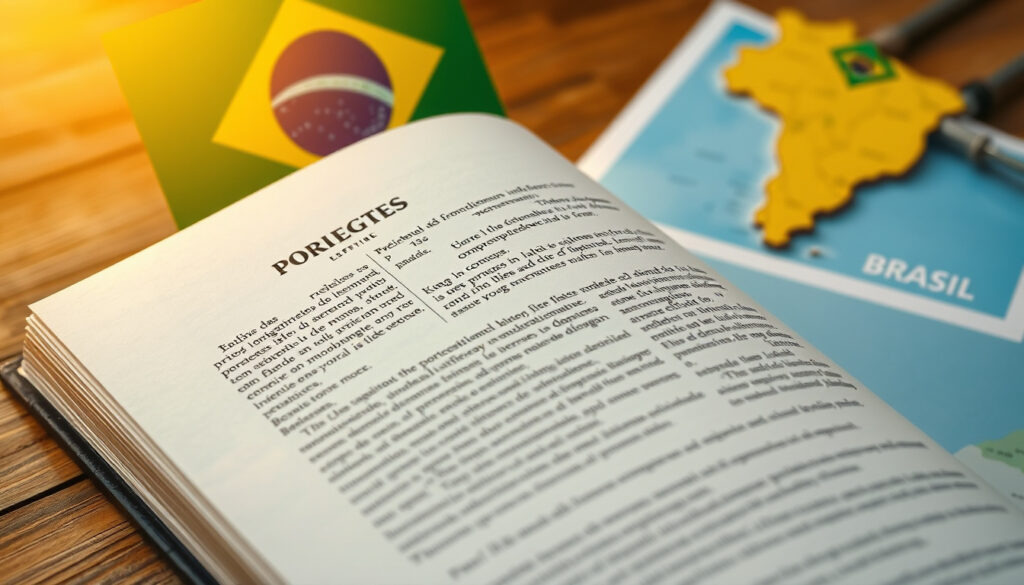
What Language Is Spoken in Brazil? Portuguese & Facts
You might have heard that Brazil is in South America, but if asked what language they speak, many people guess Spanish. The answer is Portuguese — and that distinction shapes everything from government to daily life in the region’s largest country.
Official language: Portuguese ·
Native speakers (Portuguese): 97.9% of 214 million ·
Total living languages: Approximately 228 ·
Largest Indigenous language: Ticuna (approx. 50,000 speakers) ·
Sign language recognized: Libras (Brazilian Sign Language)
Quick snapshot
- Portuguese (Babbel (language learning platform))
- Used in government, education, and media (Babbel)
- Spoken by 97.9% of the population (Tomedes (translation services provider))
- Around 228 languages (Babbel)
- Largest is Ticuna (Instituto Socioambiental (Indigenous rights organization))
- Constitutionally recognized since 1988 (Constitute Project (constitutional text repository))
- Libras (Brazilian Sign Language) (Indiana University South Bend LibGuides (academic reference))
- Official auxiliary language since 2002 (Indiana University South Bend)
Six facts in particular define Brazil’s linguistic landscape — from the dominance of Portuguese to the persistence of Indigenous tongues.
| Fact | Value |
|---|---|
| Official language | Portuguese |
| Percentage of speakers | 97.9% |
| Total languages in use | Approximately 228 |
| Indigenous language families | Over 20 (e.g., Tupi, Macro-Jê, Arawak) |
| German speakers | Approximately 3 million |
| Japanese community | Largest outside Japan, ~1.5 million |
What is the official language of Brazil?
Portuguese as the sole official language
- Portuguese is the official and national language of Brazil, spoken by virtually the entire population. The Constitute Project (constitutional text repository) confirms that the 1988 Constitution designates Portuguese as the official language of the Federative Republic of Brazil.
Constitutional recognition
- Article 13 of the 1988 Constitution states that “Portuguese is the official language of the Federative Republic of Brazil.” This status has remained unchanged since the country’s independence in 1822 and was reaffirmed after the democratic transition. (Constitute Project)
Because Portuguese is the sole official language at the federal level, all government documents, court proceedings, and public education are conducted in it. This creates a strong, uniform language policy that contrasts with the multilingual regimes of countries like Bolivia or Peru.
The pattern: Brazil’s language policy is rigidly centralized, which streamlines federal operations but sidelines minority tongues.
Is Brazil Spanish or Portuguese?
Why Portuguese, not Spanish
- Brazil was colonized by Portugal, not Spain. The Treaty of Tordesillas (1494) divided the New World, giving the eastern part of South America to Portugal. As a result, Portuguese took root. Babbel (language learning platform) notes that Brazil is the only South American country with Portuguese as its official language.
Common misconception clarified
- Many travelers assume Brazilians speak Spanish because of the country’s location. But Portuguese is a separate Romance language, not a dialect of Spanish. The Indiana University South Bend LibGuides (academic reference) emphasizes that “Portuguese is not a dialect of Spanish.” Only a small percentage of Brazilians are fluent in Spanish — estimates range from 3% to 5%.
The implication is clear: learning Spanish won’t let you fully communicate in Brazil. If you’re planning a trip, focus on Portuguese.
What are the top three languages spoken in Brazil?
Portuguese (97.9%)
- Portuguese dominates at 97.9% of the population, according to Tomedes (translation services provider). It is used in media, business, and everyday conversation across the entire country.
Indigenous languages
- The 2022 census counted 295 Indigenous languages, with Ticuna being the largest at around 50,000 speakers. The Instituto Socioambiental (Indigenous rights organization) reports more than 160 Indigenous languages and dialects are still spoken today.
Immigrant languages (German, Italian, Japanese)
- German dialects like Hunsrik and Pomeranian are spoken by about 3 million people, mainly in the south. Talian (a Venetian-based dialect) is used in parts of Rio Grande do Sul. Japan’s largest diaspora outside Japan lives in Brazil — roughly 1.5 million people of Japanese descent, many of whom speak Japanese at home. (Tomedes)
Brazil’s federal government recognizes only Portuguese at the national level, but a 2002 law (Law 10.436) made Libras (Brazilian Sign Language) an official auxiliary language. Meanwhile, Indigenous and immigrant languages have no such national status, despite being spoken by millions.
The catch: Facing this paradox, millions of Brazilians navigate daily life in languages that the state officially ignores.
What language was spoken in Brazil before Portuguese?
Tupian languages
- Before 1500, hundreds of Indigenous languages flourished. The Tupian family, especially Tupinambá, was widely used along the coast. Colonists and missionaries adopted it as a lingua franca called Língua Geral, which remained common well into the 18th century. (Instituto Socioambiental)
Other indigenous language families
- Beyond Tupi, the Macro-Jê family and 19 other linguistic families (e.g., Arawak, Carib) were present. The Indigenous Peoples in Brazil portal identifies two large branches (Tupi and Macro-Jê) plus numerous smaller families that persist today.
What this means: The linguistic diversity that existed before colonization has been drastically reduced, yet remnants survive in isolated communities.
How do I say hello in Brazil?
Common greetings: “Olá” and “Oi”
- The standard greetings are “Olá” (oh-LAH) and “Oi” (oy). Both are friendly and widely understood. In casual settings, people also say “E aí?” (What’s up?).
Regional variations
- In the south, you might hear “Tchau” used as a greeting alongside “Oi.” Handshakes, hugs, and cheek kisses (often one on each cheek in São Paulo, or two in Rio) are common depending on the region and familiarity. The Babbel guide to Brazilian Portuguese notes that the number of kisses varies by state.
Learning just “Olá” gets you far, but Brazilians appreciate even a few Portuguese phrases. The effort signals respect — something that matters more in Brazil than in many other countries.
The pattern: A simple greeting opens doors, but deeper cultural fluency comes from showing willingness to learn the local language.
Timeline: Portuguese in Brazil
- : Portuguese colonists arrive, bringing the Portuguese language.
- : Portuguese becomes the dominant language, replacing Língua Geral.
- : Brazil declares independence from Portugal; Portuguese remains official.
- : Libras (Brazilian Sign Language) is recognized as an official auxiliary language (Law 10.436). (Indiana University South Bend)
The implication: Three centuries of colonial language policy cemented Portuguese, and even independence did not alter that trajectory.
Confirmed facts vs. what’s unclear
Confirmed facts
- Portuguese is the sole official language of Brazil. (Constitute Project)
- Brazil was colonized by Portugal, not Spain. (Babbel)
- There are around 228 living languages in Brazil. (Tomedes)
- Libras is an officially recognized sign language. (Indiana University South Bend)
What’s unclear
- Exact number of active Indigenous languages varies by source (228 to 250). The 2022 census counted 295, but earlier sources said 274. (Tomedes, Babbel)
- Some immigrant languages (e.g., Hunsrik) are not universally recognized as official regional languages at the national level.
- Exact number of Indigenous language speakers remains uncertain; the 2022 census counted 474,856 speakers aged two and over, but earlier estimates varied widely.
- The status of Talian (Italian dialect) as a regional language is not federally enshrined, leaving it unprotected.
The pattern: Even basic counts shift with each census, reflecting the difficulty of surveying a multilingual nation of 214 million people.
Expert perspectives
Portuguese is the official and national language of Brazil, being widely spoken by nearly all of its population.
Portuguese is by far the biggest major language spoken in Brazil, with around 97.9% of the population using it as their primary language.
The language of Brazil is Portuguese and, in spite of what some people think, Portuguese is not a dialect of Spanish.
For travelers, the message is consistent: learn basic Portuguese or rely on English in tourist hubs — but don’t expect Spanish to work.
Related reading
- I Love You in Spanish: Te Quiero vs Te Amo Explained — useful if you’re comparing Romance languages.
- Como Organizar o Tempo — a Portuguese-language piece that may help with time-management vocabulary.
The implication: Pairing language study with cultural context deepens your understanding of Brazil’s linguistic landscape.
linkedin.com, planetspark.in, iwgia.org, en.wikipedia.org, learningpartnership.org, britannica.com
Travelers can find a practical guide to Brazilian Portuguese to help with greetings and slang before visiting Brazil.
Frequently asked questions
Is English widely spoken in Brazil?
English is not widely spoken outside of tourist areas and business circles. Only about 5% of Brazilians speak English fluently.
How many Indigenous languages are still spoken in Brazil?
The 2022 census identified 295 Indigenous languages, though earlier counts reported around 274.
Do Brazilians understand Spanish?
Most Brazilians do not speak Spanish fluently. However, because Portuguese and Spanish are related, some Brazilians can understand written Spanish.
Is German spoken in Brazil?
Yes, especially in the south. Around 3 million people speak German dialects like Hunsrik and Pomeranian.
What is Libras?
Libras (Brazilian Sign Language) is the sign language recognized as an official auxiliary language since 2002.
What is the most common immigrant language in Brazil?
Japanese is the largest immigrant-language community, with about 1.5 million speakers. German dialects are second.
More related posts
 Emergency Dentist Near Me: ER or Dentist for Tooth Pain
 Is Monaco a Country? Sovereignty, Wealth & Residency Guide
 Dublin to Belfast Train: Tickets, Timetable & Travel Guide
 Russian Nuclear Submarine Accident: The Kursk Disaster
 Ryanair Share Price Euro: Live €22.60 on Euronext Dublin
 Como Organizar o Tempo: 7 Techniques for Better Time Management
 Offshore Law Companies in Guernsey: The Top Firms and Services
 How to Wear a Claddagh Ring: Rules, Meaning, Traditions Explained
