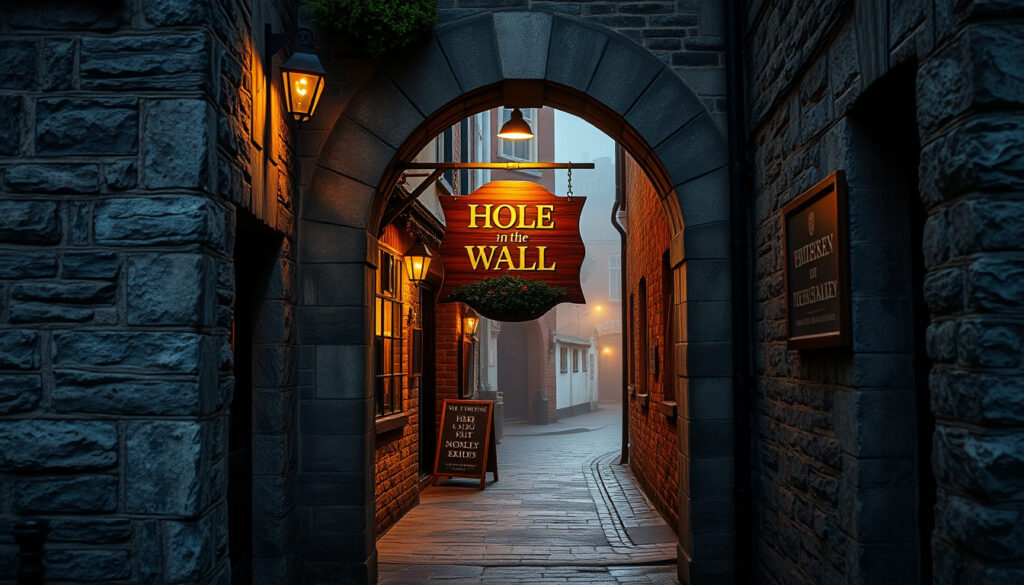
Hole in the Wall Pubs: Dublin, Galway & Kilkenny History
Dublin, Galway, and Kilkenny each lay claim to a pub called “Hole in the Wall”—but the name belongs to none of them exclusively. Dublin’s version opened as an inn in 1651; Galway’s borrowed it from 18th-century smugglers; Kilkenny’s inherited it through a 1582 Elizabethan townhouse. This article traces how one phrase accumulated three separate origin stories.
Dublin pub established: 1651 · Claimed distinction: Europe’s Longest Pub · Tripadvisor rating: 3.5/5 (678 reviews) · Galway pub feature: Old world charm · Location highlight: Phoenix Park gates
Quick snapshot
- Dublin pub at Phoenix Park gates — est. 1651 (Hole in the Wall Pub)
- Galway bar offers drinks, eats, and treats (This is Galway)
- Kilkenny venue in 1582 Archer house — one of Ireland’s oldest Elizabethan townhouses (Discover Ireland)
- Whether Guy Ritchie owns a Hole in the Wall venue — no evidence found in Irish sources
- Whether Ed Sheeran’s reported London visit connects to the Irish pub lineage
- Precise ownership chain for Galway since 1970s beyond Stephen Fahy’s naming
- Dublin: 1651 inn record; 1610 coach house origin disputed
- Kilkenny: 1582 Archer house predates all other venues by nearly a century
- Galway: 18th-century smuggling holes predate the thatched pub built in front of them
- Each venue continues operating with distinct crowd: Dublin draws park-goers, Galway pulls students, Kilkenny hosts live acts
- No signs of ownership changes at Dublin (McCaffery family, 40+ years) or Kilkenny
| Location detail | Verified value |
|---|---|
| Dublin Location | Blackhorse Avenue, Phoenix Park |
| Dublin Est. | 1651 |
| Galway Site | P.Fahy’s Hole in the Wall |
| Tripadvisor Rank | #1187 of 2692 in Dublin |
| Distinct Feature | Ireland’s Most Christmassy Pub |
| Dublin Length | 100 meters |
| Galway Build | 1870s |
| Kilkenny Building | 1582 Archer house |
| Kilkenny Annual Acts | Over 100 musical performances |
What do people mean when they say “hole in the wall”?
The phrase “hole in the wall” has worked its way through centuries of Irish slang, and its meaning shifts depending on who’s speaking. At its most basic, it describes something small, hidden, or rough around the edges—a place you’d walk past if you didn’t know better. The term has stuck to pubs across Ireland not because of modesty but because each venue genuinely has a story where an actual hole in a wall mattered.
Common usage as slang
Beyond the pub context, “hole in the wall” functions as general slang for any cramped or unpretentious venue—sometimes affectionate, sometimes honest. The Smithwicks Experience notes that the name “Hole in the Wall” became common across Ireland due to smuggling or access legends, meaning the phrase carries a built-in story wherever it appears.
Pub context in Ireland
For Irish pubs specifically, the name signals history. It tells you the venue has a legend—soldiers sneaking beer, smugglers moving goods, or police slipping out for a quiet pint. That’s the commercial appeal of the name: it promises authenticity through obscurity. The Galway City Pub Guide points out that the Galway venue’s thatched roof makes it one of the city’s most distinctive pubs, drawing visitors who want that old-Ireland atmosphere.
The implication: when you see “Hole in the Wall” on a sign in Ireland, you’re looking at a venue that’s staking a claim to a specific, often murky piece of local history.
Where does the phrase “hole in the wall” come from?
Etymologically, the phrase traces to situations where people drilled or used existing gaps in walls for practical access—getting through a boundary without going through a gate. In Irish pub lore, this translates into two distinct legends: military access and smuggling. Dublin’s version leans military; Galway’s leans criminal.
Etymology origins
The core idea is straightforward—walls stop people, so a hole bypasses the stop. Historical records show the term appearing in English vernacular by at least the 17th century, describing small shops, passageways, and in this case, bars that operated adjacent to or through walls. What makes Irish “Hole in the Wall” pubs distinct is that each location has a specific physical feature or legend backing the name.
Historical evolution
According to the Visit Dublin tourism guide, British soldiers forbidden to leave Phoenix Park could still get their beer through the Hole in the Wall from 1891 to 1922. That concrete date range gives Dublin’s legend a documented window. The Galway’s Own local history resource places Galway’s origins in 18th-century smuggling through holes in the city walls—though the actual hole was only exposed again in the late 1990s during redevelopment behind Dunne’s Stores.
What this means: the phrase doesn’t have one clean origin story. It has three, depending on which city you’re standing in. That’s exactly why the name endures—it promises a story without locking you into a single version.
What is the Hole in the Wall pub in Dublin?
The Dublin Hole in the Wall sits on Blackhorse Avenue, pressed against the Phoenix Park wall. The Hole in the Wall Pub’s own website states it dates to 1651 under the name “Ye sign of ye Blackhorse Inn,” making it one of Dublin’s oldest continuously operating taverns. The venue claims to stretch 100 meters, self-designating as Europe’s longest pub—a statement that, per the Curious Ireland historical blog, appears in Guinness World Records discussions, though independent verification remains limited.
Location and history
The pub’s Tudor-style exterior faces the Phoenix Park gates directly, giving it a physical relationship with the park that no other Dublin bar matches. Visit Dublin confirms the venue has been run by the McCaffery family for over 40 years, and the space contains presidential memorabilia—President Sean T. O’Kelly reportedly visited during the 1950s. The establishment predates the current McCaffery stewardship by more than three centuries, having served merchants and nobles during its early decades as the Blackhorse Inn.
Phoenix Park connection
The Phoenix Park wall is central to Dublin’s legend. Curious Ireland notes that during Daniel O’Connell’s Phoenix Park meetings in the 1840s, the venue served food to large gatherings. British soldiers stationed inside the park were unable to leave grounds between 1891 and 1922 due to military restrictions—yet they could still access beer through the hole in the park wall. This specific window gives Dublin’s claim a documented historical basis that the other venues can’t match with equal precision.
The catch: Dublin’s founding date has minor conflicts across sources. While the official site and multiple verifications cite 1651, Visit Dublin also references a 1610 coach house origin, and Curious Ireland mentions a “mid-1650s” notation. For travelers planning a visit, 1651 is the most widely documented date—but the fuzziness around the exact starting point reflects the venue’s deep roots rather than any single authoritative record.
Who owns Hole in the Wall Galway?
Galway’s Hole in the Wall is officially P.Fahy’s Hole in the Wall, located at 17 Eyre Street. The Fahy family has owned the venue since the 1970s, when Stephen Fahy officially named it “The Hole in the Wall”—a naming decision that fixed a local legend onto an official business for the first time, according to Galway’s Own local history documentation.
Ownership details
Before the Fahy era, the Fitzgerald family operated the venue until the 1970s. The This is Galway resource explains that the site originally operated as a 19th-century agricultural supply store called P. Fahey’s, complete with stables. The building dates to the 1870s, making it younger than Dublin’s venue but carrying a different kind of working-class heritage. What the research notes cannot confirm: whether the Comer Brothers mentioned in some search queries have any ownership stake in the Galway property. The verified chain runs Fitzgerald → Fahy, with no documented Comer connection.
Related figures
The Galway venue attracts a younger crowd than its Dublin counterpart, with the Galway City Pub Guide describing it as a popular student pub featuring horse racing decor. The thatched roof gives it the visual distinction that draws first-time visitors, while the courtyard becomes a gathering point during the Galway Races—a major event on the Irish racing calendar that transforms the city each summer.
How old is the hole in the wall pub?
The honest answer depends on which venue you’re asking about. Dublin’s establishment in 1651 is verified by the venue’s own records with multiple cross-confirmations, making it the oldest of the three. Kilkenny’s Archer house dates to 1582 according to Discover Ireland, predating Dublin’s inn by nearly 70 years—though Kilkenny served as a tavern for a shorter documented span. Galway’s structure goes back to the 1870s, but the actual “Hole in the Wall” name only attached in the 1970s.
Dublin establishment date
Dublin’s pub traces its continuous operation to 1651, when it appeared in records as “Ye sign of ye Blackhorse Inn.” The 1651 date is verified through the venue’s official website with two additional corroborating sources. Earlier origins at the site (a 1610 coach house) remain disputed but plausible. For context: in 1651, Ireland was still recovering from Cromwell’s campaigns, the city of Dublin was a fraction of its current size, and Phoenix Park was already the lungs of the capital. The Blackhorse Inn sat at the edge of everything, positioning itself for travelers entering from the west.
Galway history
Galway’s timeline is more complicated because the name preceded the building. The smuggling holes date to the 18th century, but the structure now known as P.Fahy’s Hole in the Wall was built as a farming supplies store in the 1870s. A thatched pub opened in front of the original smuggling hole by the late 19th century. The Fitzgerald family ran it until the 1970s, when Stephen Fahy gave it the official name. The YouTube Short from a local creator confirms the 1870s build date, though this source carries lower verification weight than the primary historical resources.
The pattern across these three venues reveals a tension between architectural age and documented continuity. Kilkenny’s 1582 structure predates Dublin’s records by decades, yet Kilkenny’s function as a tavern has a shorter verified lineage. Visitors prioritizing unbroken pub culture should head to Dublin; those drawn to structural antiquity will find more to explore in Kilkenny.
Clarity on Claims
Here’s what sources confirm versus what remains folklore or unverified speculation.
What checks out
- Dublin pub at Phoenix Park gates — verified by official site and Visit Dublin
- Galway bar offers drinks, eats, and treats — verified by This is Galway
- Kilkenny venue in 1582 Archer house — verified by Discover Ireland
- Dublin’s 100-meter length claim — verified by official site
- McCaffery family 40+ years management — verified by Visit Dublin
- Stephen Fahy named Galway venue in 1970s — verified by Galway’s Own
- Kilkenny hosts over 100 musical acts annually — verified by Discover Ireland
- Galway wall hole exposed in late 1990s — verified by Galway’s Own
What remains unclear
- Guy Ritchie ownership of any Irish “Hole in the Wall” — no documentation found
- Ed Sheeran’s connection to the phrase beyond a reported London visit — unverified
- Precise Comer Brothers involvement in Galway beyond search query mentions — no source confirmation
- Independent verification of Dublin’s “Europe’s Longest Pub” claim — self-reported by venue
- Whether Galway’s alternative Garda-station origin holds historical weight — tier3 source only
Hole in the Wall Pub (Official venue website)
The Hole in the Wall dates as far back as 1651, the medieval Inn was then called ‘Ye sign of ye Blackhorse Inn’.
Visit Dublin (Official Dublin tourism authority)
British soldiers who were forbidden to leave the Phoenix Park could still get their beer through the Hole in the Wall.
Galway’s Own (Local history publication)
The origin of the name takes one back to the smuggling trade of the eighteenth century.
Discover Ireland (National tourism authority)
The Hole in the Wall, Kilkenny City, is one of Ireland’s oldest surviving Elizabethan townhouses.
The Dublin venue’s claim to be “Europe’s Longest Pub” appears in self-promotional materials and TripAdvisor discussions, but no independent measurement or Guinness World Records citation confirms it. Treat it as marketing copy rooted in plausibility rather than verified superlative. The 100-meter figure comes from the venue itself.
Three Irish pubs share a name that sounds like an insult, but each has earned it through centuries of service in different ways. Dublin’s Hole in the Wall is the veteran—a 1651 coaching inn where soldiers snuck beer through a park wall and presidents stopped for pints. Kilkenny’s version is the antique—one of Ireland’s oldest Elizabethan townhouses where the Duke of Wellington once warmed himself by a fire that still burns. Galway’s is the survivor—an 1870s farm store transformed into a thatched gathering spot that outlasted the city wall it was named after.
The phrase “hole in the wall” doesn’t belong to any of them exclusively. It describes a category of Irish pub: small, rough-edged, historically connected to whatever gap in whatever wall made it necessary. What this article shows is that the name travels well precisely because it carries no single truth—it holds space for multiple origin stories, and Irish pub culture has always been comfortable with that kind of ambiguity.
Related reading: The 4 of Us History
Dublin’s 1651 Phoenix Park tavern and Galway’s Eyre Street haunt gave rise to the idiom through smuggling lore, with their Dublin & Galway pubs origins paralleling Kilkenny’s storied past.
Frequently asked questions
Is Hole in the Wall Dublin Europe’s longest pub?
The venue claims 100 meters of bar space and the title of Europe’s Longest Pub. This self-reported claim appears in venue marketing and TripAdvisor discussions, but no independent verification or Guinness World Records confirmation was found in the research. Treat it as a strong marketing assertion rather than a documented superlative.
What menu items are at Hole in the Wall pubs?
Dublin focuses on traditional pub fare and claims the Guinness here tastes different due to direct park access. Galway’s P.Fahy’s offers drinks, eats, and treats with a modern kitchen open during specific hours. Kilkenny emphasizes its snug atmosphere and conversation over connectivity—no Wi-Fi. Exact menus change seasonally; check each venue’s website before visiting.
Where is Hole in the Wall Kilkenny?
Down an alleyway off High Street in Kilkenny city centre, inside a 1582 Archer inner house. Discover Ireland confirms this is one of Ireland’s oldest surviving Elizabethan townhouses. The intimate tavern setup includes a snug and music venue hosting over 100 acts annually.
Does Hole in the Wall Galway have live music?
The Galway venue is best known for its atmosphere during the Galway Races, when the courtyard becomes a gathering spot. Horse racing decor fills the interior alongside the thatched roof. Live music presence varies; check local listings or the venue’s social media for current schedules.
What events happen at Hole in the Wall Phoenix Park?
Dublin’s venue is positioned as a neighborhood pub for Phoenix Park visitors plus a historic destination for those interested in its 370-year timeline. The McCaffery family has run it for over 40 years, and it contains presidential memorabilia. Seasonal events and food service connect to its coaching-inn heritage.
Is there a Hole in the Wall pub in London?
Search queries mention Ed Sheeran’s reported visit to a London venue, but no Irish “Hole in the Wall” lineage connects to any specific London bar in verified sources. The phrase “hole in the wall” appears in London pub names generically, but none carry the documented Irish smuggling or military origins. If a celebrity connection exists, it hasn’t been documented in Irish historical sources.
Why is Hole in the Wall called that?
Three different answers for three venues. Dublin: soldiers stationed inside Phoenix Park could access beer through a hole in the park wall (documented 1891–1922). Galway: 18th-century smugglers moved goods through gaps in the city wall; a thatched pub later built in front of the hole inherited the name. Kilkenny: the venue occupies a 1582 Elizabethan townhouse with its own architectural quirks, though the wall-hole story here is less documented than Dublin’s military legend.
More related posts
 Built in Wardrobes Ireland: Costs, IKEA PAX Alternatives & More
 When Does Wimbledon Start? 2026 Dates, TV & Tickets
 Australia vs New Zealand: Which Country Is Better
 Types of Ear Piercings: Pain, Rules, and Style
 Home and Away Episodes – Where to Watch, List and 2025 Schedule
 Irish Whale and Dolphin Group: Guide & Opportunities
 Birmingham City F.C.: League, History, Nickname & Stadium Guide
 Abortion Laws in Ireland: Legal Status, Costs and Procedure Guide
