Australia vs New Zealand: Which Country Is Better
Choosing between Australia and New Zealand often feels less like comparing two countries and more like picking a favourite child, with the rivalry spanning rugby, landscape, and even who makes a better flat white. But the data shows each country excels in different areas, turning the decision into a personal trade-off between economic scale and quality of life.
Population: Australia: ~26 million, New Zealand: ~5 million ·
GDP per capita (nominal): Australia: ~$65,000, New Zealand: ~$48,000 ·
Rugby World Cup titles: Australia: 2, New Zealand: 3 ·
Land area: Australia: 7.7 million km², New Zealand: 268,000 km²
Quick snapshot
- Cost of living is 7–12% higher in Australia (Numbeo, global cost-of-living database)
- Australian rent is roughly 24% more expensive than New Zealand’s (MoneyHub, New Zealand personal finance authority)
- Which country offers a “better” lifestyle remains subjective and varies by personal priorities (IMF World Economic Outlook)
- Long-term economic growth projections for both nations carry significant uncertainty (IMF World Economic Outlook)
- Australia’s population is about 5 times larger than New Zealand’s (Trading Economics, macroeconomic data)
- Migration from New Zealand to Australia has accelerated post‑COVID, driven by wage gaps (Upmove, moving cost comparison)
- Housing affordability in Australian capitals continues to diverge from NZ prices (Livingcost.org, expense data)
- Closer Economic Relations (CER) is expected to deepen, making labour movement even smoother (Australian Department of Home Affairs, immigration authority)
- The Bledisloe Cup will remain the centrepiece of the sporting calendar (Wikipedia, Bledisloe Cup history)
Five key facts, one pattern: Australia and New Zealand are constitutional siblings living on very different geographical scales.
| Attribute | Australia | New Zealand |
|---|---|---|
| Capital cities | Canberra | Wellington |
| Official languages | English | English, Māori, NZ Sign Language |
| Currency | AUD | NZD |
| Government type | Parliamentary democracy under constitutional monarchy | Parliamentary democracy under constitutional monarchy |
| Time zones | UTC +8 to +11 | UTC +12 (UTC +13 DST) |
Is it better to live in NZ or Australia?
A single person moving from New Zealand to Australia can expect their rent to jump by roughly a quarter, but their take‑home pay may increase by an even wider margin. The cross‑currents in this decision are strong enough to keep the trans‑Tasman migration flow one of the busiest in the world.
What are the downsides of moving to Australia?
- Higher living costs. Numbeo (global cost-of-living database) reports consumer prices including rent are 11.6% higher in Australia.
- Tough housing market. The average rent for a one‑bedroom city‑centre apartment in Australia is around AUD 2,300, compared with NZD 1,850 in New Zealand, according to MoneyHub (New Zealand personal finance authority).
- Harsher climate. Intense heatwaves, bushfire seasons, and tropical cyclones are recurring realities.
- Distance from home. Even though both countries are neighbours, the flight from Sydney to Auckland is over three hours, making regular visits more expensive.
Why are people moving out of New Zealand?
- Higher wages. Australia’s GDP per capita is roughly $65,000 compared to New Zealand’s $48,000, a 35% gap reported by the IMF World Economic Outlook (international economic statistics).
- Broader job market. Australia offers more positions in technology, finance, and trades, with lower unemployment rates in many sectors.
- Housing pressure at home. Auckland and Wellington have experienced some of the steepest price‑to‑income ratios in the world, pushing skilled workers overseas.
What are the biggest problems in Australia?
- Housing unaffordability. Sydney and Melbourne are consistently ranked among the most expensive cities globally. Numbeo places Australian rent 24.4% above New Zealand’s.
- Cost of living squeeze. Despite higher nominal wages, everyday expenses—from groceries to transport—add up. Livingcost.org (crowdsourced expense data) estimates the average cost of living in Australia is about 35% higher than in New Zealand.
- Geographic isolation. Australia is a vast, sparsely populated continent; accessing services, healthcare, and even some consumer goods can mean long travel times.
What disqualifies you from moving to Australia?
- Criminal record. Australia has strict character requirements—any conviction carrying a prison sentence of 12 months or more can lead to visa refusal ( Australian Department of Home Affairs, immigration authority ).
- Health conditions. Applicants must meet minimum health standards; significant ongoing medical costs can block entry.
- Age limits. Skilled migration points test heavily favours applicants under 45. Older migrants may need employer sponsorship.
The decision between higher earning potential and lower daily costs frames the trans‑Tasman choice.
Which is richer, New Zealand or Australia?
On paper, the answer is straightforward: Australia’s nominal GDP is roughly 8.5 times larger than New Zealand’s. But per‑capita numbers tell the same story at the household level.
- GDP per capita. ~$65,000 (Australia) vs ~$48,000 (New Zealand), per IMF World Economic Outlook.
- Local purchasing power. Numbeo estimates purchasing power is 5.8% higher in Australia, meaning a typical Australian salary buys slightly more goods and services overall.
- Wealth distribution. New Zealand has a modestly lower Gini coefficient, indicating slightly less income inequality than Australia (Trading Economics, macroeconomic data).
The pattern: Australia is the wealthier country by aggregate and per capita. New Zealand narrows the gap only when the cost of housing is subtracted from the equation.
Which is more beautiful, Australia or New Zealand?
If money is not the deciding factor, the landscapes are. Both countries top global “most beautiful” lists, but they attract very different tastes.
- UNESCO World Heritage sites. Australia has 20 (including the Great Barrier Reef, Uluru, and the Sydney Opera House); New Zealand has 3 (Tongariro National Park, Te Wāhipounamu, Sub‑Antarctic Islands) (UNESCO World Heritage Centre).
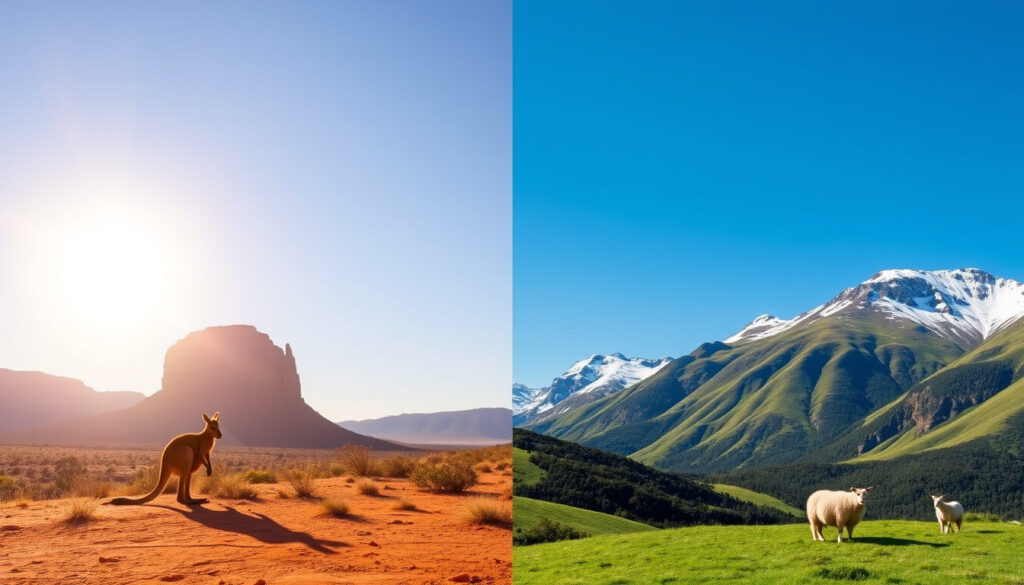
- Diversity of terrain. Australia offers everything from tropical rainforests (Daintree) to vast red deserts (Uluru) to world‑class beaches (Whitehaven). New Zealand packs fjords, glaciers, volcanoes, and rolling green pastures into a land area smaller than the US state of California.
- Tourism perceptions. Repeated traveller polls rank New Zealand’s South Island as one of the most beautiful regions on earth, while Australia’s natural landmarks are more individually iconic.
The trade‑off: Australia impresses with sheer scale and spectacle. New Zealand impresses with intimacy and variety concentrated into a small, accessible area.
How to watch Bledisloe Cup?
The annual rugby union match between Australia and New Zealand is a cultural event. Here is how to catch the action.
- In Australia: Stan Sport (requires a subscription) and Nine Network (free‑to‑air) have broadcast rights.
- In New Zealand: Sky Sport (pay‑TV) and TVNZ Duke (free‑to‑air for selected matches) carry the series.
- Schedule: The Bledisloe Cup is typically played across August and September, forming part of the international rugby calendar.
Has New Zealand ever won a test match in Australia?
- Yes — and emphatically. The All Blacks’ first Bledisloe Cup win on Australian soil was in 1986 at Concord Oval in Sydney. Since the annual series began in 1996, New Zealand has won the Cup 9 times to Australia’s 12 (Wikipedia, Bledisloe Cup history).
The catch: The Bledisloe Cup is far more than a sporting trophy—it is the annual referendum on a rivalry that runs far deeper than any economic statistic can capture.
Do NZ and Australia get along?
More than most sibling couples. The ANZAC bond forged in the hills of Gallipoli is a foundation of shared identity. Diplomatic and trade relations are among the closest in the world, underpinned by the Trans‑Tasman Travel Arrangement and the Closer Economic Relations (CER) agreement of 1983.
How do aussies say ‘sorry’?
- Pronunciation. “Sorry” is pronounced more like “saw‑ry” by most Australians, whereas New Zealanders tend toward a shorter “so‑ree.”
- Slang. “Arvo” (afternoon), “no wukkas” (no worries), and the quintessential “G’day” mark Australian speech. New Zealanders are more likely to use “sweet as”, “chur”, and “choice”.
- Cultural distance. Despite the shared language, the humour and social cues differ enough to fuel a constant, affectionate stream of ribbing. As one Wellington‑born writer put it: “We are two countries divided by a common tongue and a mutual sense of superiority.”
What this means: The relationship is a unique cocktail of genuine familial affection and fierce competition. The trans‑Tasman bond means the door never fully closes—emotionally, culturally, or economically.
Australia vs New Zealand: side‑by‑side comparison
Seven categories, one consistent split: Australia wins on economic scale; New Zealand wins on affordability and natural density.
| Category | Australia | New Zealand |
|---|---|---|
| Population | ~26 million | ~5 million |
| GDP (nominal) | ~$1.5 trillion (IMF) | ~$250 billion (IMF) |
| GDP per capita | ~$65,000 | ~$48,000 |
| Cost of living (incl. rent) | 11.6% higher than NZ (Numbeo) | Baseline |
| Monthly rent (1‑bed city centre) | AUD ~2,300 (MoneyHub) | NZD ~1,850 (MoneyHub) |
| Minimum wage (per hour) | AUD 24.10 (Fair Work Ombudsman) | NZD 23.15 (Employment New Zealand) |
| UNESCO World Heritage sites | 20 | 3 |
Living in Australia
- Higher wages and stronger job market
- Warmer climate year‑round
- Larger cities with more cultural amenities
- Housing is significantly more expensive
- Extreme weather (bushfires, heatwaves)
- More competitive, faster‑paced lifestyle
Living in New Zealand
- Lower cost of living overall
- World‑class natural beauty in a compact area
- Slower, less stressful pace of life
- Lower wages across most industries
- Smaller job market, fewer career paths
- Geographic isolation, even from Australia
Confirmed facts
- Cost of living and rent are higher in Australia (CityCost, global cost comparison)
What’s unclear
- Which country offers a “better” overall lifestyle (subjective)
- Future economic growth rates post‑COVID recovery
- Long‑term climate change impacts on agriculture and tourism
- Australia has a larger population and GDP
- The Bledisloe Cup is contested annually
- Both countries rank highly on global human development indices
“In peace as in war, we have shown we are one people and one family.”
— ANZAC commemoration writings, reflecting the shared bond between Australia and New Zealand
“Moving from Christchurch to Brisbane felt like stepping up a level professionally, but I lost the comfort of having wilderness on my doorstep. It’s a straight swap of ambition for convenience.”
— Expat forum user, r/newzealand
For any New Zealander or Australian weighing the move, the honest answer is that neither country is “better” in every sense. Australia rewards ambition with higher incomes and broader horizons. New Zealand rewards calmness with a lower cost of living and immediate access to nature. The trans‑Tasman door swings both ways, but making the switch requires a clear‑eyed view of which rewards you want to prioritise.
For a global perspective on navigating international borders, see our guide on travel restrictions to Canada. If you are weighing up the cost of living in different regions, our breakdown of Seattle time, weather and costs offers a useful North American comparison.
getwherenext.com, livingcost.org, intergate-emigration.com, mylifeelsewhere.com, freightamigo.com, idp.com, moneybalance.co.nz, thecurrencyshop.com.au
Frequently asked questions
What is the cost of living in Australia vs New Zealand?
Cost of living across Australia is generally higher. Numbeo (global cost-of-living database) reports consumer prices including rent are about 11.6% greater than in New Zealand. Rent is the largest driver of this difference, averaging 24% higher in Australian cities.
Which country has better healthcare, Australia or New Zealand?
Both have high-quality public healthcare systems. Australia runs Medicare, while New Zealand has the public health system (PHO). Life expectancy is similar, around 83 years, though Australia spends a higher proportion of its GDP on health (Trading Economics, macroeconomic data).
How strong is the Australian economy compared to New Zealand?
Australia’s nominal GDP is approximately 8.5 times larger than New Zealand’s. GDP per capita is around $65,000 in Australia versus $48,000 in New Zealand, making Australia’s economy unequivocally larger and richer on aggregate (IMF World Economic Outlook).
What is the history of the Bledisloe Cup?
First contested in 1931, the Bledisloe Cup is an annual rugby union competition between Australia and New Zealand. Since the modern annual series began in 1996, Australia has won 12 titles to New Zealand’s 9 (Wikipedia, Bledisloe Cup history).
Are there trade agreements between Australia and New Zealand?
Yes. The Closer Economic Relations (CER) agreement, signed in 1983, is the bedrock of the trans‑Tasman economic relationship, creating a single economic market for goods, services, and labour.
Which country has better job opportunities?
Australia typically offers a larger, more diverse job market with higher wages across most sectors. New Zealand’s job market is smaller but often benefits from lower competition in specialised fields such as environmental science and agriculture.
How do Australian and New Zealand cultures differ?
While sharing a foundation of ANZAC spirit and English heritage, New Zealand culture is more deeply influenced by Māori and Pacific Island traditions, while Australia has a more pronounced multicultural character drawn from a longer history of global migration.
What is the process for moving from New Zealand to Australia?
New Zealand citizens can apply for the Special Category Visa (subclass 444) upon arrival, which allows them to live and work in Australia indefinitely (Australian Department of Home Affairs, immigration authority). They do not require prior sponsorship but must meet character and health requirements.
More related posts
 M7 Traffic Accident Today: Live Updates
 Dogs for Sale Ireland: Find Puppies, Prices, and Safety Tips
 Convert PDF to Word Free: Tested for Accuracy & Privacy
 Dublin Weather This Week: Forecast, Rain & Temperatures
 Pitch and Putt Dublin: Prices, Courses & Beginner Tips
 Talking Pictures TV Listings: Today’s Schedule & Catch-Up Guide
 What Are Query Parameters? Definition and Examples
 What Is a CAPTCHA Challenge Response? Meaning & Solving Guide
