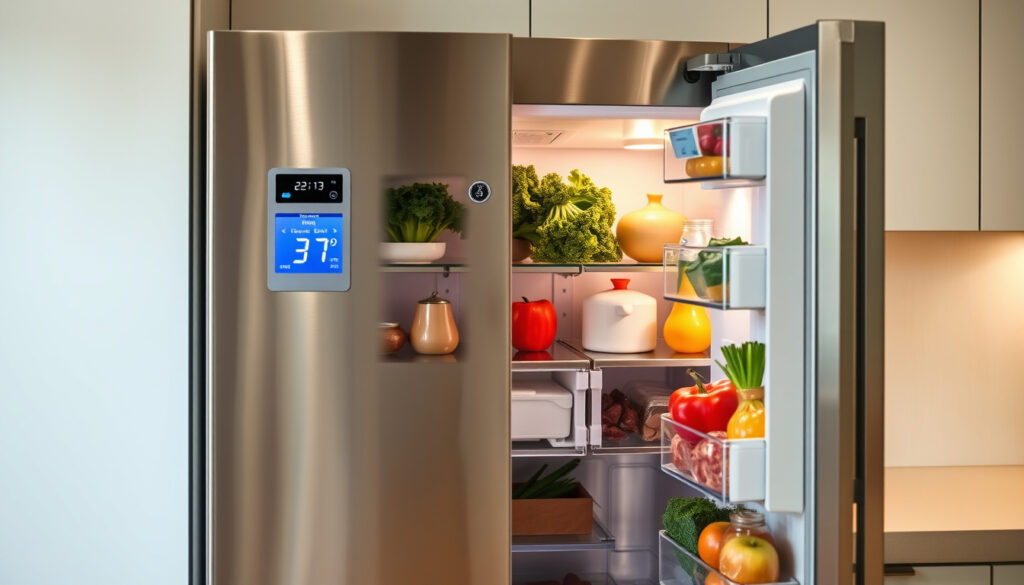
What Temperature Should Your Fridge Be? Safe Range Guide
The short answer: aim for 35°F to 38°F in the fridge and keep the freezer at 0°F.
Temperature Basics
- Ideal fridge range: 35–38°F (1.7–3.3°C)
- Freezer: 0°F (-18°C)
- Above 40°F is unsafe
Dial Settings Guide
- 1 = warmest, 5 = coldest (typical)
- Start at 3 or 4 and verify with thermometer
- Adjust lower if fridge is too cold
Verification Methods
- Use a $5 fridge thermometer
- Check center of middle shelf
- Look for condensation or spoilage
Key Facts
- Ideal fridge temperature: 35–38°F (1.7–3.3°C)
- Freezer: 0°F (-18°C)
- Dial numbers: 1 (warmest) to 5 (coldest)
What temperature should your fridge be?
The ideal refrigerator temperature is between 35°F and 38°F (1.7°C to 3.3°C). The dial on your fridge is not a thermometer; use a standalone thermometer to verify the actual temperature. This guide explains how to set your fridge for safety, efficiency, and longevity of your food.
Why 35°F to 38°F?
Keeping your fridge in this range prevents bacterial growth while keeping food fresh. The FDA and CDC recommend keeping the refrigerator at or below 40°F (4°C) and the freezer at 0°F (-18°C). However, most fridges operate best when set slightly cooler than 40°F to account for temperature fluctuations when the door opens.
How to read your dial
Most fridge dials run from 1 (coldest) to 5 (warmest). For a typical fridge, setting the dial to 3 or 4 usually achieves the ideal temperature. However, this varies by model. Always verify with a thermometer.
| Dial Setting | Approximate Temperature | Use Case |
|---|---|---|
| 1 | 38–40°F (3.3–4.4°C) | Mild cooling for drinks |
| 2 | 36–38°F (2.2–3.3°C) | Standard setting |
| 3 | 34–36°F (1.1–2.2°C) | Recommended for most food |
| 4 | 32–34°F (0–1.1°C) | Coldest setting |
The table above shows a common mapping. Some fridges use a different scale (e.g., 1–7). Always check your manual.
Verify with a thermometer
Place a fridge thermometer in the center of the middle shelf. Wait 5–8 hours. If the temperature is above 38°F, adjust the dial to a colder number. If it’s below 35°F, adjust to a warmer number.
How do I know if my fridge is cold enough?
Beyond a thermometer, there are visual cues: ice cream that’s too soft, milk that spoils early, or condensation on shelves. These signs indicate the fridge might be too warm.
Does a full fridge stay colder?
A full fridge retains cold better when the door is open because the food acts as a thermal mass. However, overstuffing blocks air vents, reducing efficiency. Leave space for air to circulate.
What temperature is unsafe for a fridge?
Any temperature above 40°F (4.4°C) is unsafe for perishable foods. Bacteria grow rapidly in the “danger zone” between 40°F and 140°F (4°C to 60°C). Always keep your fridge at or below 40°F.
Related reading: Cheese, Chicken, Pasta Recalls in Ireland (FSAI List) · How to Use a Tommee Tippee Bottle Warmer: Step-by-Step Guide
fda.gov, fda.gov, fda.gov, cdc.gov, fda.gov, extension.illinois.edu, health.state.mn.us, cdc.gov, cde.ca.gov, fda.gov, canada.ca, usfoods.com
FAQ: Fridge Temperature Questions
What is the ideal fridge temperature?
The ideal fridge temperature is between 35°F and 38°F (1.7°C to 3.3°C). This range keeps food safe and fresh.
Should a fridge be on 1 or 5?
It depends on your model. On a standard 1–5 dial, 1 is warmest and 5 is coldest. Start at 3 and adjust based on a thermometer.
How do I know if my fridge is cold enough?
Use a standalone fridge thermometer. Place it in the middle of the center shelf. Wait 5–8 hours. The reading should be between 35°F and 38°F.
Does a full fridge stay colder?
A full fridge retains cold better due to thermal mass. However, don’t overstuff, as blocked vents reduce efficiency.
What temperature is unsafe for a fridge?
Temperatures above 40°F (4.4°C) are unsafe because bacteria multiply quickly. Keep your fridge at 40°F or below.
Summary
To keep your food safe, set your fridge to 35–38°F (1.7–3.3°C) and your freezer to 0°F (-18°C). Use a thermometer to verify the actual temperature, regardless of the dial. A full fridge runs more efficiently, but avoid overstuffing. If the temperature rises above 40°F, discard perishables immediately.
Additional Resources
For more information, see the FDA’s guide on safe food storage and the CDC’s recommendations on refrigerator and freezer temperatures.
More related posts
 How to Draw Santa: Easy Step-by-Step Guide for All Ages
 Bus from Galway to Dublin – Timetable Prices and Booking Guide
 Cast of The Usual Suspects: Full Guide to Actors and Roles
 Carrauntoohil: Ireland’s Tallest Mountain – Height & Peaks
 Carraig Donn Opening Hours: Store Times, Locations & Company Info
 His & Hers on Netflix: Plot, Cast, Killer Explained (2026)
 May Bank Holiday 2026 Ireland: Date, Long Weekend, & More
 How Much CRP Level Is Dangerous – Thresholds, Ranges and Risks
