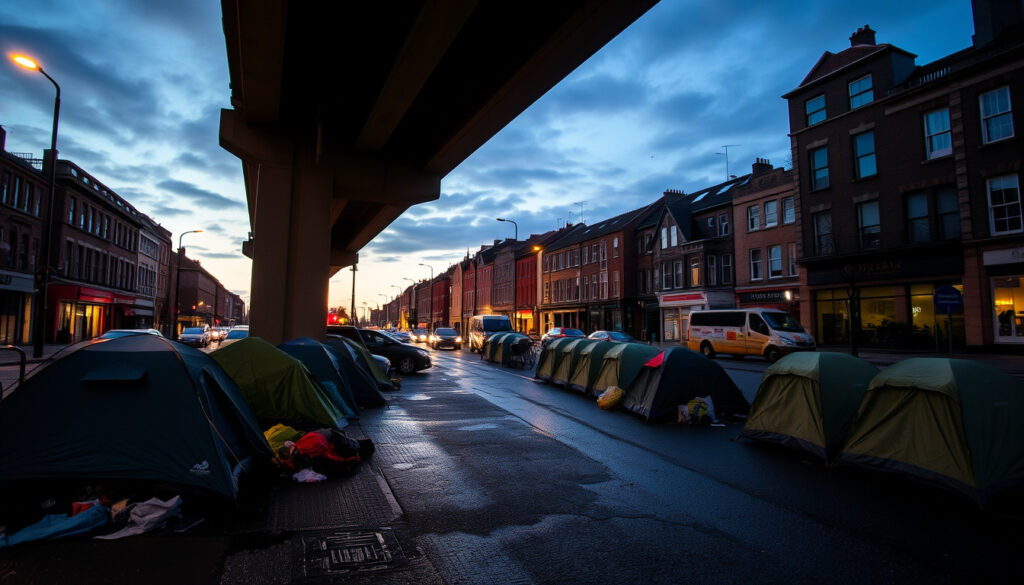
How Many Homeless in Ireland? Official 2026 Figures
Anyone watching Irish news knows the homelessness numbers have been hard to ignore: last winter a record 17,112 people were counted in emergency accommodation, and the monthly tallies have kept climbing since. This article tracks the official data from early 2026 and answers common questions.
Record high (April 2026): 17,548 ·
Children homeless (March 2026): 5,571 ·
Families in emergency accommodation (February 2026): 2,609
Quick snapshot
- 17,548 people in emergency accommodation in April 2026 (Simon Communities of Ireland (national homelessness charity))
- 5,571 children homeless in March 2026 (RTÉ (Irish public broadcaster))
- 2,609 families in emergency accommodation in February 2026 (TheJournal.ie (Irish news site))
- Exact number of hidden homeless – Simon Communities estimate 290,000 but this is not an official count
- How many people are homeless outside the emergency accommodation system (Simon Communities)
- Precise weekly or monthly outflow rates (Simon Communities)
- January 2026: 17,112 – record high (The Irish Times (Irish daily newspaper))
- February 2026: 17,308 – new record (RTÉ)
- April 2026: 17,548 – highest so far (Simon Communities)
- Monthly figures expected to stay above 17,000
- Government under pressure to increase social housing output
- Winter 2026–2027 could push numbers even higher
Six monthly counts from 2026, one pattern: every month has set a new record or stayed near it — the crisis is not easing.
| Month (2026) | People in emergency accommodation | Children | Families | Source |
|---|---|---|---|---|
| January | 17,112 | 5,319 | 2,555 | The Irish Times |
| February | 17,308 | 5,457 | 2,609 | RTÉ |
| March | 17,517 | 5,571 | — | RTÉ |
| April | 17,548 | — | — | Simon Communities |
| May | 17,447 | 5,583 | 2,684 | Novas (homelessness charity) |
| June | 17,482 | — | — | RTÉ |
The pattern: The upward trajectory has been relentless. Even May’s slight dip was erased the following month. Every new report undercuts any hope of a plateau.
What percentage of the Irish population is homeless?
Calculating an exact percentage is tricky because the official emergency accommodation count does not capture everyone without a home. The Census 2022 recorded 10,321 homeless out of a population of roughly 5.1 million, which worked out to about 0.2% (CSO data). By April 2026, the emergency accommodation figure alone had risen to 17,548 – approximately 0.3% of the current population estimate. But that does not include the so-called “hidden homeless” – people sofa-surfing or living with relatives because they have no place of their own. The Simon Communities of Ireland estimate that number at around 290,000, which would bring the total to nearly 6% of the population.
Why this matters: The official count understates the scale. The 0.2%–0.3% range reflects only those in the state’s emergency system, not the full crisis.
The most commonly cited “homelessness rate” – 0.2% – is an artefact of counting only the tip of the iceberg. If the hidden homeless estimate holds, the real affected share is thirty times larger, which changes the policy conversation entirely.
The implication: the official figures capture only a fraction of the problem.
Which county in Ireland has the most homeless?
Official data consistently shows Dublin accounts for the majority of those in emergency accommodation. The Census 2022 found 7,238 homeless people in the Dublin region – about 70% of the national total. Recent monthly reports do not always publish county-level breakdowns, but charities like Focus Ireland have repeatedly stated that the Dublin region continues to bear the heaviest burden. Outside Dublin, counties such as Cork, Limerick, and Galway also report significant numbers, though none approach the capital’s scale.
What this means: Homelessness is not evenly spread. The crisis is overwhelmingly an urban problem, concentrated where housing costs are highest and social housing supply has fallen furthest behind demand.
How many people in Ireland are homeless in 2026?
Based on official Department of Housing monthly reports, the emergency accommodation count for 2026 has ranged from 17,112 to 17,548. Here is the month-by-month trajectory with verified sources:
- January: 17,112 – including 5,319 children and 2,555 families (The Irish Times)
- February: 17,308 – including 5,457 children and 2,609 families (RTÉ; TheJournal.ie)
- March: 17,517 – including 5,571 children (RTÉ)
- April: 17,548 – 31 more than March (Simon Communities)
- May: 17,447 – a slight decline of 101 (Novas)
- June: 17,482 – back up again (RTÉ)
The catch: The modest May drop was temporary. The underlying trend has been upward for over a year. The 17,000+ plateau is now the baseline, not a peak.
The pattern: each month’s data reinforces the upward trend.
Do homeless people get benefits in Ireland?
Homeless individuals generally can apply for standard social welfare payments. According to reported policy guidelines, those in emergency accommodation may be eligible for Jobseeker’s Allowance or Supplementary Welfare Allowance while they wait for longer-term housing support. After 56 days in emergency accommodation, residents reportedly gain access to the Housing Assistance Payment (HAP) or Rent Supplement, which can help secure a private rental. However, the exact rules and amounts depend on individual circumstances, and the government’s own guidance recommends checking with the Department of Social Protection or a local authority. For more on the social welfare application process, see our guide on Irish Social Welfare Application Rejections.
The trade-off: Benefits exist, but they often cover only part of the cost of private rent, and many landlords refuse HAP tenancies. The system helps but does not solve the underlying shortage of affordable housing.
What happens after 56 days homeless?
Once an individual or family has spent 56 consecutive days in emergency accommodation, they reportedly become eligible for a long-term housing subsidy. This threshold is intended to move people from temporary shelter into stable tenancies. In practice, the availability of suitable rental properties and landlord participation limits how quickly that happens.
What is the biggest cause of homelessness in Ireland?
Charities across the sector point to one dominant factor: a chronic shortage of affordable and social housing. Focus Ireland has repeatedly stated that the lack of supply at rents people can afford is the primary driver. Evictions, family breakdown, and mental health issues are contributing triggers, but they tend to push people into homelessness only when the housing safety net is already frayed. The Simon Communities of Ireland, commenting on the April 2026 record, said: “We will only end homelessness by having all stakeholders at the table” – a line that underscores the need for a coordinated policy response rather than blaming any single cause.
- Lack of affordable housing – insufficient new builds and rising rents (Focus Ireland (homelessness charity))
- Evictions – particularly from the private rented sector
- Inadequate social housing supply – long waiting lists for local authority homes
Why this matters: Without tackling the root cause – supply – even the best emergency supports will only manage the crisis, not end it.
If new housing output does not accelerate, the emergency accommodation count could approach 18,000 within a year. For the thousands of families stuck in B&Bs and hotels, the cost – both human and financial – will keep rising.
The implication: housing supply is the decisive factor.
Timeline: Homelessness in emergency accommodation (2026)
- January 2026 – 17,112 homeless – new record. Published by Department of Housing, reported by The Irish Times.
- February 2026 – 17,308 – another record. 5,457 children and 2,609 families (RTÉ).
- March 2026 – 17,517 – 5,571 children (RTÉ).
- April 2026 – 17,548 – highest total so far (Simon Communities).
- May 2026 – 17,447 – slight decline to 5,583 children (Novas).
- June 2026 – 17,482 – uptick resumes (RTÉ).
The timeline confirms the relentless upward climb.
What we know and what remains unclear
Confirmed facts
- 5,571 children and 2,609 families were homeless in March/February 2026 (RTÉ; TheJournal.ie).
- The monthly total has risen by at least 1,200 since January 2025 (based on available data).
What’s unclear
- Exact number of hidden homeless – Simon Communities estimate 290,000 but not an official figure.
- Precise breakdown by county for 2026 – most monthly reports do not publish regional data.
- How many people exit homelessness each month – outflow statistics are not always released.
These gaps underscore the limits of the official data.
Voices from the sector
“We will only end homelessness by having all stakeholders at the table.”
— Simon Communities of Ireland, commenting on the April 2026 record
“These figures are a stark reminder that the housing crisis is deepening. We need a sustained increase in social and affordable housing delivery.”
— Focus Ireland spokesperson, quoted in The Irish Times
The trajectory is plain: record after record. For the Irish government, the choice is clear – scale up social housing delivery and rental supports on a wartime footing, or watch the 18,000 threshold become the new normal.
Related reading: Irish Social Welfare Application Rejections: Reasons & Appeals · GP Visit Card Online Apply Ireland: Eligibility & Steps
simon.ie, novas.ie, irishtimes.com, irishtimes.com, rte.ie, extra.ie, thurles.info, anglocelt.ie, novas.ie
Frequently asked questions
How many homeless children are in Ireland?
In March 2026, the Department of Housing reported 5,571 children in emergency accommodation (RTÉ). This number has grown month on month.
What is the average age of homeless people in Ireland?
Official monthly reports do not consistently publish age demographics beyond the adult/child split. The Simon Communities and Focus Ireland have noted a rising share of young adults in emergency accommodation.
How long do people typically stay homeless in Ireland?
There is no single figure. Some families cycle through emergency accommodation for months or years, while others move into HAP tenancies after the 56-day eligibility period. The system is not designed for quick exits.
Is homelessness criminalized in Ireland?
Rough sleeping is not a criminal offence itself, but certain related activities such as trespass or begging can result in legal action. The focus of policy is on support rather than punishment.
What is the government doing to address homelessness?
The government has ramped up social housing construction and this year announced a new target for affordable rental homes. However, charities argue the pace is too slow to keep up with rising demand.
How many homeless deaths occur in Ireland each year?
Official figures on homeless deaths are not published annually. The Dublin Region Homeless Executive has reported numbers in the past, but the data is not current as of 2026.
More related posts
 Why Is My Poop Green? Causes, When to Worry, and More
 Cast of Barbie (2023) – Full Actors and Characters List
 Best Black Friday Deals Ireland 2026: Top Retailers & Discounts
 Al-Nassr vs Al Kholood: Preview, Head-to-Head, Prediction
 Latest Man Utd News: Ederson Transfer Confirmed, Hojlund Departs
 Countries Beginning with D: Complete List and Key Facts
 Ireland Extreme Heat Weather Forecast: Records & Outlook
 Serena Williams Weight Loss: GLP-1 Confession and How She Lost 31-34 Pounds
