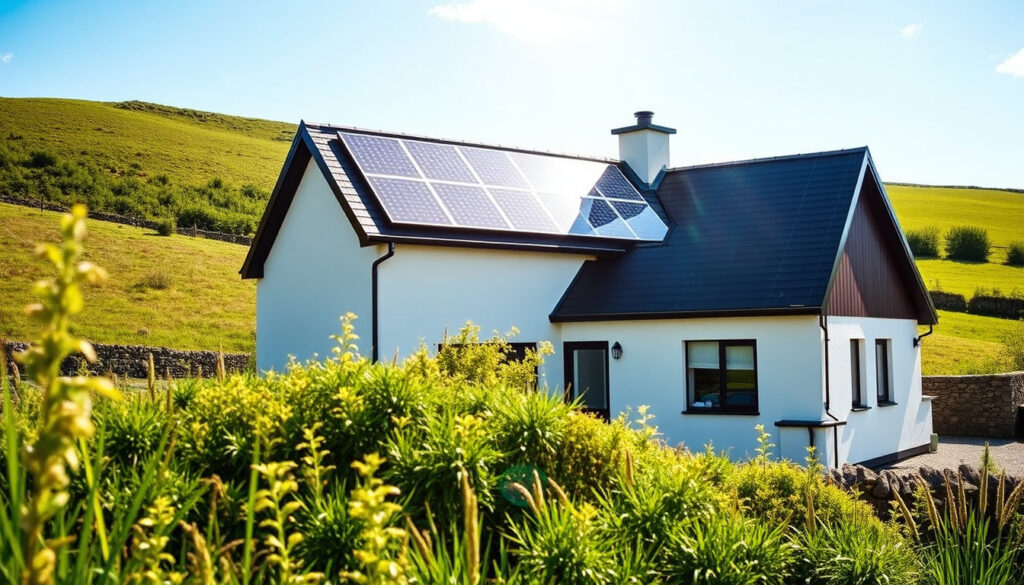
Grant for Solar Panels Ireland 2026: How Much & Who Qualifies
The SEAI grant for solar panels in 2026 offers up to €1,800 off installation costs, but the fine print on eligibility and pensioner support can be tangled. This guide walks through the key numbers, who qualifies in both the Republic and Northern Ireland, and what the recent changes mean for your household.
Maximum SEAI grant for solar panels (2026): €1,800 for systems 4 kWp or above ·
Grant for businesses and non-profits: Up to €162,600 ·
Eligible system size threshold: 4 kWp or larger ·
Available in: Republic of Ireland via SEAI; separate schemes in Northern Ireland
Quick snapshot
- SEAI domestic grant: up to €1,800 (SEAI (Ireland’s energy authority))
- Non-domestic: up to €162,600 (SEAI)
- Home must be built before 2021 (SEAI)
- Whether the “2026 window grant” is a separate programme or confusion with the solar grant (SolarQuotes Ireland (industry guide))
- Exact number of households that have claimed the grant in 2026 (SolarQuotes Ireland (industry guide))
- Future grant levels beyond 2026 (SolarQuotes Ireland (industry guide))
- Early 2026: SEAI updates solar grant with revised payment structure (max €1,800 domestic) (SEAI)
- 2022–2025: Previous grant levels up to €2,400 for larger systems (SEAI)
- 2025: Flogas and other installers report increased interest after electricity price rises (SEAI)
- New window replacement grant introduced in 2026 (separate from solar) may cause confusion
- Northern Ireland schemes may be updated in 2026/2027
- Potential for further grant reductions if uptake accelerates
The pattern is clear: the grant per kWp drops for smaller systems, so sizing matters.
| Label | Value |
|---|---|
| Maximum SEAI Grant (Domestic) | €1,800 |
| Minimum System Size for Full Grant | 4 kWp |
| Grant per kWp (Domestic) | €450 (example: 4 kWp × €450 = €1,800) |
| Business Maximum Grant | €162,600 |
| Northern Ireland Grant Type | NISEP / Affordable Warmth (variable) |
| Estimated Payback Period | 5–7 years (typical) |
How much of a grant do you get for solar panels?
SEAI grant amounts in 2026
- For a domestic system of 4 kWp or larger, the maximum grant is €1,800 (SEAI (Ireland’s energy authority)).
- Smaller systems qualify for lower amounts, calculated at a fixed rate per kWp.
- Energia, an energy supplier, confirms the same maximum and that the property must have been built before 2021 (Energia (energy supplier guidance)).
Maximum grant of €1,800 for systems 4 kWp or above
The €1,800 figure applies to the full 4 kWp system. Installers like Purevolt, an SEAI-registered installer, explain that the grant is fixed at €450 per kWp (SolarQuotes Ireland (industry guide)). So a 6 kWp system still receives only €1,800 — the cap is on the grant, not the system size.
Difference between domestic and non-domestic grants
Businesses, farms, and community organisations can apply for a separate non-domestic grant that reaches up to €162,600, according to the SEAI scheme guide (SEAI PDF guide (official scheme document)). The domestic grant is capped at €1,800.
What is the new SEAI grant 2026?
Changes to grant levels from 2026
- The SEAI solar electricity grant was updated in 2026 with revised payment amounts. The maximum domestic grant remains €1,800, but some installers claim total savings up to €2,100 when combining with other supports (SolarQuotes Ireland (industry guide)).
- Previous levels (2022–2025) were up to €2,400 for larger systems — the 2026 revision effectively lowered the cap.
Updated eligibility criteria
Key requirements from the SEAI’s own application guide (SEAI PDF guide):
- Home must be built and occupied on or before 31 December 2020.
- Applicant must own the home (private landlords also qualify).
- No previous SEAI solar PV grant at the same MPRN (electricity supply point).
- Grant approval must be obtained before any work starts or materials are purchased.
How to apply for the 2026 SEAI grant
- Get at least three quotes from SEAI-registered installers.
- Ensure your property has a current Building Energy Rating (BER) certificate.
- Apply online through the SEAI portal before installing anything.
- Receive a Letter of Offer from SEAI.
- Proceed with installation using an SEAI-registered installer.
- After installation, SEAI inspects and pays the grant directly to you.
SolarInfo Ireland, an independent guide, stresses that the grant is unavailable if work has started before the Letter of Offer (SolarInfo Ireland (independent guide)).
Can old age pensioners get free solar panels?
Free solar panel schemes for pensioners in Ireland
There is no universal programme providing completely free solar panels to all pensioners. The SEAI standard grant is available to all homeowners, including pensioners, on the same terms regardless of age (SolarQuotes Ireland (industry guide)).
Income-assessed supports and SEAI grants
Low-income pensioners may qualify for free or heavily subsidised solar panels through the Warmer Homes Scheme or similar energy efficiency programmes. These are income-assessed, not age-based.
Eligibility for pensioners in Northern Ireland
In Northern Ireland, the Northern Ireland Sustainable Energy Programme (NISEP) and the Affordable Warmth Scheme may offer support to low-income households, including pensioners. Grant amounts and eligibility vary by local council and funding rounds.
Pensioners are not automatically entitled to free panels. The most accessible route is the standard SEAI grant, which caps at €1,800 — meaningful but not free. Income-assessed schemes are the only path to a zero-cost install, and they require a means test.
Is there a grant for solar panels in N Ireland?
Solar grants in Northern Ireland compared to the Republic
Northern Ireland does not have a direct SEAI equivalent. Support comes through NISEP and the Affordable Warmth Scheme, both of which are smaller and more variable than the Republic’s program.
Northern Ireland Sustainable Energy Programme (NISEP)
NISEP provides grants for energy efficiency measures, including solar PV, but the amounts are determined by local councils and funding rounds. Homeowners should check with their local council for current offerings.
Other local support schemes
The UK government’s Smart Export Guarantee (SEG) applies in Northern Ireland, allowing households to sell excess electricity back to the grid. This is separate from a grant but adds to the financial case.
Why are people getting rid of their solar panels?
Common reasons for removing solar panels
- Roof repairs or replacement — panels must be removed and reinstalled, which can be costly.
- Moving house — new owners may not want the system.
- Outdated technology — older panels have lower efficiency.
Drawbacks and long-term costs
Inverter failures and battery degradation can lead to expensive replacements. Inverters typically last 10–15 years, and replacing one can cost €800–€1,200. Poor initial installation or shading issues may reduce output and cause frustration.
Alternatives to removal
Energy storage and better inverter options can often solve these problems without removal. Modern batteries and hybrid inverters can extend the life of a system and improve returns.
Most removals stem from avoidable issues: poor installation or aging components. Buyers should budget for an inverter replacement within 15 years and ensure the installer is SEAI-registered and provides a warranty.
Pros and Cons of the SEAI Solar Grant
Upsides
- Up to €1,800 off installation costs.
- 0% VAT on supply and installation since May 2023 (SolarQuotes Ireland).
- No means test — property-based, not income-based (SolarInfo Ireland).
- Available to private landlords as well as homeowners.
Downsides
- Home must be built before 2021 — excludes newer builds.
- Grant maximum capped at €1,800 regardless of system size beyond 4 kWp.
- Approval must be obtained before any work starts; no retroactive claims.
- Tenants are not eligible (Energia).
How to Apply for the SEAI Grant (Step-by-Step)
- Check your property’s BER certificate — you need one.
- Get at least three quotes from SEAI-registered installers.
- Apply online at the SEAI portal before purchasing any equipment.
- Wait for the Letter of Offer — do not start work.
- Install with an SEAI-registered installer.
- After installation, SEAI arranges an inspection.
- Grant is paid directly to your bank account within a few weeks.
The SEAI’s own guide emphasises: “Grant approval must be obtained before solar panels are installed… you cannot apply if you have already purchased materials or started the installation” (SEAI (official site)).
Timeline: SEAI Solar Grant Changes
- 2022–2025: Previous SEAI grant levels up to €2,400 for larger systems.
- Early 2026: SEAI updates solar electricity grant with revised payment structure — maximum €1,800 domestic (SEAI).
- 2026 (ongoing): New window replacement grant introduced (separate from solar); confusion may arise with “2026 window grant”.
- 2025: Flogas and other installers report increased interest following electricity price rises.
The grant reduction from €2,400 to €1,800 means homeowners who waited for 2026 got a smaller subsidy. The trend suggests grants may tighten further as adoption grows.
What’s confirmed and what’s unclear
Confirmed facts
- SEAI solar electricity grant maximum is €1,800 for domestic systems 4 kWp or above (SEAI).
- Grant is available to homeowners and private landlords.
- Pensioners are not automatically entitled to free solar panels but may qualify for income-assessed schemes.
- Northern Ireland does not have a SEAI-equivalent grant; support is through NISEP and local schemes.
What’s unclear
- Whether the “2026 window grant” is a separate programme or a misinterpretation of the solar grant.
- Exact number of households that have claimed the grant in 2026.
- Future grant levels beyond 2026.
Expert perspectives on the SEAI grant
“The Solar Electricity Grant can help you with the cost of buying and installing solar photovoltaic (PV) panels for your property.”
— SEAI (Ireland’s energy authority), SEAI grant page
“The maximum grant is €1,800 in 2026 for systems of 4kWp or above.”
— Purevolt, SEAI-registered installer, SolarQuotes Ireland (industry guide)
“Save up to €2100 on solar” — including non-cash benefits or aggregated savings.
— LVP Renewables, SEAI-registered installer, SolarQuotes Ireland (industry guide)
“There is no means test because the SEAI solar grant is property-based, not income-based.”
— SolarInfo Ireland, independent guide
The data paints a clear picture: the SEAI grant is generous but capped, and it’s not a blank cheque. For pensioners on low incomes, the Warmer Homes Scheme offers a more targeted route. For homeowners in Northern Ireland, the patchwork of local schemes requires persistence. The 2026 changes have tightened the cap, but with 0% VAT and payback periods of 5–7 years, the economics still work for most households. The choice for the Irish homeowner is clear: act before the next grant revision, or risk a smaller subsidy.
solarquotesireland.ie, seai.ie, seai.ie, solarquotesireland.ie, comparesolarni.com, seai.ie, solarpanelni.com, solarinfo.ie
Frequently asked questions
How do I apply for the SEAI solar grant?
Apply online through the SEAI portal after obtaining at least three quotes from SEAI-registered installers. You must have a BER certificate and not have started any work yet.
Can I get a grant for solar panels on a new build?
No. The property must be built and occupied before 31 December 2020. New builds are not eligible for the SEAI solar grant.
What is the biggest drawback of solar panels?
Inverter failure and battery degradation are the most common long-term costs. Inverters typically need replacement after 10–15 years, costing €800–€1,200.
How much does solar panel installation cost in Ireland?
A typical 4 kWp system costs between €6,000 and €9,000 before the grant. After the €1,800 SEAI grant, the net cost is roughly €4,200–€7,200.
Do I need planning permission for solar panels in Ireland?
Generally no, provided the panels are within certain size and placement limits. But it’s always best to check with your local authority.
Can businesses get the SEAI solar grant?
Yes, but through a separate non-domestic scheme with a maximum grant of €162,600. The application process is different.
How long does it take to receive the SEAI grant after installation?
Once the installation is complete and inspected by SEAI, the grant is typically paid within a few weeks.
Related reading: Air Source Heat Pump: Cost, Downsides & Grants in Ireland · Irish Social Welfare Application Rejections: Reasons & Appeals
More related posts
 Houses for Sale in Crumlin: 3 Bed, Detached, New Listings
 The Madame Blanc Mysteries: Seasons, Cast & Filming Guide
 Why Is My Poop Green? Causes, When to Worry, and More
 Horse Racing Results Today: Fast Results & Updates
 Ireland v Czech Republic 2026: Match Report & Travel Guide
 Old Trafford New Stadium – Capacity, Cost and Timeline
 Dunnes Stores Waterproof Jackets: Vs Gore-Tex Comparison
