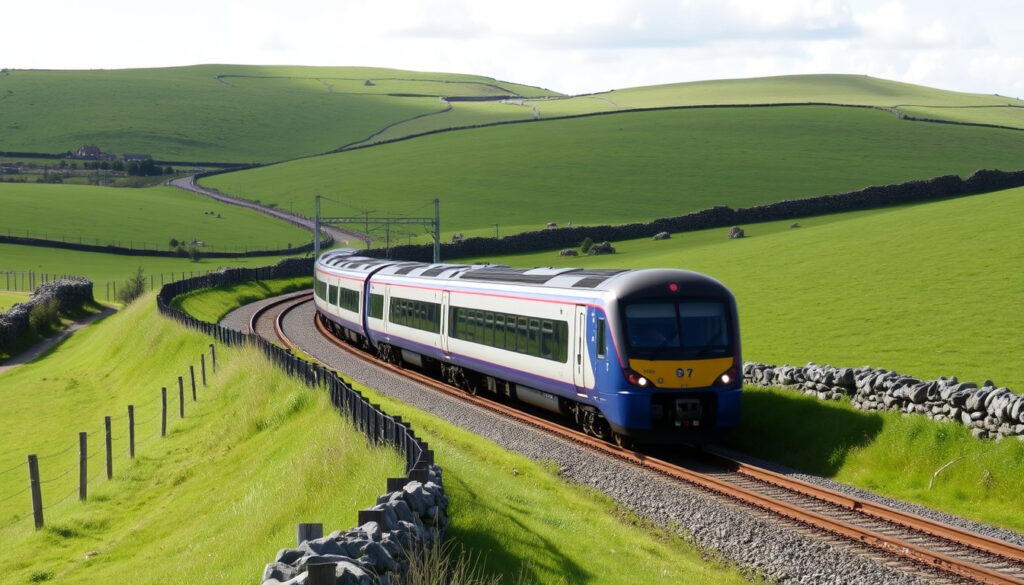
Dublin to Belfast Train: Tickets, Timetable & Travel Guide
Planning a trip between Dublin and Belfast often sparks a debate — bus, train, or flight? For many travelers, the train strikes a practical balance, and with the Enterprise service now running hourly, it’s an even stronger option. This guide breaks down the direct train service, compares it with buses and flights, and gives you the facts you need to choose the best way to cross the border.
Distance: 140 km (87 miles) ·
Average journey time: 2 hours 8 minutes ·
Lowest ticket price: €12 (advance single) ·
Highest ticket price: €35 (flexible single) ·
Daily departures: 8 (approx) ·
Operator: Enterprise (Iarnród Éireann / Translink)
Quick snapshot
- Direct train service between Dublin Connolly and Belfast Grand Central (Irish Rail official operator)
- No passport required for Irish citizens within the Common Travel Area (BBC News UK news outlet)
- Average journey time is 2 hours 8 minutes (Wikipedia community encyclopedia)
- Ticket prices range from €12 to €35 (Irish Rail official operator)
- Exact 2025 schedule changes may occur (Translink transport authority)
- Dynamic pricing can cause fare variations depending on booking time (Omio travel aggregator)
- Long-term construction projects may affect journey times in future (BBC News UK news outlet)
- Enterprise began hourly operation on 29 October 2024 (Wikipedia community encyclopedia)
- £548 million investment plan announced to upgrade the Belfast–Dublin rail link (BBC News UK news outlet)
- Journey times could be cut to under 2 hours under the investment plan (BBC News UK news outlet)
- Future services may increase to 16 daily in each direction (BBC News UK news outlet)
- Journey time cuts to under 2 hours are a long-term goal (BBC News UK news outlet)
- Enhanced rolling stock and track upgrades are being evaluated (BBC News UK news outlet)
| Distance | 140 km (87 miles) |
|---|---|
| Average journey time | 2 hours 8 minutes |
| Operator | Enterprise (Iarnród Éireann / Translink) |
| Daily departures | 8 (peak times) |
| Lowest price | €12 |
| Highest price | €35 |
Is there a direct train from Dublin to Belfast?
Enterprise Service Details
- The Enterprise is the direct cross-border inter-city train service between Dublin Connolly and Belfast Grand Central (Irish Rail official operator).
- Since 29 October 2024, it operates hourly, with 15 daily services Monday to Saturday and 8 on Sunday (Wikipedia community encyclopedia).
- No transfers are needed; it is a direct connection with intermediate stops at stations like Drogheda, Dundalk, Newry, and Portadown (Translink transport authority).
Hourly frequency means less waiting, making the Enterprise a genuine alternative to driving or flying for spontaneous trips.
The implication: If you want a straightforward, no-transfer rail journey, the Enterprise delivers. The recent frequency upgrade has closed the gap with bus services in terms of departure flexibility.
Route and Frequency
- Trains depart from Dublin Connolly station in the city centre and arrive at Belfast Grand Central station (Irish Rail official operator).
- With 15 daily services on weekdays, the longest gap between departures is rarely more than 2 hours (Wikipedia community encyclopedia).
- Sunday service is reduced to 8 departures, so plan accordingly (Irish Rail official operator).
Ticket Options
- Standard single tickets start at €12 when purchased in advance online (Irish Rail official operator).
- Flexible single tickets allow last-minute travel and cost up to €35 (Irish Rail official operator).
- First class tickets range from €20 to €50 and include extra legroom, complimentary refreshments, and quieter carriages (Irish Rail official operator).
- Children, seniors, and groups often qualify for discounted fares — always check before booking (Translink transport authority).
Dynamic pricing means the cheapest €12 tickets sell out fast. Book at least a week ahead to secure the lowest fare.
How much is a train ride from Dublin to Belfast?
Standard and Advance Fares
Ticket prices vary by how far in advance you book and the type of service. Here’s the breakdown:
- Advance single (non-flexible): €12 (Irish Rail official operator)
- Standard single (flexible, buy on day): €35 (Irish Rail official operator)
- Return tickets are available and offer a small discount over two singles (Translink transport authority)
First Class Pricing
- First class advance single: €20 (Irish Rail official operator)
- First class flexible single: €50 (Irish Rail official operator)
- Perks include complimentary hot and cold drinks, newspapers, and more spacious seating (Irish Rail official operator)
Discounts and Savings
- Children under 4 travel free; children aged 4–15 typically get 50% off (Translink transport authority)
- Senior citizens (60+) and students can get reduced fares with a valid ID (Translink transport authority)
- Group travel (3+ adults) may qualify for a 20% discount (Irish Rail official operator)
- Booking via Irish Rail or Translink directly is the only way to access the cheapest advance fares — third-party sites often add fees (Irish Rail official operator)
Why this matters: A family of four traveling off-peak with advance tickets can make the round trip for as little as €48, undercutting bus and car costs for the same journey.
How long is the train ride between Dublin and Belfast?
Typical Journey Time
- The average journey time is 2 hours 8 minutes (Wikipedia community encyclopedia)
- The fastest Enterprise trains complete the route in 2 hours 5 minutes with fewer stops (Wikipedia community encyclopedia)
- Slower services with more intermediate stops can take up to 2 hours 20 minutes (Wikipedia community encyclopedia)
Factors Affecting Duration
- Number of intermediate stops: 4-stop pattern is fastest, 6-stop pattern adds 15 minutes (Wikipedia community encyclopedia)
- Weather conditions and track maintenance can add delays (Translink transport authority)
- Border checks are not performed on the train, so no time lost there (BBC News UK news outlet)
Fastest Service
- The fastest current schedule is 2 hours 5 minutes, achieved by the 07:30 departure from Dublin (Translink journey planner)
- Future infrastructure investment could reduce journey time to under 2 hours (BBC News UK news outlet)
The catch: While the train is consistently faster than a bus (2h 30m–3h), it rarely beats a flight’s airborne time (1h) — but door-to-door, the train often wins because of city-centre stations and no security queues.
Do I need a passport from Dublin to Belfast by train?
Common Travel Area Rules
- No passport is required for Irish citizens traveling within the Common Travel Area (CTA) (BBC News UK news outlet)
- UK and Irish citizens can travel freely with just a valid photo ID (UK Government official guidance)
Accepted Identification
- A passport or national identity card is recommended for all travelers (UK Government official guidance)
- A driver’s license is acceptable for EU/EEA nationals, but not always accepted by all carriers (Translink transport authority)
UK Border Requirements
- Non-EEA nationals must carry their passport and valid visa (UK Government official guidance)
- Random spot checks by immigration officers can occur at Belfast station (BBC News UK news outlet)
- EU citizens should carry their passport or national ID card to prove right of residence (Translink transport authority)
Even if no passport is required, always bring a photo ID — particularly if you booked a discounted fare that requires age or status verification.
The pattern: For most Irish and UK residents, the journey is essentially document-free. But for visitors from outside the CTA, carrying a passport is non-negotiable.
What is the best way to travel from Dublin to Belfast?
Train vs Bus – Cost and Time
Four key dimensions show the Enterprise train leads on speed and comfort while buses compete on price:
| Factor | Train (Enterprise) | Bus (Aircoach, Bus Éireann, etc.) |
|---|---|---|
| Typical time | 2h 8m (Wikipedia community encyclopedia) | 2h 30m–3h (Omio travel aggregator) |
| Starting price | €12 advance (Irish Rail official operator) | €10–€13 advance (Omio travel aggregator) |
| Frequency | Hourly (15/day weekdays) (Irish Rail official operator) | ~15 departures daily (Omio travel aggregator) |
| Comfort | High (seats, tables, onboard café, wifi) (Irish Rail official operator) | Moderate (some coaches have wifi and power) (Dublin Express coach operator) |
Train vs Flight – Price and Convenience
- Flight time is only 1 hour, but door-to-door (including transfers and security) often exceeds 3 hours (Omio travel aggregator)
- Flights cost €30–€80 round-trip depending on airline and booking window (Ryanair budget airline)
- Train from city centre to city centre saves an hour of transfer time each side (Irish Rail official operator)
Overall Recommendation
- For most travelers, the train offers the best balance of speed, reliability, and cost (BBC News UK news outlet)
- If budget is the only concern, buses start at €10 and still get you there in under 3 hours (Omio travel aggregator)
- Flying makes sense only if you’re connecting to another flight from Belfast or have a tight schedule at the destination airport (Busbud bus aggregator)
The implication: If you value time and comfort over a few euros, the Enterprise train is the clear winner. Bus is fine for budget trips, and flying is only competitive if your journey starts or ends near an airport.
How to Book Your Dublin to Belfast Train Ticket
Booking correctly can save you up to 66% off the walk-up fare. A family of four booking advance tickets saves €92 round-trip compared to buying on the day.
- Check the timetable — Visit Irish Rail official operator or Translink transport authority for live departure times. Hourly service means you can usually find a train within 60 minutes.
- Choose your fare type — Advance single (€12) for locked-in savings; flexible single (€35) for open return flexibility; first class (from €20) for premium comfort.
- Book online — Purchase tickets via Irish Rail official operator or the Translink app. Select your exact train for advance fares.
- Collect your ticket — Most online bookings offer e-ticket or print-at-home. You can also pick up from station kiosks.
- Arrive at Dublin Connolly — Aim to be at the station 15–20 minutes before departure to find your platform and settle in.
- Board and enjoy — Standard class has spacious seats, free wifi, and an onboard café. First class adds complimentary refreshments and quieter carriages.
The pattern: Six simple steps, and the savings are real. Book at least a week ahead for the best price.
Clarity Check
Confirmed facts
- Direct train service exists hourly since October 2024.
- No passport required for Irish citizens.
- Typical journey time is 2h 8m.
- Advance tickets from €12 available.
- 15 daily services on weekdays.
What’s unclear
- Exact 2025 schedule changes may occur.
- Dynamic pricing can cause fare variations.
- Long-term construction may affect timings.
- Future journey time cuts depend on funding approval.
“The Enterprise service is positioned as a convenient option for day trips and longer stays between Dublin and Belfast.”
Irish Rail official operator
“£548 million investment could cut journey times to under two hours and support up to 16 services in each direction daily.”
BBC News UK news outlet
The verdict: With hourly departures, advance fares as low as €12, and a reliable 2h 8m journey, the Enterprise train is the smart choice for most Dublin–Belfast trips. For the traveler who wants city-centre to city-centre efficiency without airport hassle, the rail option hasn’t been this competitive in years.
For the frequent traveler between Dublin and Belfast, the choice is clear: book the Enterprise train for the best balance of speed and cost, or risk wasting time and money on slower alternatives.
ncbytrain.org, scribd.com, checkmybus.com, x.com, amtrak.com, transportforireland.ie
För resenärer som planerar sin resa från Dublin till Belfast är det värt att jämföra med den omvända resans Belfast to Dublin timetable för att få en komplett bild av avgångar och priser.
Frequently asked questions
Can I take a bike on the Dublin to Belfast train?
Yes, but bike spaces are limited and must be booked in advance. Contact Irish Rail or Translink at the time of booking to reserve a space. Folded bikes are generally allowed without booking. (Translink transport authority)
Are there toilets and wifi on the Enterprise train?
Yes, all Enterprise trains have accessible toilets and complimentary wifi. Power outlets are available at most seats in both standard and first class. (Irish Rail official operator)
How early should I arrive at Dublin Connolly for the train?
Arriving 15–20 minutes before departure is sufficient — enough time to find your platform and buy a coffee. There is no security screening, unlike at airports. (Irish Rail official operator)
Can I buy tickets on the train or must I purchase in advance?
You can buy tickets at the station or on board, but walk-up fares are more expensive (up to €35 single). Advance online purchase (from €12) is recommended for the best price. (Irish Rail official operator)
Is there first class on the Enterprise and what does it include?
Yes, first class is available on all Enterprise services. It includes wider seats, complimentary hot/cold drinks, newspapers, and a quieter carriage. Prices range from €20 to €50 depending on advance booking. (Irish Rail official operator)
What is the luggage allowance?
There is no strict weight limit, but you should be able to carry your luggage on and off the train yourself. Large suitcases can be stored in overhead racks or at carriage ends. Bikes and bulky items need advance booking. (Translink transport authority)
Are there any scenic views along the route?
Yes, the route passes the Mourne Mountains near Newry and the Cooley Peninsula. The coastal sections around Dundalk offer pleasant sea views. It’s a comfortable ride with plenty to see. (BBC News UK news outlet)
More related posts
 What Is Parkinson’s Disease: Symptoms, Causes & Life Expectancy
 The Day the Earth Stood Still: Plot, Cast & Meaning (1951/2008)
 Bantry Bay Golf Club: Green Fees, Tee Times, Reviews & Location
 W2 Bus Timetable Waterford: Routes, Stops & Real-Time Tracking
 New Zealand vs Ireland 2026: Match Details, Costs & More
 Kia Sportage for Sale Ireland: Best Model & Prices
 Marks & Spencer Online Ireland: Shopping, Delivery & Food Guide
