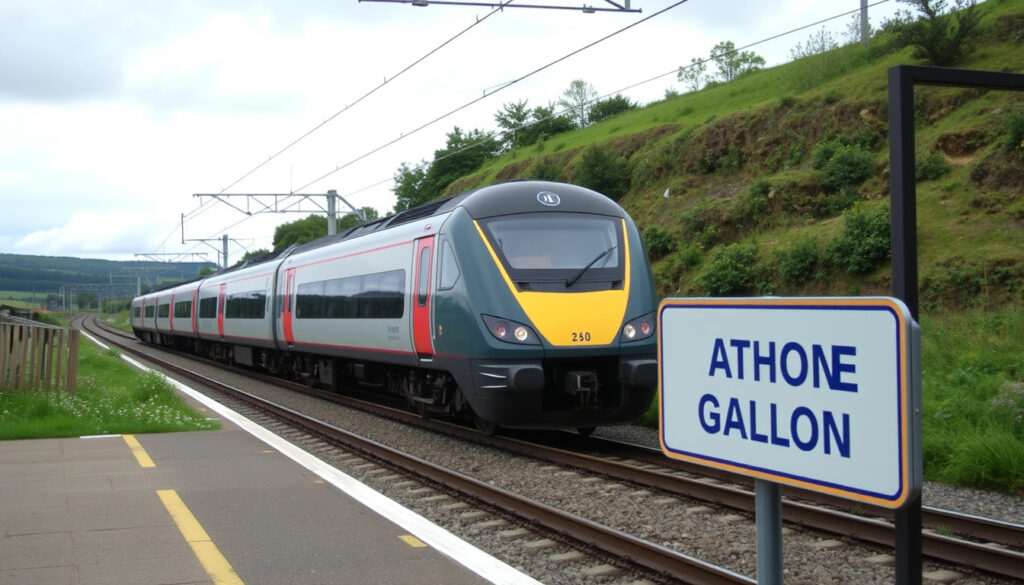
Athlone to Galway Train: Timetables, Tickets, and Station Guide
Anyone who has ever stood on the platform in Athlone, watching the departures board tick over, already knows the appeal of the Galway train: roughly an hour from the centre of Ireland to the edge of the Atlantic, with transit-data site Moovit putting the typical end-to-end run at 66 minutes. Official Irish Rail timetables, Transport for Ireland bus listings, and station-level details sort out what is dependable from what changes week to week.
Average journey time: 55–90 minutes ·
Ticket price from: €9 ·
Daily departures: Multiple (early morning to evening) ·
Distance: 76 km (47 miles)
Quick snapshot
- Irish Rail operates direct Athlone–Galway trains, with fastest journeys around 55 minutes (Virail (journey-search platform)).
- Exact timetables shift by date, and third-party data is date-sensitive.
- The rail line is described with seven stations and a typical 66-minute end-to-end run.
- Book online in advance to access the operator’s lowest fares (Irish Rail train timetables and fares).
Eight facts, one pattern: the route is short, direct, and cheaper when booked ahead.
| Attribute | Value |
|---|---|
| Route | Athlone (Co. Westmeath) to Galway (Co. Galway) |
| Operator | Iarnród Éireann (Irish Rail) |
| Distance | 76 km (47 miles) |
| Average journey time | 55–90 minutes |
| Fastest direct services | About 55 minutes |
| Starting fare | €9 when booked in advance |
| Station access | Roughly a 10-minute walk from Athlone town centre |
| Station facilities | Sheltered bicycle parking, lockers, APCOA car park |
How do I get to Galway from Athlone?
Three options connect Athlone and Galway: the direct InterCity train, a Bus Éireann coach, or a car. Each has a different trade-off, and the right choice depends on your schedule, your budget, and whether you need a car at the other end.
Taking the train
- The direct InterCity train from Athlone to Galway Ceannt is the no-change option on the route, and the one most visitors end up booking.
- Irish Rail operates these services, and the corridor carries more than a few daily departures from early morning to evening.
If your main goal is to get from one city centre to the other without thinking about traffic, this is the service to start with.
Taking the bus
- Bus Éireann route 65 (Galway–Athlone–Cavan–Monaghan) and route 70 (Galway–Athlone–Mullingar–Dundalk) both connect the two cities.
- Virail reports an average bus journey of about 1 hour 4 minutes over roughly 71 km, with a lowest reported fare of €15.17 — data Virail itself flags as date-sensitive.
A reported lowest fare only matters if the bus actually runs at a time that suits you. On a route with limited daily departures, that condition does a lot of the work.
Driving
- The direct distance between Athlone and Galway is about 76 km (47 miles) — short enough that driving is a realistic option if you already have a car.
- Driving makes the most sense for groups, or for travellers continuing to other parts of the West of Ireland afterwards.
The implication: the train is the time winner, the bus is the regional option, and driving trades money for flexibility. None of the three is universally best.
How long does it take to get to Athlone from Galway?
Train journey duration
- Virail’s rail aggregator reports an average Galway–Athlone journey of about 1 hour 5 minutes, a shortest time of around 55 minutes, and a direct example departing Galway Ceannt at 07:30 and arriving Athlone at 08:27.
The 07:30 example shows the fastest end of the range; later services can run longer, particularly when they call at intermediate stations.
Factors affecting time
- Direct services are faster than trains that stop at every station, so the specific train you pick matters more than the corridor average.
- The corridor is short, which means the difference between a 55-minute and a 66-minute run comes down to stops rather than distance.
The timetable for your exact date is the only version that matters. Averages are context, not a reservation.
What this means: the route is fast enough to day-trip in either direction, but the timetable — not the distance — is the variable you control.
What trains go direct to Galway?
Direct train services from Athlone
- Many InterCity services from Athlone run direct to Galway Ceannt, so a same-train journey is the norm rather than the exception.
- The corridor’s position on the wider Irish Rail network means the Athlone–Galway leg is served by trains whose full routes extend beyond either city.
Connecting services
- When no direct service lines up with your travel time, the Journey Planner displays the fastest connection with live availability.
The pattern: Athlone is a junction, not a terminus. That is good news for flexibility and a reason to check the specific train number instead of assuming every service stops everywhere.
Does the Galway train stop in Athlone?
Trains from Galway eastbound
- Athlone sits on the Dublin Heuston–Galway line, which is why most Dublin–Galway trains call there.
- The same service that arrives from Galway generally continues toward Dublin, so the return journey uses the same trains in reverse.
Checking the stop at Athlone
- Confirm the stop for your exact train number in the operator’s Journey Planner before travelling; calling patterns can vary by service.
The trade-off: you can plan around a typical stopping pattern, but the train number is the only thing that guarantees the platform you need.
How far is Athlone train station from the town?
Distance and walking time
- Athlone station is roughly a 10-minute walk from the town centre, according to TravelPlan.guide (a travel-information site).
Public transport options
- A bus stop outside the station links the platform to the rest of the town.
- If you’re arriving by bike, the station area includes sheltered bicycle parking, which makes cycle-and-rail trips practical.
Why this matters: the station’s location makes the train genuinely convenient for town-centre hotels and short stays — the kind of convenience that tips a journey decision.
Train vs bus: a side-by-side comparison
Two public options, one corridor, and a pattern worth naming: the train is faster and cheaper when booked ahead, while the bus earns its place on the regional network.
| Option | Typical journey time | Starting fare | Best for |
|---|---|---|---|
| Train (Irish Rail InterCity) | About 55–66 minutes direct | From €9 booked in advance | Fastest city-to-city travel, no parking needed |
| Bus (Bus Éireann routes 65/70) | Around 1 hour 4 minutes | From €15.17 reported | Towns along the Galway–Athlone–Mullingar corridor |
| Driving | 76 km (47 miles) distance | Fuel plus parking | Side trips and group travel |
Figures in this table consolidate the sources cited above; bus time and fares are drawn from Virail’s aggregator data, which Virail flags as date-sensitive.
A €15.17 bus fare against a €9 advance train fare is not a close contest — but the bus wins when your destination is a town on Route 70 that the train skips.
What this means: if your journey starts and ends in the two city centres, the train is the rational choice. If you’re visiting a town on the regional bus network, the bus is a real alternative — but verify the schedule for your date.
How to book your Athlone to Galway train ticket
Booking is straightforward once you accept one rule: the timetable for your date is the source of truth, and the lowest fare lives online.
- Check the Irish Rail Journey Planner or app for your travel date before choosing a service; station timetable information can change.
- Pick a direct InterCity train where possible; direct services are the fastest way across the corridor.
- Book online in advance — the operator’s lowest fares are sold that way.
- Arrive at Athlone station with enough time to find your platform before departure.
The pattern: every cost-saving decision on this route happens before the train departs — the ticket you buy on the day will not be the advance fare you saw online.
What’s confirmed and what’s still unclear
Here’s the honest split between what operators state plainly and what you still need to verify before you travel.
Confirmed
- Athlone is a through-station on the main Dublin–Galway rail corridor, so the same trains serve both cities (Athlone railway station (official Irish Rail page)).
- Bus Éireann routes 65 and 70 connect Galway and Athlone on a daily basis (Transport for Ireland (national transport authority)).
- Athlone station is close enough to the town centre to reach on foot in about 10 minutes (TravelPlan.guide (travel-information site)).
What’s unclear
- The exact timetable for a specific date — calling patterns and times vary, so the operator’s Journey Planner is the only authoritative check.
- Bus fares and departure counts, which the aggregator itself flags as date-sensitive.
- Third-party schedule displays, which are useful for planning but not guaranteed on the day.
Why this matters: the corridor itself is stable — what moves is the per-day detail. Planning around today’s timetable without checking tomorrow’s departure list is a gamble on a schedule that can change.
What passengers should know
“Station timetable information can change — use the Journey Planner or app for the latest train times.”
— Irish Rail, national rail operator
“Bus Éireann route 65 runs Galway–Athlone–Cavan–Monaghan, and route 70 runs Galway–Athlone–Mullingar–Dundalk.”
— Transport for Ireland, national transport authority
“Athlone station is approximately 10 minutes from the town centre — an approximate walking estimate rather than an official measurement.”
— TravelPlan.guide, travel-information site
The through-line: official sources confirm the service exists; third-party data describes what travel actually feels like. When both align on a roughly one-hour train, you can plan with confidence.
The takeaway
For the visitor or commuter moving between Athlone and Galway, the decision is not really about distance — the 76 km is the same by train, bus, or car. It is about what you optimise for. The train is the fastest and, with advance booking, the cheapest single-occupancy option. The bus is a regional connector with higher reported fares and limited daily departures. Driving makes sense only when you are travelling as a group or continuing beyond Galway. For the typical traveller, the choice is clear: check the Irish Rail Journey Planner for your date, book the direct InterCity service in advance, and treat the hour-long crossing as the dependable default it is — or accept a slower bus schedule that may not run when you need it.
Frequently asked questions
Is there a direct train from Athlone to Galway?
Yes. Irish Rail operates the direct InterCity service between Athlone and Galway Ceannt; direct trains are the standard option on this corridor, and the fastest journeys take around 55 minutes.
What is the cheapest way to get from Athlone to Galway?
On published fares, the train is cheapest: from about €9 when booked online in advance. Virail’s reported lowest bus fare is €15.17, so the bus rarely wins on price.
How far in advance should I book train tickets from Athlone to Galway?
Irish Rail’s guidance is to book online in advance to access the lowest fares. The exact advance-purchase window depends on the fare type shown for your travel date.
Does the Galway train stop at Athlone on the way to Dublin?
Yes. Athlone sits on the Dublin Heuston–Galway line, so most trains between Galway and Dublin call at the station; check the specific train number in the Journey Planner to confirm.
What time is the first train from Athlone to Galway?
Moovit’s displayed schedule shows a 07:30 Athlone departure on some operating days, but Moovit notes its day-specific data is not a substitute for the official timetable. Check the Irish Rail Journey Planner for the first service on your date.
If your journey boils down to one decision, it’s this: the train is the dependable default, the bus is the regional option, and the date-specific timetable settles the rest.
More related posts
 Cast of Barbie (2023) – Full Actors and Characters List
 Houses for Sale in Macroom – Prices €55k to €650k Guide
 Dr Melaxin Peel Shot Review: Does It Work? Side Effects & Safety
 Top Things to Do in Gran Canaria: Attractions, Beaches & Tips
 Paddy Power Racing Results Today Live Updates
 When Is High Tide Today – NOAA Predictions Near You
 Birds for Sale Ireland: Cheap Parrots, Baby Birds & Live Listings
 The Curious Case of Benjamin Button: Facts, Plot & FAQs
