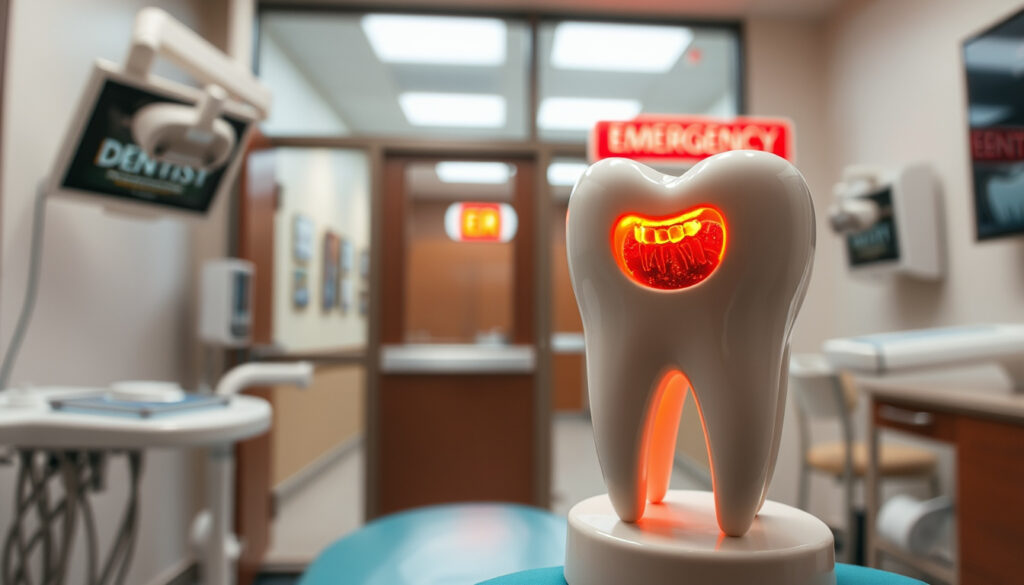
Emergency Dentist Near Me: ER or Dentist for Tooth Pain
When a toothache hits at 2 AM, your brain scrambles between two questions: can you survive until morning or should you go to the ER? The answer depends on what’s happening in your mouth — a dull ache and a spreading infection are different beasts — so this guide maps out when to call an emergency dentist in Dublin, when to head to the hospital, and how the HSE classifies real dental emergencies.
24-hour emergency dentist Dublin clinics: 5+ ·
Emergency dentist open Sundays: Yes (Dame Street Dental Centre) ·
Most common dental emergency: Toothache (HSE data)
Quick snapshot
- Severe toothache (HSE child dental guidance)
- Swollen face/gums (Children’s Health Ireland)
- Knocked-out tooth (HSE general advice)
- Abscess (Dublin Dental University Hospital)
- Call emergency dentist (Dublin Dental University Hospital)
- Take OTC pain relief (HSE child dental guidance)
- Apply cold compress for swelling (HSE child dental guidance)
- Save knocked-out tooth in milk (Dublin Dental University Hospital emergency service)
- Uncontrollable bleeding (Dental Council of Ireland emergency code)
- Fever over 38°C (Children’s Health Ireland)
- Difficulty breathing/swallowing (Dental Council of Ireland)
- Swelling spreading to eye or neck (Children’s Health Ireland)
- Exact wait times for emergency dentist vary by clinic (Dublin Dental University Hospital notes up to 2h callback)
- Whether a specific clinic accepts medical card — call ahead (Dublin Dental University Hospital)
A few numbers, one pattern: the difference between a dental problem you can manage at home and one that needs urgent care often comes down to swelling and fever.
| Detail | Value |
|---|---|
| Emergency dentist Dublin open 7 days | Yes (e.g., Dame Street Dental Centre) |
| HSE emergency dental service | Available out-of-hours 5pm-10pm Mon-Fri, 9am-10pm weekends |
| Average cost emergency visit | €80-€150 (without insurance) |
| Medical card accepted | Some clinics |
What is classed as a dental emergency?
Severe toothache not relieved by painkillers
- The HSE (Ireland’s public health authority) classifies severe, unrelenting tooth pain as a dental emergency. If over-the-counter painkillers do not touch the pain for more than a few hours, it signals deeper nerve involvement or infection. The Dublin Dental University Hospital (the national teaching hospital) says its out-of-hours emergency service is for “severe dental emergencies only” — meaning pain that disrupts sleep or daily function qualifies.
Swelling of face or gums
- Visible facial swelling, especially if it spreads toward the eye or neck, is a red flag. The Dental Council of Ireland (the regulatory body for Irish dentists) mandates that every practice has a written emergency action plan for medical emergencies including abscesses. Swelling that makes it hard to open your mouth fully may indicate a spreading infection requiring hospital-level care.
Bleeding that doesn’t stop
- Uncontrolled bleeding after an extraction, a fall, or a dental injury counts as an emergency. The Children’s Health Ireland (CHI) dental services team at Temple Street, Crumlin, and Tallaght lists urgent bleeding as a reason for same-day assessment.
Knocked-out tooth
- Time is the decisive factor. The HSE advises picking up the tooth by the crown (not the root), rinsing it gently, and placing it back into the socket if possible, or storing it in milk. Every minute out of the mouth reduces the chance of successful reimplantation.
Broken or loose fillings/crowns
- Not every broken restoration is an emergency. The Dublin Dental University Hospital says a broken filling without pain is not a reason to use its out-of-hours service. But if the break exposes the inner dentine or pulp, pain can follow quickly, and a temporary filling from a pharmacy can buy time until a dentist appointment.
What is the 3-3-3 rule for toothache?
The 3-3-3 rule is a practical frame: 3 days of pain that worsens, 3 hours of sleep lost, 3 painkillers that did not help — that is the point at which most dental emergencies require professional intervention. Use it as a trigger to call the emergency dentist, not to suffer through another night.
A patient with a severe toothache faces a choice: wait for an emergency dentist appointment (which may involve a €100 minimum charge and a callback delay of up to 2 hours at Dublin Dental University Hospital) or go to the ER (which handles infection but cannot perform root canals). The cost and time difference can be significant.
What this means: The HSE’s classification of dental emergencies prioritises conditions with risk of systemic spread — infection, swelling, fever — over purely structural issues like broken fillings. The consequence for a Dublin resident: a broken crown without swelling can wait until normal clinic hours, but a swollen face demands immediate action.
Will an emergency dentist see me?
What to expect during an emergency visit
- Most Dublin emergency dentists require a phone call first. The Dublin Dental University Hospital (the HSE-funded national centre) is clear: its out-of-hours emergency service is “by telephone only, not by walk-in attendance.” Callers dial 01 612 7200 and may wait up to 2 hours for a return call. If accepted, the visit carries a minimum charge of €100, which covers the initial assessment and any follow-ups within a month for the same problem. The same clinic notes that having a HSE medical card does not automatically waive that fee.
Do I need an appointment?
- Private emergency dentists in Dublin (such as Dame Street Dental Centre) do accept walk-ins, especially on Sundays. But the HSE-funded service operates by appointment only. For children under 16, the HSE says parents should call the local HSE dental clinic directly — most childhood dental emergencies can be managed by a community-based dentist rather than the hospital.
Why this matters: The difference between “walk-in” and “appointment only” determines whether you stand at a door or sit by a phone. For the Dublin Dental University Hospital out-of-hours service, you must call first — presenting in person is explicitly discouraged because the service is managed by appointment only.
What can the ER do for a tooth?
Can I go to A&E with unbearable tooth pain?
Yes, you can go to the Emergency Department with unbearable tooth pain, but the ER’s role is limited to pain management and infection control. It cannot perform definitive dental procedures like extractions or root canals. If the pain is accompanied by fever, swelling, or difficulty breathing, the ER is the correct place.
Pain management and antibiotics
- An Emergency Department can provide pain relief (usually via IV or injected NSAIDs) and prescribe antibiotics if an infection is present. The Dental Council of Ireland (regulatory body for Irish dentists) notes that ER doctors can manage acute inflammation but cannot perform definitive dental procedures like extractions, root canals, or fillings because they are not equipped with dental tools or imaging.
When ER is necessary (abscess, fever)
- If a tooth infection spreads beyond the jaw and causes fever (over 38°C), difficulty breathing, or swelling that narrows the airway, the ER becomes the correct location. Children’s Health Ireland (CHI) lists these symptoms as criteria for urgent paediatric dental care via the Emergency Department at Temple Street, Crumlin, or Tallaght. The HSE adds that a spreading infection with swelling reaching the eye or neck is a medical emergency, not just a dental one.
An ER can stabilise you — control pain, fight infection — but it cannot fix the tooth. You will leave with a prescription and a referral to a dentist, not a functioning molar. The Dental Council of Ireland’s emergency code requires that every dental practice have a written protocol for referring patients back to the hospital if sepsis is suspected.
Is a broken dental crown an emergency?
When to see a dentist immediately
- A broken crown is an emergency only if it causes severe pain, exposes the nerve, or leaves sharp edges that damage the tongue or cheek. The Dublin Dental University Hospital classifies this as a non-urgent issue for its out-of-hours service unless accompanied by bleeding or swelling. Children’s Health Ireland (CHI) advises that a broken crown in a child, if it follows a fall or accident, should be checked by a dentist — but it can usually wait until the next working day.
How to tell if a tooth is dying under a crown?
If a crown is broken and the nerve is exposed, it may indicate that the tooth is dying. Symptoms include persistent pain, sensitivity to hot or cold, and gum swelling near the crowned tooth. See a dentist within 24 hours.
Can teeth go bad under a crown?
Yes, teeth can decay under crowns if the seal fails or if there is a gap. Watch for pain, sensitivity, or gum infection. This requires a dentist’s evaluation to prevent further damage.
Temporary solutions until appointment
- If the crown falls off entirely, over-the-counter temporary dental cement (available at most Dublin pharmacies) can hold it in place. Avoid chewing on that side. If the crown is loose but still in place, avoid sticky foods and see a dentist within a week. The HSE guidance for children who injure their mouth in a fall says to take the child to a dentist for a check — same applies to adults with a dislodged crown.
What are signs of sepsis from a tooth infection?
Symptoms of dental sepsis
- Dental sepsis — a systemic infection originating from an abscessed tooth — presents with fever, chills, rapid heart rate, and swelling that extends beyond the jaw to the floor of the mouth or neck. The Dental Council of Ireland (DCI) emergency code of practice requires that every dental practice have a written plan for recognising and managing medical emergencies, including sepsis. The DCI specifically notes that swelling causing difficulty breathing or swallowing constitutes a “medical emergency requiring immediate hospital transfer.”
What does dental sepsis feel like?
Dental sepsis feels like a spreading infection: fever, chills, rapid heart rate, and swelling that moves from the jaw to the neck or face. Difficulty swallowing or breathing are critical signs.
When to go to the ER
- Go to the nearest Emergency Department if you have: a fever over 38°C, swelling that spreads to your neck or eye area, trouble swallowing your own saliva, or difficulty breathing. Children’s Health Ireland (CHI) operates paediatric dental services at Temple Street, Crumlin, and Tallaght for children who need urgent care under these criteria. The HSE adds that parents should call the local HSE dental clinic first unless the child has significant breathing issues.
A tooth infection that reaches the neck can obstruct the airway within hours. The Dental Council of Ireland’s code mandates immediate hospital referral for any patient with swelling that limits mouth opening or causes voice changes. For a Dublin patient with facial swelling and fever, waiting for a callback from the emergency dentist is the wrong move — go to the ER.
Why this matters: Sepsis from a dental source is rare but deadly. The Dental Council of Ireland’s emergency code requires every practice to have a plan for it. For a Dublin patient with a swollen face and fever, the decision is not “dentist or ER” — it is “ER first, dentist second.”
Comparison: Emergency dentist vs. ER for tooth problems
Four options, two very different scopes: the emergency dentist can fix the tooth but charges upfront; the ER handles the infection but leaves the tooth broken.
| Criterion | Emergency Dentist (e.g., Dublin Dental University Hospital) | Emergency Department (e.g., St. James’s Hospital) |
|---|---|---|
| Treatment scope | Extractions, root canals, temporary fillings, reimplantation | Pain relief, IV antibiotics, abscess drainage, referral |
| Cost (uninsured) | Min. €100 (Dublin Dental University Hospital) | €100 ED charge (if admitted/treated) |
| Medical card accepted | Does not waive €100 charge (Dublin Dental University Hospital) | Yes, for ED assessment; no charge for GMS cardholders |
| Wait time | Up to 2 hours callback, then appointment | Several hours (triage-dependent) |
| Available Sundays | Yes (Dublin Dental University Hospital 9am-10pm) | Yes (24/7 at major hospitals) |
| Definitive fix | Yes — tooth treated | No — referral only |
| Best for | Knocked-out tooth, severe pain, broken crown with nerve exposure | Facial swelling, fever, difficulty breathing, uncontrollable bleeding |
Upsides: Emergency Dentist
- Definitive fix – tooth repaired or extracted
- Same-day treatment for severe cases
- Can perform root canals and reimplantation
Downsides
- Cost €80–€150 without insurance
- May not accept medical card
- Requires phone call first, up to 2h callback
Upsides: Emergency Department
- Pain relief and IV antibiotics
- Free for medical card holders
- Handles life-threatening infection
Downsides
- No definitive dental fix – referral only
- Long wait hours
- Only infection control, not tooth repair
The implication: The emergency dentist is the go-to for fixing a tooth; the ER is for containing a crisis. A Dublin patient with a knocked-out tooth and no fever should head to the dentist. A patient with a swollen face and fever should head to the ER. The two are not substitutes.
Decision steps for a tooth emergency
- Assess symptoms. Do you have fever (over 38°C), swelling spreading to your neck or eye, or trouble breathing? If yes — go to the ER immediately. If no — proceed to step 2.
- Call the emergency dentist. For the HSE-funded out-of-hours service, dial 01 612 7200 (Dublin Dental University Hospital). You may wait up to 2 hours for a callback. For private clinics like Dame Street Dental Centre, call to confirm walk-in availability especially on Sundays.
- Manage pain and swelling at home. Take paracetamol or ibuprofen (check safety dosage guide). Apply a cold compress to the outside of the cheek for 15 minutes on, 15 minutes off.
- Preserve any knocked-out tooth. Pick it up by the crown, rinse gently with water, and place in milk or saliva. Do not scrub the root.
- If bleeding does not stop after 20 minutes of pressure — go to the ER. Uncontrolled bleeding after an extraction or injury is a medical emergency.
- For children under 16 — call the local HSE dental clinic first. Most childhood dental emergencies can be managed by a community dentist. If the child has facial swelling or fever, go to CHI at Temple Street, Crumlin, or Tallaght.
For Dublin patients, the 3-3-3 rule offers a practical frame: 3 days of pain that worsens, 3 hours of sleep lost, 3 painkillers that did not help — that is the point at which most dental emergencies require professional intervention. Use it as a trigger to call the emergency dentist, not to suffer through another night.
Follow these steps to decide – time is critical.
Confirmed facts
- Dental emergencies include severe pain unrelieved by painkillers, facial swelling, and trauma (HSE classification).
- ER can provide pain relief and antibiotics but not definitive dental treatment (Dental Council of Ireland emergency code).
- Broken crown without pain is not an urgent condition (Dublin Dental University Hospital guidance).
- The Dublin Dental University Hospital out-of-hours service operates Mon-Fri 5pm-10pm, weekends and public holidays 9am-10pm, by phone only (01 612 7200).
- A minimum €100 charge applies for accepted A&E visits at Dublin Dental University Hospital; HSE medical card does not automatically remove this fee.
- Uncontrolled bleeding, fever over 38°C, difficulty breathing, or swelling spreading to neck/eye require ER attendance.
- Children under 16 should be taken to the local HSE dental clinic for emergencies; severe cases go to CHI Temple Street, Crumlin, or Tallaght.
These facts are sourced from official HSE and dental bodies.
What’s unclear
- Exact wait times for emergency dentist vary significantly by clinic and demand. The Dublin Dental University Hospital warns callers may wait up to 2 hours for a callback.
- Whether a specific private clinic accepts medical card patients — policies vary and should be confirmed by phone before attending.
Uncertainties exist; always call ahead to verify.
Expert perspectives
“Our out-of-hours emergency service is for severe dental emergencies only. Patients must call first — we operate by appointment, not walk-in. The €100 charge covers the initial visit and any follow-ups within a month for the same problem.”
— Dublin Dental University Hospital, emergency services page
“Most dental emergencies in children can be handled by a community-based dentist. Some children may need urgent dental care if requested by the Emergency Department or another service.”
— Children’s Health Ireland, dental services
“Every dental practice must have a written action plan for medical emergencies including sepsis. Swelling causing difficulty breathing or swallowing requires immediate hospital transfer.”
— Dental Council of Ireland, Code of Practice regarding Medical Emergencies
For a Dublin resident facing a tooth emergency, the choice between an emergency dentist and the ER is defined by two factors: fever and swelling. If your face is swollen and you have a temperature, the ER is the right call. If you have pain but no systemic symptoms, the emergency dentist — reached by calling 01 612 7200 — can fix the tooth. The Dublin Dental University Hospital’s out-of-hours service covers evenings and weekends, but it charges a minimum €100 and requires a phone call first. Private clinics offer Sunday walk-ins but may not accept medical cards. The pattern is clear: contain the infection first, fix the tooth second.
waterforddentalgroup.com, sharmadentalcenter.com, dublindentalcare.com, dentalhealth.ie, childrenshealthireland.ie
Frequently asked questions
How do I find an emergency dentist near me?
Search for “emergency dentist Dublin” or call the Dublin Dental University Hospital emergency line at 01 612 7200 for HSE-funded out-of-hours service. Private clinics like Dame Street Dental Centre offer walk-ins on Sundays. Always call ahead to confirm availability and whether they accept medical cards.
Can I use a medical card for emergency dental?
Some clinics accept medical card patients but policies vary. The Dublin Dental University Hospital notes that a HSE medical card does not automatically waive its €100 minimum charge for emergency visits. Call the specific clinic before attending to confirm.
What should I do if I knock out a tooth?
Pick the tooth up by the crown (avoid touching the root), rinse it gently with water if dirty, and place it back into the socket if possible. If that is not possible, store the tooth in milk or saliva. Call an emergency dentist immediately — time is critical for successful reimplantation. The Dublin Dental University Hospital emergency line is 01 612 7200.
Is a tooth abscess an emergency?
Yes — a tooth abscess with swelling, fever, or spreading pain is a dental emergency. If the swelling reaches your neck, eye, or causes difficulty breathing, go to the ER immediately. For less severe cases, call an emergency dentist for same-day treatment. Abscesses do not resolve on their own and require drainage and antibiotics.
How long can I wait with a broken tooth?
If there is no pain, bleeding, or swelling, a broken tooth can wait a few days for a dentist appointment. Avoid chewing on that side and use temporary dental cement from a pharmacy. If the break exposes the nerve (sharp pain to air or temperature), see a dentist within 24 hours. The Dublin Dental University Hospital does not classify a painless broken crown as an emergency.
What painkillers are safe for toothache?
Paracetamol and ibuprofen are the standard over-the-counter options for tooth pain. Check our separate guide on safe paracetamol dosage. Avoid placing aspirin directly on the gum — it can cause chemical burns. If pain persists despite painkillers, call an emergency dentist.
Does dental insurance cover emergencies?
Most private dental insurance plans in Ireland cover emergency visits, but coverage levels vary. Check your policy for “emergency dental treatment” limits. The HSE-funded Dublin Dental University Hospital charges a minimum €100 regardless of insurance status. Some policies reimburse this fee — check your plan details.
These FAQs cover common concerns, but each situation is unique.
Related reading
- Burst blood vessel in eye: causes and treatment — eye emergencies can sometimes co-occur with facial trauma from dental incidents.
- How often can you take paracetamol safely — dosage guide for managing tooth pain at home.
More related posts
 M7 Traffic Accident Today: Live Updates
 Carrigtwohill to Cork Bus: Timetables, Routes & Tickets
 Luas Green Line Stops: Complete Guide with Map & Timetable
 What Is Non-Binary? Definition, Examples, Pronouns, and More
 How to Steam Dumplings: Fresh & Frozen Times, No-Steamer Methods
 Blue Lagoon Iceland Christmas Opening Times & Winter Guide
 Ireland v Czech Republic 2026: Match Report & Travel Guide
