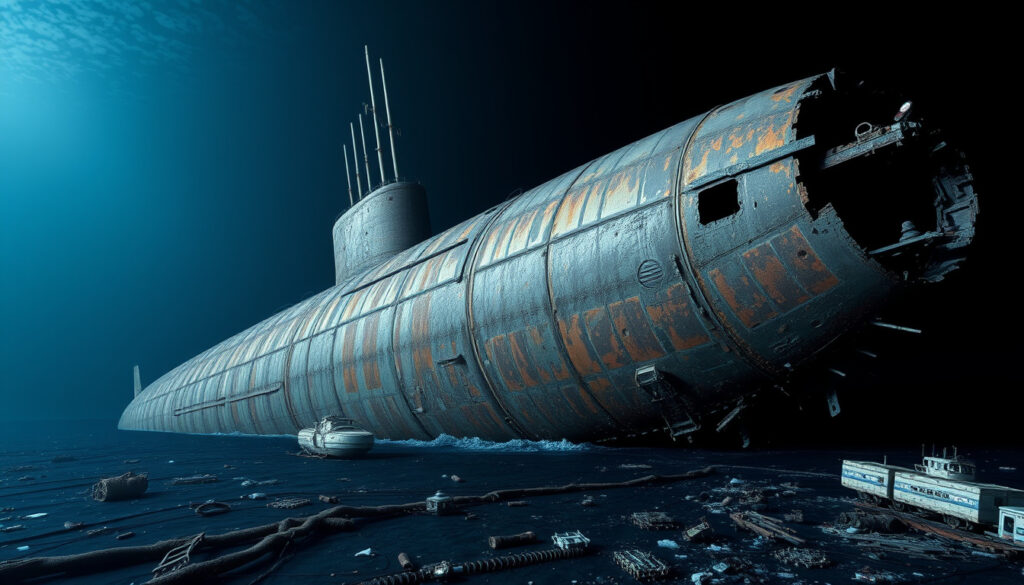
Russian Nuclear Submarine Accident: The Kursk Disaster
Some disasters stay difficult because the official story changes before the wreck goes cold. On 12 August 2000, the Russian nuclear submarine Kursk settled onto the Barents Sea floor in 108 meters of water, taking 118 sailors with it.
Date: August 12, 2000 · Location: Barents Sea, off northern Russia · Depth: 108 m (354 ft) · Lost: 118 · Cause: hydrogen-peroxide torpedo explosion
The Submarine
- K-141 Kursk — The Moscow Times
- Oscar II class — The Moscow Times
- Nuclear-powered — Britannica
- 18,300 tons surfaced — Wikipedia
The Disaster
- August 12, 2000 — The Moscow Times
- Barents Sea — The Moscow Times
- Two explosions — U.S. Naval Institute Proceedings
- 118 crew lost — The Moscow Times
The Cause
- Torpedo leak — New Scientist
- Hydrogen Peroxide — New Scientist
- Worst Russian sub accident — Britannica
- Systemic failures — U.S. Naval Institute Proceedings
The Aftermath
- Failed international rescue — EBSCO Research Starters
- Hull recovered in 2001 — Wikipedia
- 23 bodies found — The Moscow Times
- Naval safety reforms — Britannica
The clearest starting point is the machine itself: a large, fast submarine that turned out to be far more fragile than its missile deck suggested.
| Name | K-141 Kursk |
| Class | Project 949A Antey / Oscar-II class |
| Displacement | 18,300 tons surfaced |
| Length | 154 meters (505 ft) |
| Armament | 24 P-700 Granit missiles, 6 torpedo tubes |
| Nuclear plant | 2 × OK-650B reactors |
| Date of accident | August 12, 2000 |
| Depth of water | 108 meters (354 ft) |
| Total crew lost | 118 |
| Bodies recovered | 23 |
| Primary cause | Hydrogen-peroxide leak from a practice torpedo |
| Worst Russian nuclear submarine disaster? | Yes |
What happened on 12 August 2000?
The standard version of the timeline is straightforward on the surface and disturbing beneath it. At 11:28 Moscow time, an explosion ruptured the forward torpedo area. Two minutes and fifteen seconds later, a much larger explosion tore through the same part of the boat, according to reference publisher Britannica.
The second event was not the main weapon load. In Britannica’s words, the secondary detonation of torpedo warheads caused the catastrophic destruction of the bow. The Kursk then fell, nose tilted, through the Barents Sea and hit the bottom at 108 meters.
For the next several days, the rescue story dominated international coverage. The research platform EBSCO Research Starters places that painful aftermath at the center of the Kursk story: search teams could not dock rescue bells with the flooded hull, and the men sealed inside the aft compartments remained out of reach.
What was the real cause of the Kursk submarine disaster?
The most common early explanation, repeated by Russian officials in the first weeks, involved a collision with a foreign submarine or a mine. That explanation never matched the wreck. New Scientist later ran the summary that still defines the technical record: “Torpedo fuel leak sank Kursk.”
The science magazine identified the trigger as a leak of hydrogen-peroxide fuel from an unarmed practice torpedo. The leak created a chemical reaction that ignited the torpedo’s remaining fuel. The result was the first explosion. The second explosion, the one that destroyed the bow, came when the warheads of other torpedoes detonated in the fire.
None of this implicates the nuclear reactor. New Scientist explicitly frames the accident as a torpedo-fuel event rather than a nuclear event. The significance matters: the Kursk was not destroyed by the reactor inside it; it was destroyed by one of the most unstable fuels ever put inside a submarine weapon system.
“There seems to be no hope. We are writing blindly. It’s dark to write but I’ll try by feel. It seems there are no chances, 10–20 percent. Let’s hope that at least someone will read this.” — Captain-Lieutenant Dmitri Kolesnikov, note recovered from the 9th compartment
| Source of the explosion | Initial official narrative | Established technical view |
|---|---|---|
| Trigger | Collision with a foreign submarine or mine | Hydrogen-peroxide leak from a practice torpedo |
| Bow damage | Collision damage from external impact | Secondary detonation of torpedo warheads |
| Nuclear reactor | Implied by early reports of a nuclear accident | No nuclear explosion; the reactor was not the trigger |
Why did the Kursk sink? The evidence points to a hydrogen-peroxide torpedo
From the first hours, the official story pointed outward. Russian Navy Commander-in-Chief Vladimir Kuroyedov publicly changed the stated cause from a collision to a torpedo explosion within days of the accident, as documented by the Center for Nonproliferation Studies. The shift took time to reach the public because the wreck itself had to be examined first.
Acoustic data from a U.S. submarine was reported in the press to support an internal torpedo explosion rather than an external collision, according to the environmental group Bellona. That data matched the forensic evidence: the blast wave originated inside the hull, not outside it.
The government commission even considered the possibility that a World War II mine caused the damage, per the Center for Nonproliferation Studies. Each external theory failed for the same reason: the damage pattern pointed inward, to the torpedo room.
Did anyone survive the Kursk submarine disaster?
Parts of the submarine stayed intact long enough for the men in the aft compartments to survive the first explosion. A note from Captain-Lieutenant Dmitri Kolesnikov, recovered from the 9th compartment, suggested several sailors survived for hours. No rescue was completed in time. The recovered bodies were found in the aft sections, indicating that the final compartments did survive the initial breach.
“When we opened the hatch, the submarine was completely flooded. There was no sign of life. Everything was dark and silent.” — Einar Skogestad, Norwegian Navy diver, describing the discovery of the Kursk
Escape was impossible due to the depth, cold, and lack of equipment. The water temperature in the Barents Sea in August is around 6–8 °C (43–46 °F). At 108 meters, the pressure alone would have prevented any unassisted ascent without severe injury.
Was the Kursk ever raised from the seafloor?
Yes, but not intact. In 2001, a massive salvage operation raised most of the hull and moved it to a Russian shipyard. The badly damaged bow section could not be lifted safely; it was left on the seabed and later destroyed by recovery teams, according to timelines collected by Wikipedia.
The recovery had one grim purpose: bringing home the dead. Russian recovery teams eventually recovered 23 bodies from the aft sections of the submarine. When investigators finally entered the spaces where sailors had survived the first explosion, no survivors were found.
Where is the Kursk wreckage now?
The wreckage lies at a depth of 108 meters (354 feet) in the Barents Sea. The main hull was raised in the 2001 salvage operation. The bow section, too damaged to lift, was left on the seafloor and later destroyed by recovery teams. Only 23 of the 118 bodies were recovered.
Why did the official explanation change?
Because the wreck itself changed it. The collision story required visible external damage along the pressure hull. The recovered evidence did not show a classic collision scar. Instead, forensic work pointed inward, to the torpedo room, where a practice weapon’s fuel had pooled and ignited.
The Britannica account is careful to describe the bow explosion as a secondary detonation of torpedo warheads. That is the difference between a submarine being hit from outside and a submarine blowing itself apart from inside.
What was the worst submarine disaster in history?
The Kursk disaster is the deadliest Russian submarine accident since World War II. Other disasters such as the U.S. Thresher (1963, 129 lost) and the Israeli Dakar (1968, 69 lost) also had high casualty counts. The Soviet K-278 Komsomolets sank in 1989 due to a fire, killing 42 of her 69 crew. The Kursk ranks among the deadliest peacetime submarine losses globally.
Is there a movie about the Kursk submarine disaster?
The 2018 film titled Kursk, directed by Thomas Vinterberg, dramatizes the disaster. The movie focuses on the crew and their families. While dramatized, it is based on the book A Time to Die by Robert Moore and closely follows the known events, including the failed rescue attempts and the political aftermath.
What other Russian nuclear submarine accidents have occurred?
The Kursk is often called Russia’s worst nuclear submarine disaster, but it is not the only fatal incident in the history of the Soviet and Russian submarine fleets. The library research platform EBSCO Research Starters places the Kursk inside a longer pattern of Soviet and Russian submarine losses, including heavily publicized accidents in the K-8 class in 1970 and the Komsomolets in the 1980s.
Those earlier disasters shared a similar shape: a non-nuclear fire or torpedo accident onboard a nuclear submarine, followed by the slow, public process of trying to save the crew. The Kursk followed that shape, but in much deeper water and with far less time to solve the problem.
- K-8, 1970: a fire spread through a nuclear submarine during towing; the boat sank in the Bay of Biscay. EBSCO Research Starters
- K-219, 1986: a missile-fuel accident caused a fire; the submarine sank while being towed. EBSCO Research Starters
- K-278 Komsomolets, 1989: a fire reached ocean depth and took most of the crew with the submarine despite a long rescue effort. EBSCO Research Starters
What is confirmed about the Kursk—and what is still rumor?
Confirmed-list:
- The first explosion happened in the torpedo area while the submarine was preparing for a live exercise. — U.S. Naval Institute Proceedings
- A second, larger explosion followed 2 minutes and 15 seconds later. — U.S. Naval Institute Proceedings
- The bow was destroyed by secondary detonation of torpedo warheads. — Britannica
- All 118 sailors died; 23 bodies were recovered. — The Moscow Times
- The nuclear reactor did not cause the explosion. — New Scientist
Still unsupported / rumor-list:
- “A NATO submarine torpedoed the Kursk” — no recovered bow fragment supports this.
- “The crew died instantly” — true for some compartments, probably not true for the forward sections.
- “A conspiracy kept the truth hidden” — no, the physical evidence was recovered from the wreck.
Frequently asked questions
Was the Kursk a nuclear-powered submarine?
Yes. The Kursk was a Project 949A Antey class nuclear-powered cruise missile submarine. It carried two nuclear reactors, but the evidence indicates the reactors were not the cause of the explosion.
How many bodies were recovered from the Kursk?
Recovery teams brought 23 bodies to the surface during the salvage operation. The other 95 crew members could not be recovered in full because the flooded forward compartments were inaccessible inside the wreck.
Could the crew have been saved?
Parts of the submarine stayed intact long enough for the men in the aft compartments to survive the first explosion. No rescue was completed in time. The recovered bodies were found in the aft sections, indicating that the final compartments did survive the initial breach.
Did the Kursk have nuclear weapons on board?
The Kursk was designed to carry nuclear-armed missiles and torpedoes, but the exercise configuration of the weapons load is not publicly documented. The technical investigation focused on a practice torpedo fuel explosion, not a warhead detonation.
Was there any radiation released?
No major radiation release was reported. The reactors were eventually recovered and handled, and the evidence did not show a radiological catastrophe. The primary event was a fuel explosion, not a nuclear accident.
More related posts
 Female Pancreatitis Pain Location & What It Feels Like
 Power City Near Me: Store Locator & Hours (2025)
 How to Choose a Paint Color – 5 Steps for Perfect Results
 Marry Me Chicken Pasta: Ingredients, Sauce & Serving Tips
 Carrauntoohil: Ireland’s Tallest Mountain – Height & Peaks
 Capital of New Zealand: Why Wellington Won the Seat
 Real Madrid vs Villarreal 2026: Preview, Where to Watch
 Birmingham City F.C.: League, History, Nickname & Stadium Guide
