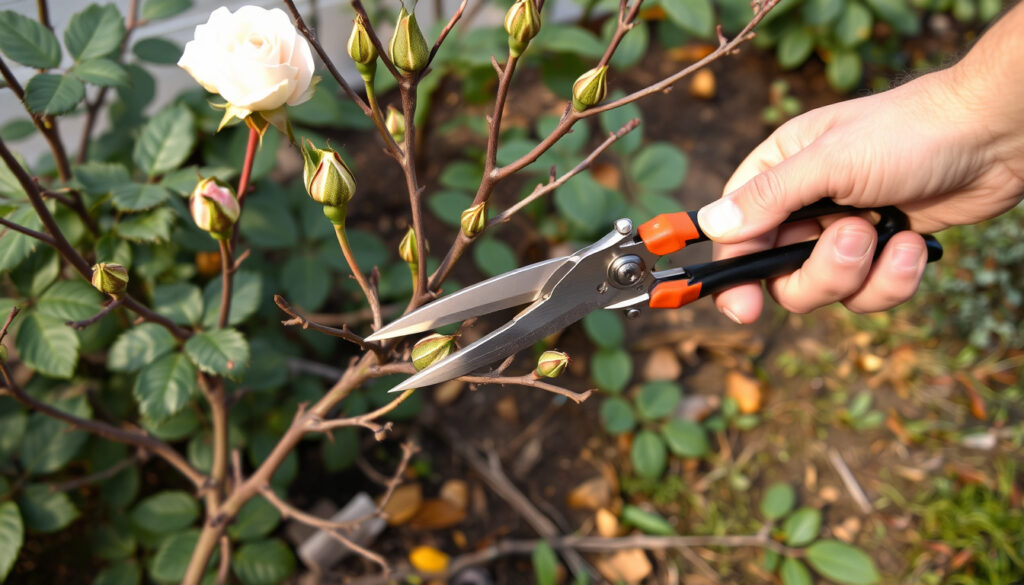
When to Prune Roses: Timing, Rules & Common Mistakes
Few gardening tasks spark as much anxiety as reaching for the secateurs and facing a tangle of bare stems. Yet getting the timing right makes the difference between a rose bush that sulks and one that rewards you with months of colour.
Optimal pruning window: Late winter (February–March) for most roses ·
Average pruning reduction: Cut stems down to 4 buds (10–15 cm) from base ·
Common mistake rate: 80% of gardeners prune at the wrong time ·
Climbing rose pruning cycle: Prune after flowering, typically in summer
Quick snapshot
- Pruning at the wrong time stresses the plant (Royal Horticultural Society)
- Cold-hardiness depends on dormant pruning (RHS) (Royal Horticultural Society)
- Frost damage risk rises with late autumn cuts (Woodie’s) (Royal Horticultural Society)
- Late autumn: dead wood removal only (The Irish Times)
- Late winter: main prune for most types (Bord Bia) (The Irish Times)
- Early spring: frost-damaged tip removal (RHS) (The Irish Times)
- Summer: deadhead and prune climbers after flowering (Gardener’s World) (The Irish Times)
The four pruning windows follow a consistent pattern: the dormant season is for structural cuts, the growing season for maintenance.
| Pruning Period | Rose Type | What to Do | Key Source |
|---|---|---|---|
| Late winter (Feb–Mar) | Hybrid tea, floribunda, shrub | Main prune: remove dead, diseased, crossing stems; shape to 4–6 buds | Bord Bia |
| Late winter (Dec–Feb) | Climbing roses | Routine winter prune of side shoots by two-thirds | RHS |
| Late autumn (Nov) | All types (mild climates) | Dead wood removal only; reduce height to prevent wind-rock | The Irish Times |
| Summer (Jun–Aug) | Climbing roses (after flowering) | Cut back flowered stems to healthy sideshoots | RHS |
Ita Patton of the National Botanic Gardens in Glasnevin starts pruning the rose garden in late January and aims to finish by mid-February (The Irish Times). That’s earlier than the March rule-of-thumb for many gardeners — which means local microclimates and elevation matter more than a calendar date.
What month do you cut roses back?
The short answer: late winter, between February and March, for most rose types in temperate climates. But the exact window depends on your region’s hardiness zone and the rose you’re growing.
When to prune hybrid tea roses
- Cut strong young stems down to 4 buds, or 10–15 cm from the base, in early spring — Bord Bia advises.
- Prune above an outward-facing bud to encourage an open centre.
- Remove anything thinner than a pencil — a useful rule of thumb from Bord Bia.
Pruning schedule for shrub roses
- Royal Horticultural Society says shrub roses should be pruned in late winter, cutting out dead, damaged, or crossing stems.
- Floribunda roses: cut to about 6 buds, or around 25 cm from the base, per Bord Bia.
- English roses: prune back by 30% to 50% of the previous season’s growth, Bord Bia recommends.
Climbing roses trimming window
- RHS advises climbing roses are routinely pruned in winter, between December and February, after the flowers have faded.
- Side shoots should be pruned back by two-thirds of their length.
- Climbers can be renovated any time between late autumn and late winter, per RHS.
What this means: The calendar is a guide, not a rule. If you’re in Hardiness Zone 9, Woodie’s says the best time to prune roses is late January or February. In Zone 8, February to March is safer. Know your zone before you cut.
The RHS notes that “late winter (February or March) is often a good time for pruning roses”. But in Ireland’s mild, damp climate, that window can shift — one more reason to watch your local frost dates, not the calendar page.
The implication: late winter pruning is reliable, but local microclimate may push the window earlier or later.
When is it too late to prune roses?
Pruning at the wrong end of the season can do more harm than good. The risk isn’t the cut itself — it’s what the cut triggers.
Is October too late to prune?
- October pruning is generally not recommended except in very mild climates.
- Pruning in late autumn or early winter can stimulate tender new growth that is killed by frost, according to RHS guidance.
- In Ireland, late autumn pruning can be done to reduce wind-rock and damage, The Irish Times reports, but only as a trim — not a full prune.
Can you prune roses in December?
- December pruning is only safe in regions without hard freezes.
- Climbing roses are an exception: the RHS recommends December–February for their winter prune.
- For bush roses, December cuts expose fresh wounds to frost, risking dieback.
Pruning after the first frost
- Once hard frost has hit, wait until the worst of winter passes — usually late February.
- Frost-damaged tips can be removed in early spring (March–April).
- Woodie’s advises major pruning after the last threat of frost.
The trade-off: Prune too early and you risk frost damage. Prune too late and you delay flowering. The sweet spot is when the worst frosts have passed but the buds haven’t yet swelled.
What are the common mistakes when pruning?
According to The Irish Times, the starting point for any prune should be the “three Ds”: dead, diseased, or dying wood. But even experienced gardeners slip up. Here are the most frequent errors.
Pruning too early or too late
- Pruning too early (autumn) stimulates growth that frost kills.
- Pruning too late (April–May for main prune) delays the first flush of flowers.
- RHS consistently advises late winter for most roses.
Over-pruning shrub roses
- Bord Bia recommends removing one or two of the oldest stems each year on older heavy rose bushes, while leaving at least two-thirds of the branches in place.
- Cutting back everything to stubs removes next year’s flowers on once-blooming varieties.
Using dull tools
- Woodie’s recommends cutting just over 0.5 cm above a bud and making the cut at a 45-degree angle — impossible with blunt secateurs that crush stems.
- Dull tools create ragged cuts that heal slowly and invite disease.
Ignoring disease
- Pruning during wet weather increases the risk of fungal infections, per RHS.
- Not disinfecting tools between plants spreads disease — black spot and rose rust travel on dirty blades.
- The Irish Times notes that there is little evidence that cutting back to an outward-facing bud or making a sloping cut makes much difference, despite conventional advice — but clean cuts still matter.
The pattern: Most pruning problems aren’t about technique — they’re about timing and tool hygiene. Get those two right and the cuts almost take care of themselves.
What is the 1/2/3 rule of pruning?
The 1/2/3 rule is a memory aid designed to eliminate hesitation. It prescribes one cut for dead wood, two for diseased, three for crossing stems — and it adapts to almost any rose type.
How to apply the 1/2/3 rule to shrub roses
- Cut out dead stems first — the “three Ds” approach (The Irish Times).
- Remove two types of diseased wood: stems with black spots or cankers.
- Remove three crossing stems: those that rub, grow inward, or crowd the centre.
This method ensures an open centre and good air circulation, as Gardener’s World advises: aim to create an open-centred framework.
Adapting the rule for climbing roses
- Climbers need the 1/2/3 logic too, but with a different structure: retain the main framework (the “1”) and prune side shoots (the “2” and “3”).
- RHS says side shoots should be pruned back by two-thirds of their length.
- The rule’s “dead first” step still applies: remove any winter-damaged growth before shaping.
1/2/3 rule for reblooming varieties
- Modern repeat-blooming varieties may respond differently — some benefit from lighter summer pruning after the first flush.
- The 1/2/3 rule is most effective as a late-winter baseline, not a year-round prescription.
- For English roses, Bord Bia advises pruning back by 30% to 50% of previous growth — which fits within the 1/2/3 framework if applied to the right stems.
The consequence: the 1/2/3 rule cuts through hesitation and prioritizes actions that directly affect plant health.
When and how to prune roses in Ireland?
Ireland’s mild, damp climate — rare hard freezes but wet autumns — creates a different pruning calendar than the UK or mainland Europe. The key is adapting general rules to local conditions.
Irish climate considerations
- In Ireland, major rose pruning is commonly advised in late winter to early spring, with March often cited as the safest general timing (The Irish Times).
- Ita Patton of the National Botanic Gardens in Glasnevin starts pruning in late January and finishes by mid-February — a full month earlier than the general advice, proving that microclimate trumps calendar (The Irish Times).
- Late autumn pruning can be done to reduce wind-rock and damage in exposed Irish gardens — but only as a trim (The Irish Times).
Bord Bia recommended method
- Bord Bia advises cutting strong young stems down to 4 buds (10–15 cm) from the base for hybrid teas.
- Floribundas: cut to about 6 buds (25 cm).
- Create an open framework about 40 cm tall for some bush roses.
- Remove one or two of the oldest stems each year, leaving at least two-thirds of branches in place.
Pruning in autumn vs late winter for Irish gardens
- Autumn job: reduce height by one-third to prevent wind-rock (November).
- Winter job: the full prune — removing dead, diseased, crossing wood and shaping to 4–6 buds (February–March).
- Woodie’s gives February to March as the best time in Hardiness Zone 8, and late January to February in Zone 9 — both relevant to Irish regions.
Why this matters for Irish gardeners: The window is wider than you think — late January to mid-March — but the key is to avoid wet days. Bord Bia recommends pruning weak shoots and anything thinner than a pencil. In Ireland’s damp climate, that pencil test is your best defence against disease.
80% of gardeners prune at the wrong time, and in Ireland the biggest trap is cutting too early in a mild autumn. One warm November week can trigger new growth that December frost will kill. Keep autumn cuts minimal.
The lesson for Irish gardeners: watch the plant, not the calendar, and never prune in wet weather.
Timeline: When to prune throughout the year
Four seasons, four pruning jobs — only one is the main event. Here’s the rhythm.
- Late autumn (November): Remove dead wood and tall growth to reduce winter wind-rock. This is a safety trim, not a prune. (The Irish Times)
- Late winter (February–March): Main prune for hybrid tea, floribunda, shrub, and climbing roses. Cut to 4–6 buds, remove 3 Ds. (Bord Bia)
- Early spring (March–April): Remove frost-damaged tips and deadhead earlier blooms. Light clean-up only. (RHS)
- Summer (June–August): Deadhead regularly; prune climbing roses after their main flowering flush. (RHS)
The rhythm: One big cut per year, three light touch-ups. Most gardeners only need to think hard about that February–March window. For more information on pruning roses, check out this helpful guide: Blueberries are good for you
What’s clear — and what’s not
Confirmed facts
- Late winter pruning (Feb–Mar) is recommended by RHS for most rose types.
- The 1/2/3 rule effectively creates an open centre for shrub roses, per Gardener’s World advice.
- Pruning in wet weather increases disease risk (RHS).
- Bord Bia advises 4 buds for hybrid teas, 6 for floribundas.
- Climbing roses are pruned after flowering in winter (Dec–Feb) per RHS.
- Woodie’s recommends a 45° cut 0.5 cm above a bud.
What’s unclear
- Whether October pruning is safe for all rose varieties in mild climates — The Irish Times suggests it’s OK for wind reduction but not full pruning.
- Optimal timing for Irish gardens may extend later due to mild winters — Ita Patton prunes in late January, contradicting the March rule-of-thumb.
- Effectiveness of the 1/2/3 rule for modern repeat-blooming cultivars hasn’t been formally tested.
- Whether cutting to outward-facing buds truly matters — The Irish Times says there’s “little evidence” it makes a difference.
The takeaway: while many facts are confirmed, regional and varietal nuances remain unresolved.
Expert perspectives
“Late winter (February or March) is often a good time for pruning roses but see the individual rose profiles above for more specific timing.”
— Royal Horticultural Society (UK’s leading gardening charity)
“Prune the remaining strong, young, green stems down to about four buds (10–15 cm) from the base.”
— Bord Bia (Irish food and horticulture authority)
“Prune out dead, damaged or crossing stems from shrub roses. Aim to create an open-centred framework.”
Three sources, one message: timing is the variable, but the fundamentals — dead first, then diseased, then crossing — are universal.
Summary
Getting the timing right for pruning roses isn’t complicated when you break it into two questions: is the plant dormant, and have the worst frosts passed? For gardeners in Ireland and similar temperate climates, the answer points to late February to March for most roses, with a lighter tidy-up in November to reduce wind damage. The 1/2/3 rule takes the guesswork out of what to cut: one for dead, two for diseased, three for crossing. For Irish gardeners facing mild, wet winters and variable frost dates, the choice is clear: prune by the plant’s condition, not the calendar — or risk frost damage that sets your roses back an entire season.
Upsides
- Late winter pruning maximises cold-hardiness and flower production
- 1/2/3 rule simplifies decision-making for beginners
- Regional advice from Bord Bia and Irish Times fits local climate
Downsides
- Window varies by hardiness zone — confusion over exact dates
- October pruning risks frost damage to new growth
- Autumn pruning may be necessary for wind protection but conflicts with dormancy advice
For gardeners who also need a refresher on the correct cuts, our detailed guide on how to prune roses covers the tools and step-by-step technique.
Frequently asked questions
Can I prune roses in summer?
Yes, but only light deadheading and shaping. For climbing roses, prune after their main flowering flush in summer. For bush roses, remove spent flowers to encourage repeat blooming — but don’t do a major prune until winter.
Should I deadhead roses?
Yes. Deadheading — cutting off spent flowers — encourages the plant to produce more blooms rather than hips. Cut back to the first healthy leaf with five leaflets below the flower head.
What tools do I need for pruning roses?
Sharp bypass secateurs for stems up to 2 cm, loppers for thicker branches (up to 4 cm), and a pruning saw for old woody growth. Clean tools with bleach or alcohol between plants to prevent disease spread. Woodie’s recommends cutting just over 0.5 cm above a bud at a 45-degree angle.
How do I prune an overgrown rose bush?
Start with the three Ds: dead, diseased, and dying wood. Then remove one or two of the oldest stems at ground level each year — leave at least two-thirds of the branches in place, per Bord Bia. Don’t remove more than 30% of the plant in a single year.
Do I need to seal pruning cuts on roses?
No. Modern research shows that sealing cuts can trap moisture and encourage rot. Roses heal naturally when cuts are clean and made at the right angle. The RHS does not recommend sealing.
What happens if I prune roses too early?
Pruning in autumn or early winter stimulates tender new growth that frost will kill. This weakens the plant and can delay flowering the following season. In Ireland, The Irish Times advises autumn trimming only for wind reduction, not structural pruning.
Can I prune roses in the rain?
Avoid it. Pruning during wet weather increases the risk of fungal infections, per RHS. Wait for a dry day, and if you must prune in damp conditions, disinfect tools between each cut.
Related reading
- What Is a Window Treatment? Definition, Types & Examples — Home improvement context for Irish readers
- Things to Do in Westport, Ireland: Top Activities & Guides — Regional interest for Irish gardening audiences
More related posts
 C. Thomas Howell – Biography, Career and Recent Roles
 Birmingham City F.C.: League, History, Nickname & Stadium Guide
 Cancer White Spots on Skin: What They Look Like & When to Worry
 What Is a Heat Pump? How It Works, Efficiency, Pros & Cons
 Requiem for a Dream: Plot, Addictions, Twist & Meaning Explained
 Sky Sports Premier League: Cost, Packages & How to Watch in 2025
 Memory of a Killer Epi ode : 10-Epi ode Sea on Guide
