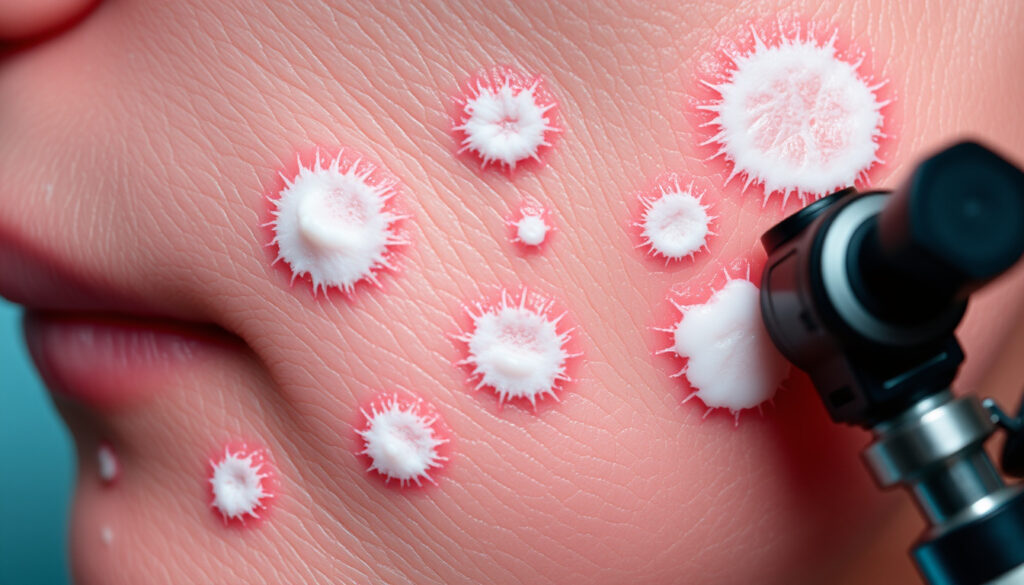
Cancer White Spots on Skin: What They Look Like & When to Worry
You notice a white patch on your skin—it’s tempting to shrug it off, but with more than 9,500 skin cancers diagnosed daily in the U.S., knowing when that pale mark needs a closer look is critical. This guide walks you through what cancerous white spots can look like, which cancers cause them, and how to tell them apart from harmless spots.
Daily skin cancer diagnoses in the US: more than 9,500 ·
Lifetime risk of developing skin cancer for Americans: 1 in 5 ·
Percentage of skin cancers that are non-melanoma: over 95% ·
Five-year survival rate for melanoma detected early: 99%
Quick snapshot
- Basal cell carcinoma can appear as a white, scar-like lesion (Mayo Clinic)
- Amelanotic melanoma lacks pigment and may look white or pink (Skin Cancer Foundation)
- Most white spots are not cancer (British Association of Dermatologists)
- Exact prevalence of white spots as a cancer presentation is not well-documented (American Cancer Society)
- Differentiating amelanotic melanoma from benign lesions often requires a biopsy (Mayo Clinic)
- Some non-melanoma skin cancers may be misdiagnosed as eczema or fungus early on (Cleveland Clinic)
- The exact mechanism by which some skin cancers appear white rather than pigmented is not fully understood (American Cancer Society)
- Basal cell carcinoma grows slowly over months to years (Mayo Clinic)
- Melanoma can change size, shape, or color within weeks (American Cancer Society)
- Schedule a skin check with a dermatologist if a white spot is new or changing (American Academy of Dermatology)
- Perform monthly self-exams using a mirror for hard-to-see areas (Skin Cancer Foundation)
Four key facts, one pattern: the vast majority of white spots are harmless, but a small subset signals skin cancer—making visual recognition and prompt dermatology referral critical.
| Statistic | Value |
|---|---|
| Most common skin cancer type | Basal cell carcinoma (80% of cases) |
| Percentage of white spots that are cancerous | Less than 1% (majority benign) |
| Early detection survival rate (melanoma) | 99% five-year survival |
| Annual US skin cancer cases | Over 5 million treated |
White spot on skin: Is it cancer?
Common benign causes of white spots
- Vitiligo: well-defined milky-white patches due to pigment loss; not cancerous (DermNet (dermatology reference)).
- Tinea versicolor: a fungal infection causing scaly, pale patches that may become more visible after sun exposure (DermNet).
- Post-inflammatory hypopigmentation: temporary lightening after eczema, psoriasis, or an injury (British Association of Dermatologists (UK dermatology body)).
- Sun damage (idioathic guttate hypomelanosis): small white spots on sun-exposed areas, harmless but permanent (Mayo Clinic).
When white spots may indicate skin cancer
A white spot that doesn’t heal, grows, or changes in border should be evaluated by a dermatologist. According to the American Cancer Society (leading U.S. oncology organization), skin cancer can appear as a new growth, a rough patch, a sore that won’t heal, or changes to a mole. The British Association of Dermatologists notes that white patches are more commonly due to non-cancerous causes, but a small fraction are malignant.
Even when a white spot looks completely benign, if it persists for more than two weeks without healing, the safe move is a dermatology visit. A biopsy is the only way to rule out cancer definitively.
The implication: most white spots are benign, but a persistent or evolving one demands a professional eye.
What do cancerous white spots look like?
Appearance of basal cell carcinoma white spots
Basal cell carcinoma (BCC) often presents as a white, waxy, scar-like area with poorly defined borders. The Mayo Clinic (leading academic medical center) describes it as skin-colored or pink on white skin, sometimes looking like a pearly bump. The Skin Cancer Foundation adds that it can mimic a scar that is white, yellow, or waxy.
White spots from squamous cell carcinoma
Squamous cell carcinoma (SCC) may appear as a firm red nodule or a flat sore with a scaly, crusting surface that can have whitish areas. The Cleveland Clinic (academic medical system) notes that it can also present as a rough, scaly lesion that itches, bleeds, or becomes crusty.
Amelanotic melanoma as a white spot
Amelanotic melanoma is a subtype of melanoma that produces little or no pigment. It often looks pink, red, or white, making it easy to mistake for a benign mole, scar, or even a pimple. The American Cancer Society emphasizes that melanomas may include patches of white, pink, or blue within a lesion. The NHS (UK public health service) warns that melanoma can start in a normal-looking area and may be brown, black, pink, or sometimes the same color as surrounding skin.
The pattern: BCC tends to be scar-like and waxy, SCC scaly and crusty, and amelanotic melanoma deceptive because it lacks the typical dark pigment. All three require a dermatologist to tell them apart from harmless spots.
What kind of cancer causes white spots on skin?
Basal cell carcinoma (BCC)
BCC is the most common skin cancer, accounting for about 80% of all cases. It arises from basal cells in the deepest layer of the epidermis and rarely spreads, but it can destroy local tissue if neglected. The National Cancer Institute (U.S. federal research agency) lists actinic keratosis as a precancerous condition linked to UV exposure that can sometimes progress to SCC, but BCC itself is a full malignancy.
Squamous cell carcinoma (SCC)
SCC originates in squamous cells and is the second most common skin cancer. It can be more aggressive than BCC and may metastasize if not caught early. The CDC (U.S. public health agency) states that UV exposure is a major risk factor for most skin cancers.
Amelanotic melanoma
Although melanoma is less common than BCC and SCC, it is far more dangerous because it spreads quickly. The American Cancer Society notes that melanoma is more likely to spread if not treated early. Amelanotic melanoma accounts for about 2–8% of all melanomas but is disproportionately deadly because diagnosis is often delayed.
Cutaneous T-cell lymphoma
This rare type of lymphoma can cause patches of pale or white skin, though it usually presents with other symptoms like itching and redness. Diagnosis requires a skin biopsy and specialist interpretation.
Knowing which cancer type can produce a white spot is essential, but the more practical question is whether the spot matches any of the warning signs described here. The majority will turn out to be nothing—but the ones that aren’t are highly treatable when caught early.
The takeaway: BCC, SCC, and amelanotic melanoma are the three main cancers that can manifest as white or pale spots. Each has a distinct visual profile, but none can be self-diagnosed reliably.
How can you tell if a spot is cancerous?
The ABCDE rule for melanoma
The American Cancer Society and the Cleveland Clinic both advocate the ABCDE checklist:
- Asymmetry – one half doesn’t match the other.
- Border – irregular, ragged, or blurred edges.
- Color – multiple colors including white, pink, red, brown, black, or blue.
- Diameter – larger than 6 mm (about 1/4 inch), though some melanomas may be smaller.
- Evolving – changing in size, shape, color, or symptoms (itching, bleeding).
Other warning signs for non-melanoma skin cancer
According to the Mayo Clinic, non-melanoma skin cancers often show as:
- A persistent sore that doesn’t heal within two weeks.
- A scaly, crusty patch of skin that may bleed.
- A waxy, pearly bump that may have visible blood vessels.
- A scar-like area without a prior injury.
When to see a dermatologist
The American Academy of Dermatology (world’s largest dermatology association) recommends evaluating any spot that looks different from others or changes over time. The Skin Cancer Foundation advises monthly self-exams to increase the chance of early detection.
The implication: a simple self-check using the ABCDE rule can flag suspicious spots, but the final judgment belongs to a dermatologist—especially for white spots that don’t fit the typical melanoma pattern.
When to worry about white spots on skin?
Signs that require immediate medical attention
- The white spot is new and continues to grow or change in shape.
- It bleeds, itches, or becomes painful.
- The border is irregular or the color is uneven.
- It appears on a scar or area of previous sunburn.
- You have a personal or family history of skin cancer (CDC).
Distinguishing harmless white spots from dangerous ones
Benign spots like vitiligo or sun spots are usually stable, symmetrical, and don’t bleed. Fungal spots (tinea versicolor) are scaly and may be slightly pink or white but don’t evolve into sores. The Cancer Council Australia (national cancer authority) advises checking the entire body, including soles of the feet, between fingers, and under nails—because skin cancers can occur in non-sun-exposed areas.
The trade-off: You don’t need to panic over every pale freckle, but any white spot that is new, growing, or not healing after two weeks deserves a professional look. Early detection of skin cancer—especially melanoma—dramatically improves prognosis.
What we know and what we don’t
Confirmed facts
- Basal cell carcinoma can present as a white, scar-like lesion (Mayo Clinic).
- Amelanotic melanoma lacks pigment and may appear white or pink (American Cancer Society).
- Most white spots are not cancerous (British Association of Dermatologists).
- UV exposure is a major risk factor for all skin cancer types (CDC).
What’s unclear
- Exact prevalence of white spots as a cancer presentation is not well-documented.
- Differentiating amelanotic melanoma from benign lesions often requires biopsy (Mayo Clinic).
- Some non-melanoma skin cancers may be misdiagnosed as eczema or fungal infections early on (Cleveland Clinic).
- The exact mechanism by which some skin cancers appear white rather than pigmented is not fully understood.
The implication: while much is known, the ambiguity in presentation underscores the importance of professional evaluation.
Expert perspectives
“Basal cell carcinoma can look like a white, waxy bump or a scar-like area that is often mistaken for a benign scar.”
— American Cancer Society (skin cancer warning signs guide)
“On white skin, basal cell carcinoma often appears as a bump that is skin-colored or pink. It may also appear as a scar-like lesion that doesn’t heal.”
— Mayo Clinic (skin cancer symptoms overview)
“A scar-like area that is white, yellow, or waxy, often with poorly defined borders, is a classic sign of basal cell carcinoma.”
— Skin Cancer Foundation (early detection page)
These expert descriptions reinforce the need for clinical correlation.
Summary
White spots on the skin are overwhelmingly benign—most turn out to be vitiligo, fungal infections, or sun-induced depigmentation. But a small fraction signal basal cell carcinoma, squamous cell carcinoma, or the more dangerous amelanotic melanoma. The key is not to guess. For anyone who notices a white spot that is new, changing, or not healing after two weeks, the choice is clear: get it checked by a dermatologist, or risk missing an early-stage skin cancer that is almost always curable when caught early.
flcancer.com, altitudedermatology.com, midcountyderm.com, oregoncancer.com
While many white spots are harmless, a detailed guide to white patches on skin can help distinguish between benign and concerning changes.
Frequently asked questions
What does a cancerous white spot feel like?
It may feel smooth, waxy, or scaly. Basal cell carcinoma often feels like a hard, pearly bump, while squamous cell carcinoma may be rough and crusty. Amelanotic melanoma can feel like a mole or a bump that doesn’t go away.
Can white spots on skin be itchy and cancerous?
Itching can occur with skin cancer, especially squamous cell carcinoma and inflammatory types like cutaneous T-cell lymphoma. However, itching alone is not a reliable indicator—benign conditions like eczema also itch.
Is a white spot on the face always skin cancer?
No. White spots on the face are often due to pityriasis alba (a mild eczema), sun spots, or vitiligo. However, basal cell carcinoma frequently appears on the face, so any persistent spot should be checked.
How quickly do cancerous white spots grow?
Basal cell carcinoma grows slowly over many months. Squamous cell carcinoma can grow faster, over weeks to months. Amelanotic melanoma can change rapidly, sometimes within a few weeks.
Are white spots after sunburn a sign of cancer?
White spots that appear after sunburn are usually post-inflammatory hypopigmentation or sun spots (idiopathic guttate hypomelanosis) and are not cancerous. But a new white spot in a sunburned area that persists should be monitored.
What doctor should I see for a white spot on skin?
A dermatologist is the specialist for skin lesions. Your primary care doctor can also evaluate and refer you if needed.
Can skin cancer start as a white dot?
Yes. Basal cell carcinoma sometimes begins as a small, white or flesh-colored papule. Amelanotic melanoma can also start as a white or pink dot that enlarges over time.
The FAQ addresses common concerns, but individual cases should always be reviewed by a healthcare provider.
Related reading: Burst Blood Vessel in Eye: Causes, Treatment & When to Worry · How Much CRP Level Is Dangerous
More related posts
 Built in Wardrobes Ireland: Costs, IKEA PAX Alternatives & More
 Prayer Time in Dublin: Compare Mosque Timetables Today
 Maximum Dose of Sertraline for Adults: 200 mg Limit
 Signs of Ectopic Pregnancy: Early Symptoms and When to Seek Help
 Athlone to Galway Train: Timetables, Tickets, and Station Guide
 I Liga Rozgrywki Terminarz 2025/2026 – Schedule Guide
 Como Organizar o Tempo: 7 Techniques for Better Time Management
 Ireland Extreme Heat Weather Forecast: Records & Outlook
