Burst Blood Vessel in Eye: Causes, Treatment & When to Worry
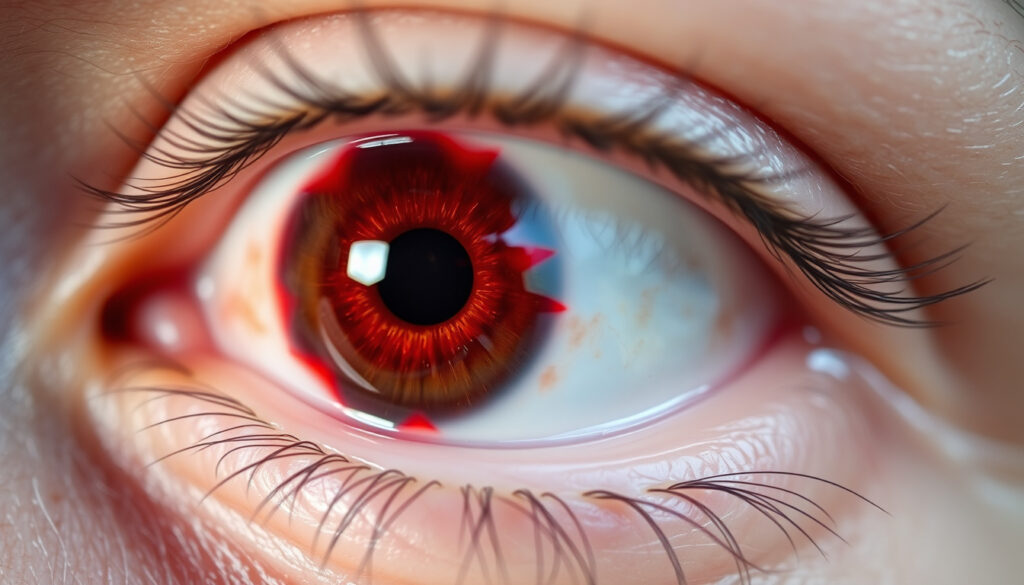
You look in the mirror and spot a bright red patch on the white of your eye. It’s alarming, but a burst blood vessel — known medically as a subconjunctival hemorrhage — is almost always harmless and clears up without treatment.
Medical term: Subconjunctival hemorrhage ·
Typical healing time: 1–2 weeks ·
Common triggers: Coughing, sneezing, straining, rubbing ·
Effect on vision: Usually none ·
Seriousness: Rarely dangerous; self-limiting
Quick snapshot
- Most subconjunctival hemorrhages do not need treatment and clear in days to weeks (Mayo Clinic, a leading academic medical center).
- Vision is typically not affected because the blood stays on the conjunctiva, not the cornea (Cleveland Clinic, ranked among top U.S. hospitals).
- Coughing, sneezing, and straining raise venous pressure and are common triggers (American Academy of Ophthalmology, the world’s largest association of eye physicians and surgeons).
- Whether stress directly causes burst blood vessels or only indirectly through physical straining.
- Whether low‑dose aspirin significantly increases the risk of recurrence.
- Healing typically takes 7–14 days; larger spots up to 3 weeks (Cleveland Clinic, ranked among top U.S. hospitals).
- The red area fades to yellow or brown, like a bruise, as the blood is absorbed (Mayo Clinic, a leading academic medical center).
- Monitor for pain or vision changes — if absent, no treatment is needed.
- If the red spot hasn’t changed after 2 weeks or you experience pain, see an eye doctor.
- Avoid rubbing the eye and use artificial tears if it feels irritated.
Key facts at a glance:
| Label | Value |
|---|---|
| Official name | Subconjunctival hemorrhage |
| Prevalence | Very common; can occur at any age |
| Vision impact | Rarely affects vision except in large bleeds |
| Typical resolution | 1–2 weeks |
| Emergency signs | Pain, vision loss, or recurrence |
How serious is a burst blood vessel in the eye?
Is a subconjunctival hemorrhage dangerous?
For the vast majority of people, no. A subconjunctival hemorrhage is a broken blood vessel that bleeds into the space between the conjunctiva and the sclera — it looks dramatic but is usually harmless. The condition resolves on its own without any medical intervention, according to Mayo Clinic (a leading academic medical center). Vision remains unaffected because the blood pools in front of the white of the eye, not over the pupil or inside the eye, as Cleveland Clinic (ranked among top U.S. hospitals) explains.
Could it be a sign of something more serious?
- Recurring hemorrhages may point to an underlying condition such as hemophilia or von Willebrand disease (Cleveland Clinic, ranked among top U.S. hospitals).
- If the hemorrhage is accompanied by pain, severe headache, or vision changes, it could indicate a more serious issue like hyphema (blood inside the front chamber of the eye) or an eye stroke.
A single, painless subconjunctival hemorrhage is almost never dangerous. Recurrence or pain, however, shifts the picture: those patients need a workup for bleeding disorders or vascular issues.
How to distinguish from an eye stroke
An eye stroke (retinal artery occlusion) is a medical emergency that causes sudden, painless vision loss in one eye — often described as a curtain coming down. In contrast, a subconjunctival hemorrhage leaves vision intact. If you experience sudden vision loss, call 911 immediately. The Cleveland Clinic (ranked among top U.S. hospitals) notes that pain or vision changes with a red eye warrant urgent evaluation.
Why this matters: Mistaking an eye stroke for a benign hemorrhage could delay sight‑saving treatment. The dividing line is pain and vision — if both are normal, it’s almost certainly a simple bleed.
Takeaway: A painless red spot with clear vision is almost always harmless. Pain or vision loss demands immediate medical evaluation.
How do you fix a popped blood vessel in your eye?
What can you do at home?
- No active treatment is needed; the body reabsorbs the blood naturally within 1–2 weeks (Mayo Clinic, a leading academic medical center).
- A cold compress can provide short‑term comfort if there is associated swelling (Northwest Eye Clinic, a regional ophthalmology practice).
- Avoid rubbing or pressing on the eye.
Are there any eye drops or medications?
No prescription drops are indicated. Over‑the‑counter artificial tears can soothe irritation or dryness that sometimes accompanies the hemorrhage (VSP Vision Care, a leading vision insurance provider). Avoid aspirin or ibuprofen unless prescribed by your doctor, as these can prolong bleeding.
When to see a doctor
- If the hemorrhage occurs after a blow to the head or eye trauma.
- If you have a known bleeding disorder or take blood‑thinning medication.
- If the red spot does not improve after 2 weeks.
- If you experience pain, vision changes, or discharge.
The catch: Most treatment is “watchful waiting.” The real action is ruling out other causes — so if you’re on anticoagulants or have recurrent episodes, an eye exam is wise.
Warning: If you have a bleeding disorder or take blood thinners, do not ignore a red spot. Consult your doctor promptly.
Home care steps for a burst blood vessel
- Apply a cold compress — for up to 5 minutes at a time if the eye feels sore or swollen. This is not essential but can reduce initial discomfort (Northwest Eye Clinic, a regional ophthalmology practice).
- Use artificial tears — 1–2 drops up to 3 times daily if the eye feels gritty or dry (VSP Vision Care, a leading vision insurance provider).
- Avoid rubbing — rubbing can re‑injure the small blood vessels and delay healing.
- Skip blood‑thinning pain relievers — avoid aspirin, ibuprofen, or naproxen without medical approval.
- Track the color change — the bright red will turn yellow or brown over 5–10 days, then fade completely. If it stays red beyond 2 weeks, contact your eye doctor.
The pattern: Patience is the cure. Monitor the color progression and resist the urge to speed things up.
Can burst blood vessels in the eye be caused by stress?
What other common triggers cause subconjunctival hemorrhage?
Stress alone does not directly pop a blood vessel. However, the physical straining that accompanies stress — violent coughing, sneezing, vomiting, heavy lifting, or straining during bowel movements — can briefly raise venous pressure in the head and cause a small vein to rupture. This is called the Valsalva maneuver. The American Academy of Ophthalmology (the world’s largest association of eye physicians and surgeons) lists these as classic triggers. Other common causes include eye trauma and recent eye surgery (Eye Physicians of New York, a specialty ophthalmology clinic).
Are there lifestyle factors that increase risk?
- Use of blood thinners or anticoagulants.
- Heavy lifting or intense exercise that involves straining.
- Chronic coughing (e.g., from smoking or COPD).
- High blood pressure may contribute, but it is rarely the sole cause.
What this means: If you’re under stress and you develop a red spot, don’t blame the stress itself — look at whether you’ve been coughing, sneezing, or straining. The link is indirect but real.
When should I worry about a broken blood vessel in my eye?
What symptoms require emergency care?
- Sudden vision loss or blurriness.
- Severe eye pain or headache.
- Trauma to the eye or head.
- Recurring hemorrhages without an obvious trigger.
The Cleveland Clinic (ranked among top U.S. hospitals) advises that anyone with pain or additional symptoms should contact an eye care specialist right away.
When is it safe to wait and watch?
If the only symptom is a painless red spot and your vision is clear, it’s safe to wait. According to My Health Alberta (a government‑operated health service), the blood will gradually disappear on its own in 2–3 weeks. No urgent care is needed. Even a large, alarming spot is usually benign.
The trade‑off: Your peace of mind matters. If the appearance bothers you enough to cause anxiety, a quick telehealth visit with an optometrist can confirm it’s harmless.
How long can a broken blood vessel in the eye take to heal?
What is the typical healing timeline?
- Most subconjunctival hemorrhages resolve in 7–14 days (Cleveland Clinic, ranked among top U.S. hospitals).
- Larger bleeds can take up to 3 weeks.
- The area changes color: bright red → dark red → yellow/brown → clear.
Mayo Clinic (a leading academic medical center) explains that the body simply reabsorbs the trapped blood, just as it would a bruise on your skin.
Does healing time depend on the cause?
Generally, no. Whether the trigger was a cough, strain, or minor trauma, the healing process is the same. The only variable is size: a tiny dot may vanish in a few days, while a large patch may persist for two to three weeks. No permanent damage occurs.
The pattern: Patience is the cure. Monitor the color progression and resist the urge to speed things up. If the red spot hasn’t changed after 2 weeks, that’s when you call the doctor.
What we know and what remains unclear
Confirmed facts
- Subconjunctival hemorrhage is usually benign and self‑limiting.
- Coughing, sneezing, and straining are common triggers.
- Healing occurs without intervention in 1–2 weeks.
What’s unclear
- Whether stress acts as a direct cause or only through physical straining.
- Whether low‑dose aspirin meaningfully increases the risk of recurrence.
For more on health thresholds, see our guide on dangerous CRP level thresholds.
Expert perspectives
“A broken blood vessel in the eye can be startling, but it is not always dangerous.”
— Dr. Jeffrey Druck, emergency physician at University of Utah Health
“Subconjunctival hemorrhage is the term for a broken blood vessel that bleeds on the surface of your eye.”
— Cleveland Clinic ophthalmology team
For more on blood pressure dangers, see our article on dangerous low blood pressure in women.
Summary: Your next move
For anyone who spots a red patch on the white of their eye, the decision is straightforward: if it’s painless and your vision is clear, let nature take its course. Use artificial tears for comfort, avoid rubbing, and wait. But if the hemorrhage recurs, lasts beyond two weeks, or is accompanied by pain or vision changes, see an eye doctor without delay. For the worried patient, the choice is clear: monitor, wait, and let time do the healing — or get a quick confirmation from a professional to ease your mind.
If you notice a red patch on the white of your eye, it is likely a subconjunctival hemorrhage, and you can learn more about burst blood vessel in eye and when it requires medical attention.
More related posts
 Northern Sound Death Notices: Cavan, Monaghan, Leitrim, Longford
 Dublin Marathon 2025 Tracker: How to Track Runners Live
 Harry Potter Studio Tour: Guide to Duration, Cost & Tips
 Carer’s Support Grant Ireland Increase – €2,000 Rate, Eligibility and Dates
 Bus from Galway to Dublin – Timetable Prices and Booking Guide
 Stranger Things: The First Shadow – Plot, Venues, Tickets & Cast
 Houses for Sale in Monkstown: Dublin & Cork Buyer’s Guide
 Error Meaning: Definition, Synonyms, Types, and How to Fix
