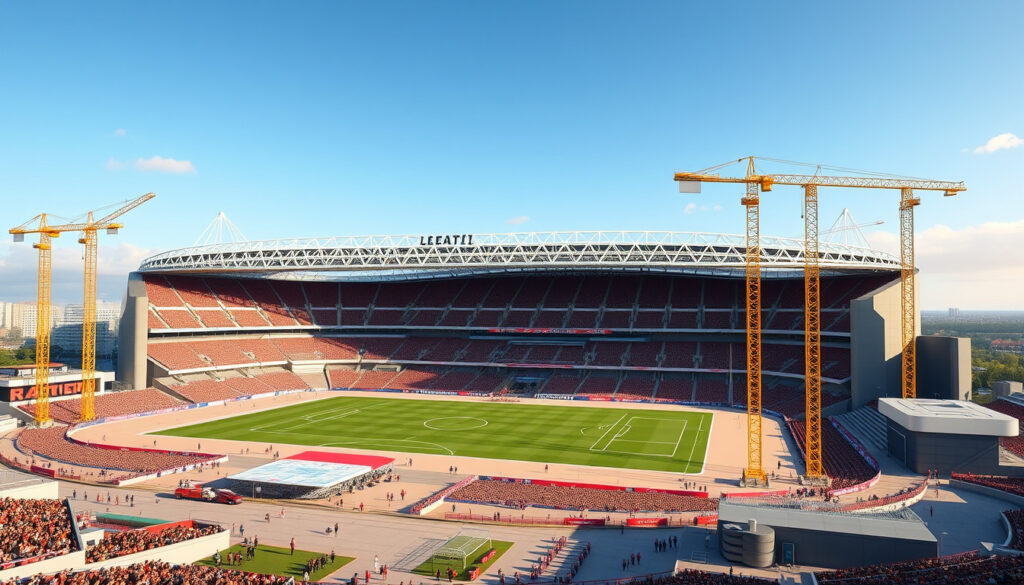
Old Trafford New Stadium – Capacity, Cost and Timeline
Manchester United is advancing plans for a new 100,000-seat stadium to replace the aging Old Trafford, with the project forming the centrepiece of a broader regeneration initiative covering more than 370 acres surrounding the current site.
The club has commissioned Foster + Partners to design the venue, temporarily named New Trafford Stadium, as part of a strategy to create what project leaders describe as the “Wembley of the North.” Sir Jim Ratcliffe and INEOS are steering the initiative, which carries an estimated price tag of £1.5-2 billion for the stadium alone, with no public money allocated for its construction.
The wider regeneration scheme aims to deliver tens of thousands of new homes and jobs, with the Old Trafford Regeneration Mayoral Development Corporation now overseeing delivery of the masterplan focused on Trafford Wharfside.
When will the new Old Trafford stadium be built?
The project has moved beyond initial concept stages, with the Old Trafford Regeneration Task Force formally established in 2024 and the Old Trafford Regeneration Mayoral Development Corporation officially launched in 2026 to drive transformation. The task force, chaired by Lord Coe, includes representatives such as Gary Neville and Mayor Andy Burnham, alongside strategic partnerships with Trafford Council and the Greater Manchester Combined Authority.
A consortium has been appointed by Trafford Council to develop the masterplan, with the document expected in early 2026. According to recent statements, a planning application is targeted within 18 months, placing the formal submission phase in or around 2027.
Four key points define where the project currently stands:
- Status: Proposed replacement for Old Trafford, with OTR MDC now overseeing delivery
- Architect: Foster + Partners selected for stadium design
- Target completion: Aiming for 2030, though 2032 appears more realistic per reporting
- Key goal: Create the “Wembley of the North” without public stadium funding
The build strategy calls for on-site construction using phased development, allowing matches to continue at Old Trafford during the new stadium’s erection on or adjacent to the existing footprint. This approach avoids the substantial disruption and cost of relocating the club during the build phase.
Fan consultations and task force recommendations have consistently favoured a new build over renovation, with progress described as steady but phased as the project moves through planning stages.
- Old Trafford Regeneration Task Force formed in 2024 with Lord Coe as chair
- OTR MDC launched in 2026 to oversee delivery of the masterplan
- Planning application targeted within 18 months of recent statements
- On-site build planned to allow continued use of existing stadium
- Completion originally aimed for 2030, now likely slipping to 2032
- Fan feedback has driven preference for new build over renovation
| Aspect | Details |
|---|---|
| Project name | Temporarily named New Trafford Stadium |
| Architect | Foster + Partners |
| Location | Old Trafford site and surrounding land |
| Stadium capacity | Approximately 100,000 seats |
| Build cost estimate | £1.5-2 billion |
| Renovation alternative | Around £1 billion, deemed less viable |
| INEOS infrastructure commitment | $300 million as part of 25% stake |
| Regeneration area | 370 acres |
| New homes planned | 15,000-17,000 |
| Jobs to be created | 90,000-92,000 |
| Public stadium funding | None confirmed |
| Interim upgrades | 2026/27 improvements including self-service bars and kiosks |
What is the capacity of the new Old Trafford stadium?
Foster + Partners has designed the new venue with a capacity of approximately 100,000 seats, positioning it among the largest football stadiums in the United Kingdom and Europe. This represents a significant increase from Old Trafford’s current capacity, which has stood at around 74,879 following the removal of some standing areas.
Comparison with other major stadiums
The 100,000-seat target would place New Trafford Stadium in a category alongside Wembley Stadium, which holds approximately 90,000 spectators. The ambition is to create a venue capable of hosting major finals and events, reinforcing Manchester United’s status as a global football institution.
Matchday experience priorities
Project briefs from the club emphasize world-class matchday experiences as a central design pillar alongside the increased capacity. Architectural innovation forms part of this approach, with the brief calling for modern facilities that meet contemporary expectations for comfort, accessibility, and entertainment.
At approximately 100,000 seats, the proposed stadium would surpass Old Trafford’s current capacity by roughly 25,000. The design emphasis on matchday experience suggests facilities extending beyond pure seat count to include hospitality areas, fan zones, and improved circulation spaces.
What does the new Old Trafford stadium redevelopment involve?
The redevelopment extends far beyond a single stadium project. The initiative encompasses a comprehensive transformation of the Old Trafford area into a vibrant district, with the new stadium serving as the catalyst for wider urban renewal across 370 acres.
Housing and employment creation
The masterplan targets between 15,000 and 17,000 new homes within the regeneration zone, addressing broader housing needs in Greater Manchester. Alongside residential development, the project aims to generate 90,000 to 92,000 jobs, providing substantial employment opportunities across construction, hospitality, retail, and associated services.
Economic impact projections
Forecasts suggest economic benefits reaching up to £7.3 billion annually for the UK economy once the regeneration is complete. The project also anticipates drawing approximately 1.8 million annual visitors to the area, supporting local businesses and strengthening regional tourism credentials.
The club has stated explicitly that no public money will fund the stadium construction itself. INEOS has committed $300 million to infrastructure as part of their 25% stake in the club. The broader regeneration may involve public-private partnerships, but the venue build will be financed independently.
What is the design for the new Old Trafford stadium?
Foster + Partners, the internationally renowned architecture firm, has been tasked with designing the new venue. The practice brings experience with major sporting and cultural projects globally, bringing heavyweight credentials to the Manchester United initiative.
Engineering constraints driving the design
Initial proposals to renovate the existing Old Trafford were ultimately rejected due to significant engineering challenges. An adjacent railway line complicates structural work, while outdated infrastructure throughout the current stadium, including cabling systems and cramped interior spaces, would require prohibitively expensive remediation. These constraints pushed the project toward a new build on or near the current site rather than extensive renovation.
Phased construction approach
The design incorporates phased development to allow Old Trafford to remain operational during construction. This strategy avoids the logistical nightmare and financial cost of finding temporary accommodation for a club of Manchester United’s stature, with the new stadium rising on land adjacent to the current venue before eventual transition.
While specific architectural details remain subject to the masterplan development and planning process, the project brief from the club has consistently emphasized innovation, world-class facilities, and architectural distinction as central objectives.
Project timeline and milestones
The path from initial concept to potential completion spans multiple years, with key dates already established and others subject to the planning process.
- 2024: Old Trafford Regeneration Task Force formed, chaired by Lord Coe and including Gary Neville and Mayor Andy Burnham. Strategic partnership established with Trafford Council and Greater Manchester Combined Authority.
- 2025: Project included in Greater Manchester Growth Plan. Trafford Council appoints development consortium for masterplan preparation, with completion expected in early 2026.
- 2026: Old Trafford Regeneration Mayoral Development Corporation officially launches, taking responsibility for overseeing delivery. Chancellor Rachel Reeves signals government support for area regeneration.
- 2027: Planning application targeted within 18 months of recent statements, placing formal submission in or around this year.
- 2030: Original completion target set for the new stadium, though industry reporting suggests this date is increasingly unrealistic.
- 2032: More probable opening date per recent reporting, with the phased approach and planning timeline contributing to the delay from original expectations.
What is certain and what remains unclear?
The project has advanced sufficiently to establish several concrete facts, though gaps remain in public understanding of certain aspects.
| Established information | Information that remains unclear |
|---|---|
| Foster + Partners confirmed as stadium architect | Specific architectural design details and renders |
| 100,000-seat capacity target set | Exact timeline for construction phases |
| OTR MDC established to oversee delivery | Status of land acquisition negotiations |
| £1.5-2 billion build cost estimate | Specific private funding arrangements beyond INEOS commitment |
| Masterplan development underway | Precise location of new stadium relative to current structure |
| Planning application expected within 18 months | Detailed interim upgrade scope and timeline |
Context and broader significance
Old Trafford has served as Manchester United’s home since 1910, making it the oldest operational football stadium among the Premier League’s current venues. The structure has undergone several expansions over its lifetime, but aging infrastructure and evolving requirements have prompted reassessment of the venue’s long-term future.
The project’s ambitions extend beyond football. Club CEO Omar Berrada has emphasized the stadium’s role as a catalyst for regeneration, positioning the venue within a framework that addresses housing, employment, and economic development across Trafford. The involvement of Lord Coe brings Olympic-level event hosting expertise, suggesting aspirations beyond domestic football to include potential international fixtures and competitions.
The initiative represents one of the most significant infrastructure proposals in British football history, requiring navigation of planning processes, funding negotiations, and complex engineering challenges. Whether the project delivers on its ambitious targets will depend on the outcomes of ongoing masterplan development and subsequent planning applications.
Sources and stakeholder perspectives
Official communications from Manchester United have framed the project as a landmark moment for the club and surrounding region. The club has highlighted the scale of ambition, the absence of public funding for the stadium itself, and the transformative potential for the wider area.
Manchester United has welcomed what it describes as a landmark moment in the regeneration plan, with CEO Omar Berrada emphasizing the stadium’s role as a catalyst for broader transformation.
— Manchester United official communications
External reporting has added context around timelines and cost estimates, with ESPN citing a 2032 opening target while noting the phased approach to construction. The involvement of Sir Jim Ratcliffe and INEOS brings private investment expertise to a project of unusual scale and complexity.
INEOS has committed $300 million to infrastructure as part of their 25% stake, with the club explicitly stating no public money will fund the stadium construction.
— Football Ground Guide reporting on INEOS commitments
Summary
Manchester United is pursuing plans for a new 100,000-seat stadium designed by Foster + Partners, with the project positioned as the centrepiece of a 370-acre regeneration scheme expected to cost £1.5-2 billion for the venue alone. The Old Trafford Regeneration Mayoral Development Corporation is now overseeing delivery, with a planning application targeted within 18 months and completion most likely around 2032 rather than the originally hoped-for 2030. The club has committed to funding the stadium without public money, while INEOS has contributed infrastructure funding as part of their ownership stake. For those tracking developments, Real Madrid vs FC Barcelona Head-to-Head Stats offers additional context on the scale of matches such a venue might host.
Frequently asked questions
How much will the new Old Trafford stadium cost?
Estimates place the new stadium build at approximately £1.5-2 billion. By comparison, renovating the existing Old Trafford would cost around £1 billion but was deemed less viable due to engineering challenges.
What is the latest update on Manchester United’s new stadium?
The Old Trafford Regeneration Mayoral Development Corporation officially launched in 2026 to oversee delivery. A planning application is targeted within 18 months, with completion now most likely around 2032.
Who is designing the new Old Trafford stadium?
Foster + Partners, the internationally renowned architecture firm, has been commissioned to design the new venue with a capacity of approximately 100,000 seats.
What happened to plans for renovating Old Trafford?
Renovation was considered but ultimately rejected. An adjacent railway line and outdated infrastructure including cabling and cramped interiors presented prohibitive engineering challenges.
How will the new stadium affect surrounding areas?
The regeneration scheme aims to deliver 15,000-17,000 new homes, create 90,000-92,000 jobs, and generate up to £7.3 billion annually for the UK economy.
Will public money fund the new stadium?
Manchester United has explicitly stated that no public money will fund the stadium itself. INEOS has committed $300 million to infrastructure as part of their 25% stake.
What is the timeline for construction?
The original target was 2030, but recent reporting suggests 2032 is more probable given the phased approach and ongoing planning process. The build will occur on or near the existing site to allow continued use of Old Trafford.
What upgrades are planned for Old Trafford before the new stadium opens?
Interim improvements announced include self-service bars and kiosks planned for the 2026/27 season, enhancing the matchday experience while the new stadium project progresses through planning and construction phases.
More related posts
 What Is Hyrox Training? Format, Prep & CrossFit Comparison
 Pay As You Go Electricity Ireland: Compare Costs & Plans
 How to Get Rid of Mice Fast According to Pest Pros
 The Studio TV Series Guide: Episodes, Awards & More
 Woman of the Dead: Netflix Guide to Seasons & Setting
 Dublin Weather This Week: Forecast, Rain & Temperatures
 How to Clean Window Screens: Simple Methods and Hacks
 The Madame Blanc Mysteries: Seasons, Cast & Filming Guide
