Is Monaco a Country? Sovereignty, Wealth & Residency Guide
Freddie George Cooper Harrison • 2026-07-29 • Reviewed by Hanna Berg
Most people point to Monaco on a map and feel a small twinge of confusion, wondering if that tiny dot is really a country. It is — a sovereign city-state that unlocks economic privileges and lifestyle restrictions that challenge everything you think you know about wealth, taxes, and what a nation can be.
Area: 2.02 sq km (0.78 sq mi) · Population (2024 est.): 36,297 · GDP per capita (PPP): $171,000 (highest globally) · UN Member State: Yes, since 1993 · Official Language: French · Government: Constitutional monarchy (Prince Albert II)
The exact minimum financial threshold for residency is informal; no fixed legal amount is published in official documents (HTJ Tax advisory)
The full extent of corporate tax avoidance via Monaco is debated among economists (HTJ Tax advisory)
3Timeline signal
Monaco became a sovereign principality in 1861 under French protection
Personal income tax abolished in 1869
4What’s next
EU pressure on tax transparency continues; Monaco was on the FATF gray list as recently as 2009
Housing costs and commuter dependence may force policy changes
Here are the key facts about Monaco.
Seven facts that define Monaco’s legal and economic identity.
Label
Value
Official Name
Principality of Monaco
Government Type
Constitutional monarchy
Head of State
Prince Albert II (since 2005)
UN Membership
Yes (1993)
Land Borders
France (5.5 km)
Coastline
4.1 km on Mediterranean Sea
Currency
Euro (EUR)
Is Monaco a country or part of France?
This is the single most common question, and the answer is clear: Monaco is a fully sovereign country, not part of France. Article 1 of the Monégasque Constitution states that “the Principality is a sovereign and independent state within the framework of international law and its particular conventions with France” (Constitute Project – Monaco’s constitution).
Monaco’s sovereignty explained
The Grimaldi family has ruled since 1297, making it one of the oldest continuous dynasties in Europe.
Monaco became a sovereign principality in 1861 through a treaty with France that ended French suzerainty.
It maintains its own flag, national anthem, currency (the euro), and passport.
The implication: Monaco’s sovereignty is not theoretical. It has its own legal system, issues its own visas, and conducts foreign relations independently — albeit with France holding a protective role.
Monaco-France treaty relations
The Treaty of July 1918, formalized within the Treaty of Versailles, created a formal French protectorate over Monaco’s sovereignty.
France must approve Monaco’s head of state (the Prince) and any changes to the constitution.
If Monaco fails to fulfill its obligations, France can assume control of its foreign policy and defense.
The trade-off: Monaco is independent but not untethered. France protects it militarily and diplomatically, and in exchange, Monaco aligns its foreign policy with French interests.
Monaco UN membership status
Monaco joined the United Nations on 28 May 1993, as its 183rd member state.
It also holds permanent observer status at the Council of Europe and is a full member of the Organisation for the Prohibition of Chemical Weapons.
Membership in international bodies is a standard marker of statehood under international law.
TL;DR: Monaco is not part of France. It’s a sovereign UN member state with its own constitution, laws, and prince. France protects its sovereignty, not absorbs it.
The pattern: Monaco’s sovereignty is real but constrained by its relationship with France.
Is Monaco a city or a country?
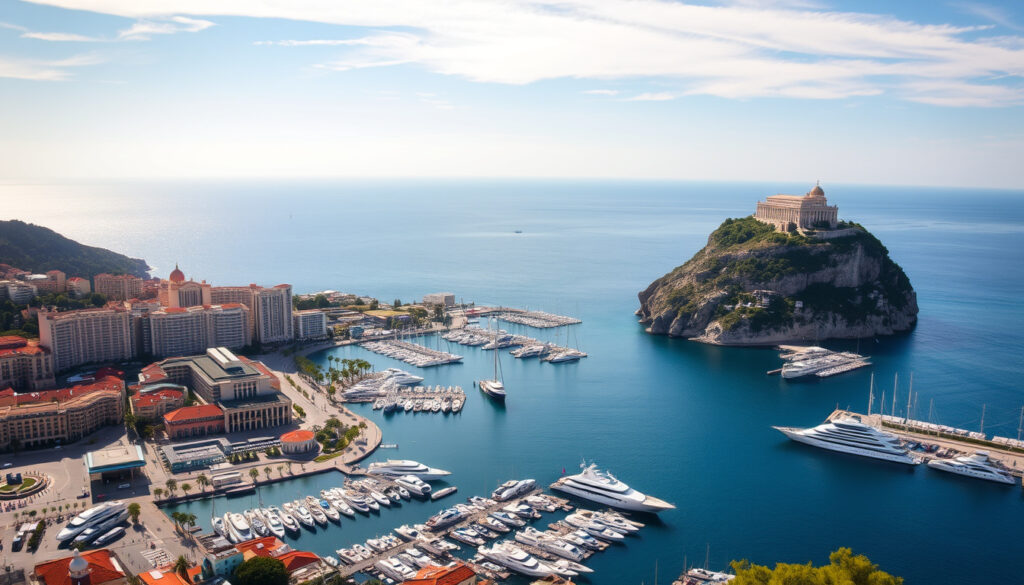
It’s both. Monaco is a city-state: a sovereign country that consists of a single urban municipality. There is no countryside, no hinterland, and no second city.
Defining a city-state
A city-state is an independent state whose territory consists of a single city and its immediate surroundings.
Historical examples include Singapore, Vatican City, and the ancient Greek city-states.
Monaco’s entire territory is 2.02 square kilometres, making it the second-smallest independent state after Vatican City.
The paradox
Monaco is a city-state, but most of its workforce — over 60% — commutes from France or Italy each day, making it a national economy powered by non-nationals.
What this means: Monaco functions as a single urban unit with no suburban sprawl. Every policy — from housing to transport to taxes — applies across the entire country at once.
Monaco’s administrative divisions
The principality is divided into 10 wards, including Monte Carlo, La Condamine, and Fontvieille.
These wards are not separate municipalities with their own governments. Monaco has a single municipal administration.
The entire country is essentially one high-density urban zone built on a rocky promontory.
TL;DR: Monaco is a country. It’s also a city. That’s what a city-state means. For travellers, think of it as one dense, very rich urban zone.
The implication: Monaco functions as a single urban unit with no suburban sprawl.
Why is Monaco so wealthy?
The answer goes deeper than the glitz of the Monte Carlo Casino. Monaco’s wealth is a structural outcome of a tax system designed in the 19th century and maintained with astonishing consistency.
Monaco’s tax regime
Monaco abolished personal income tax for residents in 1869 — a decision intended to attract wealthy foreigners.
The policy has been in place continuously for over 150 years, surviving two world wars and multiple European tax harmonisation efforts.
French nationals are the only exception: under a 1963 bilateral agreement, French citizens living in Monaco must pay income tax to France.
The implication: Monaco’s tax advantage is not a recent loophole. It’s a century-old sovereign policy that predates most modern tax systems.
Role of the Monte Carlo Casino
The Monte Carlo Casino opened in 1863 and quickly became the economic engine that funded the state.
By 2019, the casino contributed about 4% of state revenue — a far cry from its 19th-century dominance, but still a significant cultural and tourism anchor.
Monaco’s economy is now dominated by finance, real estate, and tourism, with over 40 private banks operating in the principality.
The catch
The casino’s 4% revenue share is often misrepresented as Monaco’s main income source. In reality, the principality’s wealth comes from a diversified service economy, including banking, insurance, and high-end real estate.
Banking and finance sector
Monaco’s banking sector holds over €100 billion in client assets, according to industry estimates.
The sector benefits from strict banking secrecy laws, though these have weakened under international pressure since the 2009 FATF grey-listing.
Monaco signed a tax information exchange agreement with the European Union in 2014, improving transparency.
Bottom line:Why this matters: Monaco’s wealth is real and structural, not just casino luck. The principality has built a financial ecosystem that attracts and retains the world’s wealthy.
Is Monaco 100% tax free?
No. This is one of the biggest misconceptions about Monaco. While personal income tax is zero for most residents, other taxes apply.
Personal income tax exemption
Residents pay no personal income tax, capital gains tax, or wealth tax.
The only exception is French nationals, who must pay income tax to France under the Franco-Monégasque Convention of 1963.
Non-French residents enjoy full tax exemption on earned and unearned income.
VAT and corporate taxes
Monaco applies a 20% VAT (TVA) on most goods and services, aligned with French rates.
Corporate tax of 25% applies to profits from certain activities, and companies deriving at least 25% of their revenue from outside Monaco face the corporate tax.
Businesses earning primarily outside Monaco are effectively taxed as French companies would be.
The trade-off
Zero personal income tax is real for most residents. But the corporate tax regime and VAT mean Monaco is not a tax-free zone — it’s a jurisdiction with a selective, strategic tax policy.
What this means for a potential resident: If you are a non-French individual earning income from outside Monaco, you will pay zero personal income tax. If you run a business that operates inside Monaco, you will face corporate tax and VAT.
Do you have to have $500,000 to live in Monaco?
The short answer: no, not as a legal requirement — but yes, in practice. The official documents do not specify a fixed amount. The unofficial market standard is a bank deposit of at least €500,000.
The permit can be issued with no minimum prior residency period — you can apply immediately.
EEA nationals do not need a visa before applying. Non-EEA nationals must first obtain a long-stay visa for Monaco issued by French authorities (Monaco Mission to the UN – Settling in Monaco).
Proof of financial means
Applicants must demonstrate sufficient financial resources to support themselves without working in Monaco.
Common methods: a bank deposit of at least €500,000 in a Monaco bank, or proof of employment with a Monaco-based company, or creating a company that employs at least ten local workers.
You also need to prove accommodation — renting for at least one year or owning property in Monaco (Monaco Citizenship advisory).
The pattern is clear: Monaco does not officially publish a fixed number, but the practical threshold is consistently reported at €500,000. That is the barrier to entry.
Upsides
Zero personal income tax for most residents
Low crime rate and high security
Stable constitutional monarchy with strong rule of law
Direct access to Mediterranean lifestyle and French Riviera
Downsides
Extremely high cost of living (average rent >€7,000/month)
No citizenship-by-investment program; residency does not lead automatically to citizenship
Over 60% of workforce commutes — social isolation risk
Corruption concerns in sovereign wealth funds and judiciary
Steps to get residency in Monaco
Five steps, one pattern: the process is slower than you’d expect for such a small country, but the law is clear for qualified applicants.
Secure accommodation: Rent a property in Monaco for at least one year or purchase real estate. Many agents will not show properties without proof of funds first.
Open a Monaco bank account: Most applicants deposit at least €500,000. The bank will issue a letter confirming the deposit.
Apply for a residence permit: Submit your application at the Monaco Service Public, including proof of accommodation, bank statement, criminal record check, and a valid passport.
Obtain a long-stay visa (non-EEA only): Apply to French authorities for a long-stay visa valid for Monaco before you move.
Wait for approval: The process can take 3–6 months. Once approved, you receive a carte de séjour valid for one year, renewable.
TL;DR: Monaco’s residency is straightforward on paper but expensive in practice. For the wealthy, it’s one of the easiest high-end residency paths in Europe. For everyone else, the cost barrier is prohibitive.
What is the biggest problem in Monaco?
For all its wealth, Monaco has real structural problems that rarely appear in tourist brochures.
Corruption allegations
Monaco has faced repeated criticism over its sovereign wealth fund transparency and judicial independence.
In 2009, the Financial Action Task Force (FATF) placed Monaco on its grey list for insufficient anti-money laundering controls.
While it has since improved its compliance, concerns about the intersection of wealth, politics, and justice persist.
Lack of affordable housing
Average monthly rent in Monaco exceeds €7,000, making it one of the most expensive housing markets globally.
There is virtually no affordable housing stock for middle-income workers.
This forces over 60% of the workforce — roughly 50,000 people — to commute daily from France or Italy.
Dependence on foreign workforce
Monaco’s economy depends entirely on cross-border commuters. If border restrictions ever tighten, the principality would face an immediate labour crisis.
The commuting corridor creates traffic congestion and a cultural disconnect between wealthy residents and service workers.
Monaco has no natural population growth from births — its population growth comes entirely from immigration.
The pattern: Monaco’s greatest strength — its ability to attract and retain wealthy residents — is also the root of its most persistent problems: housing unaffordability, labour dependency, and governance concerns.
Is Monaco the richest country in the world?
By GDP per capita, yes. But the number tells only part of the story.
GDP per capita comparisons
The following table compares Monaco’s GDP per capita with other wealthy states.
GDP per capita (PPP) comparison
Country
GDP per capita (PPP)
Rank
Monaco
$171,000
1st
Luxembourg
$125,000
2nd
Singapore
$100,000
3rd
These figures measure economic output per person, not personal wealth distribution.
Why this matters
A GDP per capita of $171,000 is not a reflection of average Monégasque earnings. It reflects an extreme concentration of high-net-worth residents in a tiny population base. The median resident income is far lower.
Wealth distribution
Monaco’s wealth is highly concentrated among a small number of ultra-high-net-worth individuals.
The principality has no official poverty statistics, but social workers estimate that a significant minority of Monégasque nationals live on modest incomes by local standards.
Monaco’s social welfare system — including free healthcare and education — is generous, but private wealth dominates public life.
The implication: Monaco is the world’s richest country on paper. But that title belongs to its structure, not its people. For the small number of residents who are billionaires, Monaco offers unmatched tax advantages. For the majority, it offers high wages but higher living costs.
Timeline: Key dates in Monaco’s sovereignty
Key dates in Monaco’s history.
Date
Event
1215
Genoese colony founded on the Monaco rock
1297
Grimaldi family takes control of Monaco
1861
Monaco becomes a sovereign principality under French protection
1863
Monte Carlo Casino opens
1869
Personal income tax abolished
1918
Treaty of Versailles formalizes French protection of Monaco
1993
Monaco joins the United Nations
2005
Prince Rainier III dies; Prince Albert II succeeds
2009
FATF places Monaco on its grey list for tax transparency
2023
Princess Charlene Foundation focuses on anti-doping and sports integrity
What this timeline shows: Monaco’s sovereignty was built gradually over centuries, with the critical steps being the 1861 treaty and 1993 UN membership. The 2009 grey-listing was a significant reputational shock that forced the principality to modernise its financial oversight.
Confirmed facts
Monaco is a sovereign UN member state
Monaco has the highest GDP per capita in the world
Monaco has no personal income tax for most residents
What’s unclear
The exact minimum financial threshold for residency is informal; no fixed legal amount is published in official documents
The full extent of corporate tax avoidance via Monaco is debated among economists
Standard residency requires a €500,000 bank deposit in practice, but this is not a fixed legal requirement
Quotes from key voices
“The Principality of Monaco continues to exercise its full sovereignty and independence under the constitution. Our relations with France are based on mutual respect and the treaties that have governed our relationship for over a century.”
— Prince Albert II, in a 2018 interview on Monaco’s international standing
“Monaco’s admission to the United Nations in 1993 was a recognition of its status as a sovereign state under international law. It marked the formal end of any ambiguity about Monaco’s place in the international community.”
— United Nations spokesperson, commenting on Monaco’s 1993 admission
“The residence permit process is designed to ensure that those who live in Monaco contribute to the community and respect the law. The financial requirement is not a fixed amount in law, but in practice, applicants must demonstrate they can afford the lifestyle here.”
— Monaco government official, from the Residency Department description of financial requirements
Monaco is a sovereign country, a city-state, and the world’s wealthiest jurisdiction per capita. Its tax-free status is real but not absolute, its residency path is clear but expensive, and its economic success comes with structural trade-offs in housing, governance, and labour. For those considering it as a home, the decision is a financial calculation as much as a lifestyle choice. For the wealthy individual seeking zero personal income tax, the appeal is obvious. For the middle-income worker dreaming of the Riviera, the reality is more complex. The answer to “is Monaco a country” is a clear yes. The answer to “can I live there?” depends on your bank account.
Yes. Monaco is a fully sovereign, independent constitutional monarchy recognized by the United Nations since 1993.
Does Monaco have its own military?
Monaco has a small ceremonial guard (the Compagnie des Carabiniers du Prince) but its defense is the responsibility of France under a 1918 treaty.
What language is spoken in Monaco?
French is the official language. Monégasque (a Ligurian dialect), Italian, and English are also widely spoken.
Is Monaco part of the European Union?
No. Monaco is not an EU member state, but it uses the euro and is part of the EU customs union through its treaties with France.
How does Monaco make money without taxes?
Monaco generates revenue from VAT (20%), corporate taxes (25% on certain profits), tourism, banking, and the Monte Carlo Casino (about 4% of state revenue).
Can ordinary people visit Monaco?
Yes. Monaco is a popular tourist destination. Visitors do not need a special visa; standard Schengen visa rules apply.
Is Monaco safe?
Monaco has one of the lowest crime rates in the world, with a heavy police presence per capita.