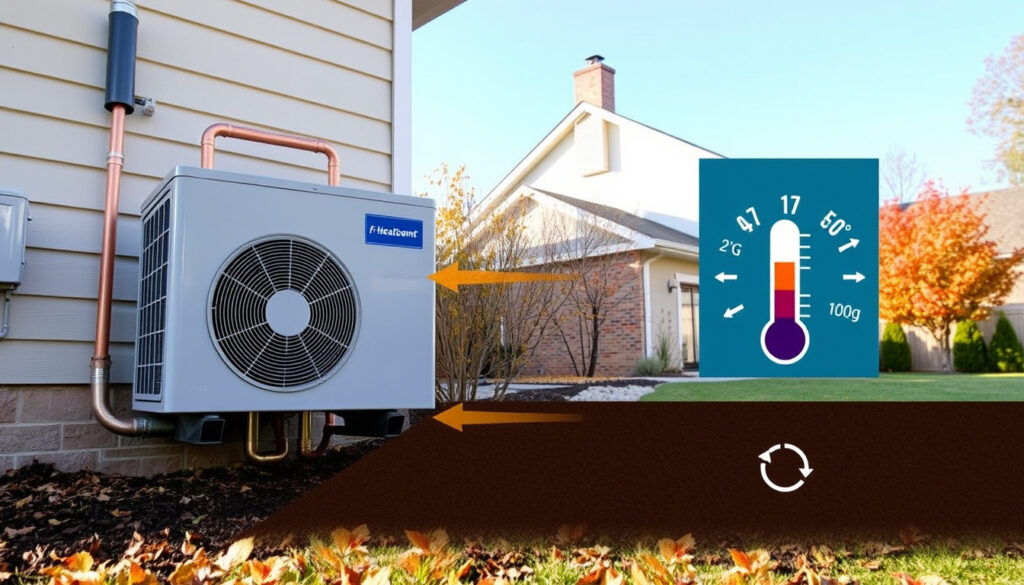
What Is a Heat Pump? How It Works, Efficiency, Pros & Cons
If you’ve ever stood next to an outdoor AC unit on a hot day and felt warm air blowing out, you’ve already seen half of what a heat pump does. The clever part is that the same machine can run in reverse to heat your house in winter. Heat pumps move heat rather than create it, and properly installed units can deliver two to four times more heat energy than the electricity they consume, according to the U.S. Department of Energy (via the California Public Utilities Commission).
Coefficient of Performance (COP): 2.5–4.0 · Annual energy savings vs. electric resistance: 30–50% · Average lifespan: 10–15 years · Upfront cost range (installed): $3,000–$7,500 before incentives · Minimum operating temperature (modern units): -13°F (-25°C)
Quick snapshot
- Air-source heat pumps deliver roughly two to four times more heat energy than the electricity they consume (U.S. Department of Energy (via California Public Utilities Commission)) (Warwick District Council (U.K. local authority))
- A coefficient of performance of 3 means 1 kW of electricity produces more than 3 kW of heat (Warwick District Council (U.K. local authority))
- Eligible heat pumps bought from 2023 through 2032 qualify for a U.S. federal tax credit of up to $2,000 (per ENERGY STAR) (Warwick District Council (U.K. local authority))
- Exact payback depends on regional climate, electricity rates, and installation quality — national averages hide wide local variation (EnergySage (U.S. clean-energy marketplace))
- ENERGY STAR certification now includes low-temperature performance testing down to 5°F (per ENERGY STAR) (EDF Energy (U.K. energy supplier))
- In England and Wales, the Boiler Upgrade Scheme offers up to £7,500 toward an air-source heat pump installation (EDF Energy (U.K. energy supplier))
- One heat pump can replace both a furnace and an air conditioner in most homes (per ENERGY STAR) (Butler Eagle (Pennsylvania regional newspaper))
- Air-source models need far less site work than ground-source systems, which require buried collector loops (Butler Eagle (Pennsylvania regional newspaper))
Six numbers anchor everything else in this article, from efficiency to operating limits:
| Attribute | Value |
|---|---|
| Heat source | Outside air (air-source) or ground (geothermal) |
| Typical COP | 2.5–4.0 (250–400% efficiency) |
| Heating output at 0°F | ~70–90% of rated capacity for modern inverter units |
| Backup heat required | Often needed when outdoor temperature drops below 20°F |
| Noise level (outdoor unit) | 50–60 dB, about the level of a refrigerator |
| U.S. federal tax credit | Up to $2,000 for eligible units purchased 2023–2032 |
What does a heat pump do and how does it work?
A heat pump doesn’t create heat — it steals it. Using a compressor and a refrigerant loop, it grabs low-temperature heat from outside air, concentrates it, and releases it inside the house. The physics is the same one your refrigerator uses, but run in a different direction: on a 30°F day, the pump still finds enough heat in that cold outdoor air to hold your thermostat at 70°F.
- Evaporation — cold liquid refrigerant absorbs heat from the outdoor air.
- Compression — the compressor squeezes the refrigerant, raising its temperature.
- Condensation — the hot refrigerant releases heat inside the home.
- Expansion — pressure drops, the refrigerant cools, and the cycle repeats.
ENERGY STAR (U.S. government efficiency program) describes the technology in one sentence: a heat pump transfers heat between outdoor air and a building rather than generating heat through combustion. Flip a reversing valve, and the same system pulls heat out of your house in summer and dumps it outside — which is why a heat pump is effectively a furnace and an air conditioner in one box.
What is an air source heat pump?
- Heat source: outdoor air, which still contains usable heat below freezing
- Configurations: split-system with an outdoor unit and indoor air handler, or ductless mini-splits
- Dual duty: heating in winter, cooling in summer, from the same outdoor unit
An air source heat pump is the most common type of residential heat pump on both sides of the Atlantic. Its outdoor coil and fan harvest heat from the surrounding air — the same coil an air conditioner uses to reject heat, working in reverse. Because the air itself is the heat source, no underground pipes are required, which is why air-source systems dominate retrofits.
How does air source heat pump work in winter?
Even at 0°F, outdoor air contains enough heat to warm a house. The colder it gets, the harder the pump must work to extract it.
Cold air still holds heat — that’s a physics fact, not a marketing claim. At 0°F, air molecules are moving slowly, but they are still moving, and a heat pump can absorb that energy. The challenge is that capacity drops as outdoor temperature falls, and the outdoor coil periodically frosts over. The unit handles frost by briefly reversing its cycle to defrost the coil, which dips heating output for a few minutes before normal operation resumes. Engineers have pushed low-temperature performance much further than the older generation of heat pumps. ENERGY STAR certification now includes third-party verification of low-temperature performance, and the program is explicit that real-world efficiency depends on outdoor temperature, flow temperature, equipment design, controls, defrost cycles, and installation quality (ENERGY STAR (U.S. government efficiency program)). That last factor — installation quality — is the one most owners underestimate.
The implication: a heat pump is a two-for-one appliance that can replace both a furnace and an air conditioner — but its performance hinges on being matched to the climate and the building. That’s where the efficiency conversation starts.
The pattern: this two-in-one capability is the fundamental reason homeowners consider a heat pump when replacing separate systems.
How efficient are air-to-air heat pumps in terms of energy efficiency?
Heat pump efficiency gets quoted two ways. COP, or coefficient of performance, measures heat output divided by electricity input under a specific operating condition; HSPF, the seasonal rating used in North America, averages performance across the whole heating season. The COP number is the one that makes people pause — Warwick District Council (U.K. local authority) explains it plainly: a COP of 3 means 1 kW of electricity can produce more than 3 kW of heat under the relevant operating conditions.
That is not a magic trick; 2 to 3 kW of that heat is being moved, not manufactured. ENERGY STAR says a certified air-source heat pump can deliver up to three times more heat energy than the electrical energy it consumes (ENERGY STAR (U.S. government efficiency program)). A U.K. comparison from EDF Energy (U.K. energy supplier) puts air-source heat pump efficiency at roughly 300–400% versus about 93% for a new gas boiler, with indicative annual running costs of £782 for the heat pump and £664 for the boiler in its example home.
What is the 20 degree rule for heat pumps?
When the outdoor temperature falls 20°F or more below the indoor setpoint, most air-source heat pumps cannot keep up on their own — backup heat has to cover the gap.
The 20 degree rule is the guideline HVAC contractors use to set expectations. Take your thermostat setting and subtract the outdoor temperature; once the difference passes about 20°F, the heat pump’s capacity may be too low to hold the setpoint without help. That’s when auxiliary heat — electric resistance strips, or a gas furnace in a hybrid system — takes over. The rule isn’t a cliff; capacity falls gradually, which is why the backup threshold varies with the specific model and its low-temperature ratings.
How does outside temperature affect efficiency?
- Capacity falls as outdoor temperature drops — there is less heat to extract from the air
- COP falls too — the compressor works harder for each unit of heat it delivers
- Defrost cycles cost a few minutes of output whenever the outdoor coil frosts over
- Backup heat below the 20°F threshold can erase the efficiency advantage if it runs for hours
Spec sheets now quote low-temperature performance for a reason. ENERGY STAR’s certification includes testing down to 5°F, and many cold-climate models are rated to produce useful heat at -13°F. The practical pattern for modern inverter units: at 0°F, heating output sits around 70–90% of rated capacity. The house still warms up; the unit just runs longer.
Efficiency specs, one pattern: the milder the outdoor temperature, the more decisively a heat pump outperforms combustion heating.
| Metric | Typical value | What it means |
|---|---|---|
| COP (coefficient of performance) | 2.5–4.0 | Each 1 kW of electricity moves 2.5–4.0 kW of heat |
| HSPF (seasonal heating rating) | Seasonal efficiency score | Averages heat output across a full heating season |
| Heat output vs. electricity consumed | 2–4× | U.S. DOE estimate for properly installed air-source units |
| ENERGY STAR certified output | Up to 3× | Verified heat output versus electricity consumed |
| Heat pump vs. new gas boiler | ~300–400% vs. ~93% | EDF Energy’s U.K. comparison of annual efficiency |
| Cold-weather certification | Down to 5°F | ENERGY STAR’s low-temperature test point |
| Backup-heat trigger | ~20°F difference | Common rule of thumb: outdoor temp 20°F below setpoint |
Why this matters: the efficiency advantage is real but conditional on outdoor temperature, system sizing, and installation quality. Backup heat quietly erases the gains whenever it runs — so cold-climate buyers should size the heat pump for the design temperature, not for the typical January afternoon.
The pattern: the efficiency advantage hinges on temperature conditions, making sizing critical.
Is a heat pump the same as an HVAC?
HVAC is the umbrella term for heating, ventilation, and air conditioning. A heat pump is a type of HVAC equipment — one that handles both the heating and the cooling side of the acronym. The useful question isn’t whether they’re the same; it’s whether a heat pump can replace the separate furnace and air conditioner your house may already treat as “the HVAC system.”
Heat pump vs air conditioner
- An air conditioner can only cool; a heat pump can both heat and cool by reversing its refrigerant flow
- A gas furnace burns fuel to create heat; a heat pump moves heat that already exists outdoors
- The efficiency gap narrows in extreme cold, which is why backup heat exists
Three ways to heat a home, one pattern: only the heat pump doubles as an air conditioner, and only the gas furnace beats it on the very coldest nights.
| Heat pump | Air conditioner | Gas furnace | |
|---|---|---|---|
| Heating | Yes — reverses refrigerant flow | No | Yes — burns natural gas |
| Cooling | Yes | Yes | Only if paired with AC |
| Annual efficiency (heating) | ~300–400% (EDF) | n/a | ~93% (EDF) |
| Energy source | Electricity | Electricity | Natural gas |
| Best fit | Homes with AC plus furnace looking to electrify | Homes with a separate furnace | Very cold climates on a gas line |
The efficiency row is the one that surprises people: a heat pump can be three to four times more efficient than a gas furnace because it is moving heat, not creating it. The gap shrinks as outdoor temperature drops, which is why the furnace stays relevant in cold climates.
Can a heat pump replace an HVAC system?
- Ducted heat pumps replace the AC-plus-furnace pairing in homes with existing ductwork
- Ductless mini-splits cover homes without ducts, room by room
- Hybrid setups keep a backup furnace for the coldest nights
Yes — a heat pump can replace a whole HVAC system. Homes with ducts get a central unit with an indoor coil that uses the existing furnace blower; homes without ducts get mini-splits. Air-source systems avoid underground collector loops entirely, which keeps the job simpler than a ground-source installation and generally lowers the upfront cost, according to the Butler Eagle (Pennsylvania regional newspaper). The trade-off, it adds, is that ground-source systems may deliver lower operating costs over time (Butler Eagle (Pennsylvania regional newspaper)).
The trade-off: a heat pump can absolutely replace an HVAC system — but in climates with sustained subzero stretches, “replace” often means “pair with backup heat.” That’s a system design decision, not a technology failure.
The pattern: a heat pump replaces both furnace and AC for most homes, but climate determines backup needs.
What is the downside of having a heat pump?
The honest case against heat pumps has three parts: upfront cost, cold-weather capacity, and comfort feel. Each is manageable, but all three need to be on the table before you sign a quote.
Cost is the first thing buyers cite. Among U.S. installations tracked by EnergySage (U.S. clean-energy marketplace), the average ducted heat pump came in at $14,529 before incentives, ductless systems averaged $25,957, and hybrid setups averaged $14,353 — and EnergySage’s own comparison flags the higher upfront cost as the most common disadvantage buyers raise against the technology. In the U.K., EDF Energy (U.K. energy supplier) lists installed air-source costs of £4,100 to £10,000 before grants.
Why is my house so cold with a heat pump?
- Undersized unit — the heat pump can’t keep up when the local design temperature hits
- Defrost cycle — output pauses while the coil de-ices on cold, damp days
- Poor installation — wrong refrigerant charge or leaky ducts degrade performance
- Missing backup heat — the system is running alone when it should have help
If a heat pump runs constantly but the house stays cold, check three things first: the size of the unit, the refrigerant charge, and the temperature of the air coming out of the vents.
The most common complaint — “my house is cold” — usually traces back to sizing and installation, not to the technology itself. ENERGY STAR lists installation quality among the factors that determine real-world performance, and contractors who skip a room-by-room load calculation are guessing with your comfort. A heat pump also delivers cooler supply air than a furnace — it warms the room for longer rather than blasting hot air — which owners often describe as “drafty” even when the thermostat is holding.
Is it okay for a heat pump to run all night in winter?
A heat pump that runs all night in cold weather is usually working correctly. A heat pump that short-cycles every few minutes is the one to worry about.
Heat pumps are built for long, steady run times. Running all night is more efficient than restarting repeatedly, because the compressor avoids startup surges and the house holds a steadier temperature. Short cycling — rapid on/off bursts — points to an oversized unit, a refrigerant problem, or a thermostat issue, and it costs both comfort and efficiency.
How many hours a day should a heat pump run in winter?
- No fixed number — run time follows outdoor temperature and how well the house holds heat
- Close to continuous in a cold snap is normal operation, not a fault
- Frequent short bursts are the abnormal pattern to investigate
The honest answer: as many as it needs. In mild winter weather, a heat pump cycles on and off with the thermostat. In a serious cold snap, it runs almost continuously, producing a low, steady output at exactly the rate the house loses heat. The problem pattern to recognize is short cycling — a few minutes on, a few minutes off — which wastes electricity and wears out the compressor.
Will my house be as warm with a heat pump?
A correctly sized heat pump holds the same thermostat setpoint as a furnace. The delivery is different: cooler air, moving longer, instead of a hot blast.
Yes — if the system is sized and installed properly. The feel is different: a gas furnace delivers a short blast of very hot air, while a heat pump delivers a longer stream of cooler air. The room reaches the same temperature, but it takes longer to recover after you lower the thermostat overnight, so many installers advise keeping the temperature steady rather than using deep setbacks.
Upsides
- One system heats and cools — no separate furnace and AC to buy or maintain
- 2–4× more heat energy per unit of electricity than resistance heating (U.S. DOE)
- No combustion on site — no gas line, no flue, no carbon monoxide risk from the unit
- Lower running costs than electric resistance, and competitive with gas in many regions (EDF)
- Air-source installation is simpler and cheaper than ground-source, with no excavation (Butler Eagle)
Downsides
- Higher upfront cost than replacing a boiler or AC-only system (EnergySage)
- Output and efficiency drop in extreme cold; backup heat needed below the 20°F threshold
- Cooler supply air can feel draftier than furnace heat
- Defrost cycles interrupt heating for minutes at a time in cold, damp weather
- Operating cost depends heavily on local electricity vs. gas prices — the U.K. example: £782 vs. £664 a year (EDF)
The catch: the disadvantages of heat pumps are mostly sizing and expectation problems, not physics problems. Get the load calculation right, and the downside list shrinks to one real issue — the upfront check.
The pattern: proper sizing eliminates most downsides, leaving upfront cost as the primary barrier.
What is the average lifespan of a home heat pump?
The typical residential heat pump lasts 10–15 years — roughly the same as a modern gas furnace. With regular maintenance, that extends toward 20 years. The variance comes from run hours, local climate, refrigerant integrity, and how consistently the filters and coils are cleaned.
How long does it take to replace a heat pump?
- Matched system replacement: 4–8 hours of labor
- With ductwork or electrical modifications: 1–2 days
- Allow extra time for the load calculation before any quote
Replacement is usually a same-day job. A matched outdoor unit and indoor coil swap takes 4 to 8 hours including wiring, refrigerant charging, and testing. If the ductwork has to be modified, the indoor unit is in a tight attic, or the electrical panel needs upgrading, plan on one to two days. The biggest scheduling variable is actually the load calculation — a competent installer measures the house room by room before quoting equipment, and that prep work is not something to skip.
What a typical replacement involves:
- Load calculation and equipment selection for the local climate
- Removal and proper disposal of the old unit and refrigerant
- Installation of the new outdoor and indoor units
- Refrigerant charge, airflow test, thermostat setup
- Final inspection of temperature split and duct leaks
What this means: past 12 years, the decision is less “repair and wait” than “replace on your own schedule, before a February failure forces the choice.” Age, repeated repairs, and climbing energy bills are the three signals that the replacement clock has started.
Confirmed facts vs. what’s still uncertain
After weighing the evidence, here’s what the research supports and what it doesn’t yet.
Confirmed facts
- Heat pumps transfer heat using a refrigeration cycle rather than generating it by combustion (ENERGY STAR)
- Certified air-source units deliver up to 3× the heat energy they consume (ENERGY STAR)
- Average lifespan is 10–15 years, extendable with maintenance (ENERGY STAR)
- Real-world efficiency depends on temperature, equipment design, controls, and installation quality (ENERGY STAR)
What’s unclear
- Exact payback varies with regional climate, electricity rates, and installation quality (EnergySage (U.S. clean-energy marketplace))
- Cold-weather performance varies by manufacturer and model — the category keeps improving quickly
- Long-term reliability of systems using the newer R-32 refrigerant is still being proven in the field
- Most units installed today will be due for replacement in 10–15 years
- Hybrid systems pair a heat pump with a backup gas furnace for the coldest nights
What this means: the open questions are mostly about local numbers, not the core technology. A heat pump will perform predictably once you know your climate, your electricity price, and the installer’s reputation.
Expert perspectives
“An inverter heat pump doesn’t blast heat the way a furnace does. It runs longer, at a steadier output, matching the heat loss of the home — that’s how it holds a comfortable temperature even in a cold spell.”
— Bosch home comfort team (inverter heat pump manufacturer)
“Most heat-pump complaints trace back to sizing. Too big, and the unit short-cycles. Too small, and it never catches up. The load calculation is the most important part of the quote.”
— This Old House (home improvement program, sizing and installation guidance)
“A heat pump running all day in winter is usually a sign it’s matched to the house and working as intended. It’s the machine that turns on and off every few minutes that deserves a service call.”
— British Gas (U.K. energy supplier, winter running guidance)
The pattern: all three expert perspectives point at the same variable — the installer’s load calculation determines whether the technology shines or stumbles.
The practical answer
Heat pumps are not a magic box. Their efficiency is real, but conditional on climate, sizing, electricity prices, and installation quality — and the payoff depends on which incentives are available in your region. The U.S. federal credit of up to $2,000 and the U.K.’s £7,500 Boiler Upgrade Scheme both shorten the payback math, and that math favors electrification in almost every case where a heat pump is replacing an aging furnace or air conditioner anyway. For a homeowner in a cold-climate state, the choice is clear: invest in a properly sized, cold-climate heat pump with a room-by-room load calculation — or keep paying the backup-heat penalty on a system that was never matched to the house.
Frequently asked questions
How much does a heat pump cost installed?
U.S. averages from EnergySage put a ducted installation at $14,529 before incentives, with ductless systems averaging $25,957 and hybrid setups $14,353. In the U.K., EDF Energy lists typical installed costs of £4,100 to £10,000 before grants. The U.S. federal credit of up to $2,000 and the U.K.’s £7,500 Boiler Upgrade Scheme both reduce the net figure.
Do heat pumps work in very cold climates?
Yes. Modern cold-climate units are rated to produce heat at -13°F or lower, and ENERGY STAR’s certification verifies low-temperature performance down to 5°F. Most systems also include backup heat for the rare stretch that exceeds the unit’s design point.
Can a heat pump heat a whole house?
Yes, with the right configuration. Ducted heat pumps connect to existing ductwork and heat the whole house; ductless mini-splits heat individual rooms or zones. Sizing to the home’s heat loss is what determines whether a whole-house system actually keeps up.
What maintenance does a heat pump need?
The basics are seasonal: clean or replace filters, keep the outdoor unit clear of debris and snow, and check that indoor airflow isn’t blocked. An annual professional check of refrigerant charge and electrical connections is the industry-recommended minimum.
How does a heat pump compare to a gas furnace?
In EDF Energy’s U.K. comparison, a heat pump runs at roughly 300–400% efficiency versus about 93% for a new gas boiler, with indicative annual running costs of £782 versus £664. The heat pump wins on efficiency; the boiler wins on very cold nights, which is why hybrid configurations pair the two.
Are heat pumps worth the investment?
Usually yes, when incentives and climate are factored in. The U.S. federal credit of up to $2,000 through 2032, state and utility rebates, and the U.K.’s £7,500 Boiler Upgrade Scheme lower the entry price, and the 2–4× efficiency advantage over electric resistance heat lowers the monthly bill. The remaining variable is local electricity prices relative to gas.
Can I use a heat pump with existing ductwork?
Yes. Ducted heat pumps are designed to connect to existing ducts, reusing the furnace blower or replacing it with a matched air handler. The ducts need to be sealed and sized for airflow; a leaky duct system will undermine the efficiency benefits.
More related posts
 Cast of How to Train Your Dragon 4: Rumors vs Facts
 Guinness Open Gate Brewery: Full Guide to 4 Locations
 Right Price Tiles Navan: Location, Hours, Reviews & Costs
 Can Dogs Eat Peppers? Safety, Risks & Serving Guide
 Back Home in Derry Lyrics: Meaning, Writer, and History
 Huddersfield Town vs Man City Lineups: Starting XI, Team News & History
 Nenagh to Limerick Bus: Timetable, Fares & Operators
 Capital of New Zealand: Why Wellington Won the Seat
