Leonardo da Vinci Paintings: Guide to Works, Locations & Value
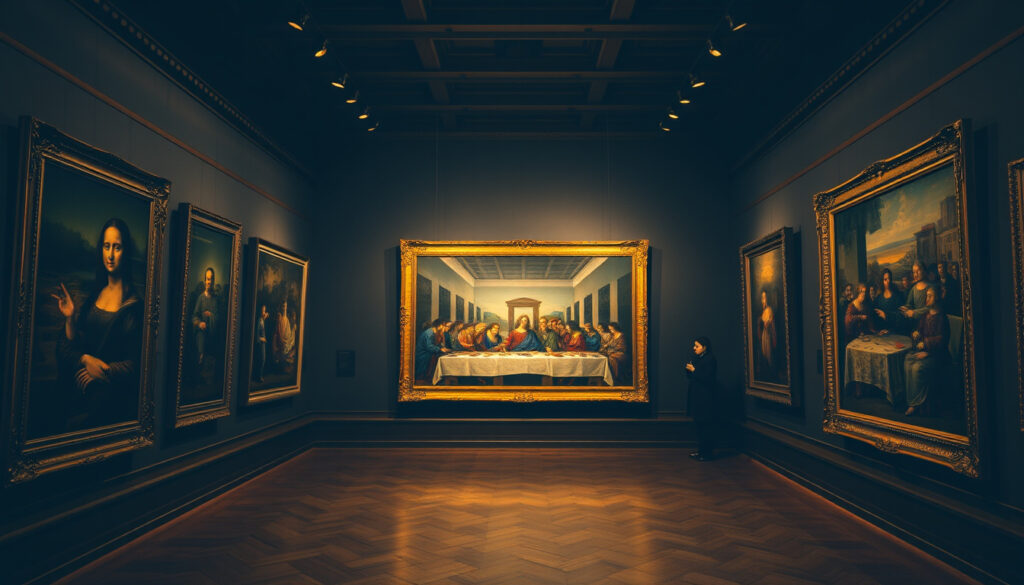
Five hundred years after his death, a Leonardo da Vinci painting still stops crowds cold — one glance at the Mona Lisa explains why. The catch: fewer than twenty finished paintings survive, scattered across museums from Paris and Milan to Kraków and Edinburgh, and that scarcity makes every single one an event. Knowing which panels are authentic, where they hang, and why the Louvre ended up with five of them changes how you do a museum visit.
Number of Authenticated Paintings: 14 (widely accepted) ·
Most Expensive Sale: Salvator Mundi – $450.3 million (2017) ·
Museum with Most Paintings: Louvre Museum, Paris (5 paintings) ·
Year of the Mona Lisa: 1503–1519
Quick snapshot
- The Louvre holds five Leonardo paintings (En-vols (French travel-culture outlet)).
- The Last Supper is a mural at Santa Maria delle Grazie in Milan, dated c. 1495–1498 (The Collector (art-history platform)).
- Lady with an Ermine hangs in the National Museum in Kraków (The Art Newspaper (international art press)).
- The exact number of authentic paintings: estimates range from 14 to 20.
- Attribution of the Munich and St Petersburg Madonnas is qualified, not settled.
- Restoration and ownership questions continue to shadow Salvator Mundi.
- c. 1483–1486: the Louvre’s Virgin of the Rocks (En-vols).
- c. 1495–1498: The Last Supper in Milan (The Collector).
- 1503–1519: work on the Mona Lisa, likely finished around 1517 (En-vols).
- Attribution debates keep shifting as institutions re-examine their holdings.
- A 2025 guide in The Art Newspaper maps how to see every Leonardo painting across Europe.
Six facts define Leonardo’s biography, and the pattern is one of extremes: a long life, a short list of finished works, and one painting that alone re-set the auction record.
| Full Name | Leonardo di ser Piero da Vinci |
|---|---|
| Born | April 15, 1452, Vinci, Italy |
| Died | May 2, 1519, Amboise, France |
| Number of Known Paintings | 14–20 (scholarly debate) |
| Most Famous Work | Mona Lisa (Louvre) |
| Highest Auction Price | $450.3 million (Salvator Mundi, 2017) |
The takeaway from those six rows: no repeat sales, no ready supply. The same facts that explain the myth also explain the market.
Which paintings did Leonardo da Vinci paint?
Start with the arithmetic, because the arithmetic is the story. Leonardo completed fewer than twenty paintings in a career that lasted half a century, and even that count is generous — scholars usually settle on roughly fourteen universally accepted works.
- One mural: The Last Supper, painted on a refectory wall in Milan.
- One portrait that outgrew its frame: the Mona Lisa.
- A dozen-plus panels, several unfinished or co-authored with his workshop.
The core list is short and well documented. The Last Supper was painted around 1495–1498 at Santa Maria delle Grazie in Milan (The Collector), and it anchors every conversation about his mature style. Around the same stretch of years he produced the Louvre’s Virgin of the Rocks, generally dated to c. 1483–1486, while the National Gallery in London holds a second version dated roughly a decade later, c. 1491–1508 (En-vols, French travel-culture outlet).
His Florentine years give us the Annunciation (c. 1472–1475), the unfinished Adoration of the Magi (c. 1482), and the Baptism of Christ, a collaboration with his master Verrocchio from about 1470–1478 (The Collector, art-history platform). Later works stretch across Europe: Lady with an Ermine in the National Museum in Kraków (The Art Newspaper) , the Portrait of a Musician in Milan’s Pinacoteca Ambrosiana, and the atmospheric La Scapigliata in Parma, dated c. 1492–1501 (The Collector, art-history platform).
List of authentic paintings
- The universally accepted core list runs to about 14 works.
- Several further panels are described only as “attributed” or “associated” with Leonardo.
Twelve works carry the bulk of the story; grouped by location, the pattern is a small corpus spread across eight countries.
| Painting | Location | Approximate date | Attribution |
|---|---|---|---|
| Mona Lisa | Louvre, Paris | 1503–1519 | Universally accepted |
| Virgin of the Rocks (Paris version) | Louvre, Paris | c. 1483–1486 | Generally accepted |
| Virgin of the Rocks (London version) | National Gallery, London | c. 1491–1508 | Generally accepted |
| The Last Supper | Santa Maria delle Grazie, Milan | c. 1495–1498 | Accepted mural |
| Baptism of Christ | Uffizi, Florence | c. 1470–1478 | Collaboration with Verrocchio |
| Annunciation | Uffizi, Florence | c. 1472–1475 | Early accepted work |
| Adoration of the Magi | Uffizi, Florence | c. 1482 | Unfinished |
| Lady with an Ermine | National Museum, Kraków | — | Accepted |
| Portrait of a Musician | Pinacoteca Ambrosiana, Milan | — | Attributed |
| La Scapigliata | Galleria Nazionale, Parma | c. 1492–1501 | Attributed |
| Madonna and Child | Alte Pinakothek, Munich | c. 1490 | Attributed to Leonardo |
| Madonna and Child | Hermitage, St Petersburg | — | Associated with Leonardo |
Paintings with disputed attribution
- The Munich Madonna and Child is shown with attribution caveats.
- The Hermitage Madonna and Child is only “associated” with Leonardo.
- The Madonna of the Yarnwinder sits on long-term loan in Edinburgh, outside the accepted core.
The Alte Pinakothek’s Madonna and Child, dated c. 1490, is presented as from Leonardo’s orbit with qualifications, and the Hermitage’s version is only “associated” with him (The Art Newspaper, international art press) — museum language that politely says the case is unproven. Two further works complicate the canon: the Madonna of the Yarnwinder, on long-term loan to the National Gallery of Scotland in Edinburgh, and a Salvator Mundi whose restoration and attribution continue to be argued about.
The implication: Leonardo’s canon is not a fixed list; it is a live argument. Museums display what they can defend, and the word “attributed” is doing heavy legal work.
The pattern: a canon this contested only makes each authenticated work more consequential — in galleries, in scholarship, and in the market.
How many Da Vinci paintings are in the Louvre?
Five — and that single number gives the Louvre a dominance no other museum comes close to matching (En-vols).
List of Da Vinci paintings in the Louvre
- Mona Lisa — displayed in the Salle des États since 1966.
- Virgin of the Rocks — the Louvre version, c. 1483–1486.
- Saint John the Baptist — the third of the Louvre’s five.
- Two further works complete the set; neither is as famous as the first three.
The same En-vols survey confirms that the Mona Lisa, the Virgin of the Rocks, and Saint John the Baptist anchor the museum’s Leonardo narrative, with two further works completing the count. No other institution holds more than three works associated with him, which means the Louvre’s Leonardo rooms are not just a collection — they are the collection.
Why the Louvre holds such a large collection
- Leonardo spent his final years in France and died at Amboise in 1519, placing his legacy squarely on French soil.
- French royal collections absorbed several works before the Louvre existed as a public museum.
- Modern French policy treats its Leonardos as untouchable national heritage.
The pattern: the Louvre’s five are not a happy accident. Leonardo’s last patron was the French crown, and his death in Amboise in 1519 left the most valuable artistic estate of the Renaissance in French hands.
Which museum has the most Da Vinci paintings?
Comparison of museums with Da Vinci holdings
- The Louvre’s five outnumber every rival collection.
- Most institutions hold exactly one Leonardo, often with attribution caveats.
Ten institutions, one pattern: the Louvre has five, and every other collection on earth has to make do with one or two.
| Museum | City | Leonardo paintings | Signature works |
|---|---|---|---|
| Louvre | Paris | 5 | Mona Lisa; Virgin of the Rocks; Saint John the Baptist |
| Uffizi | Florence | 3 (incl. 1 Verrocchio collaboration) | Annunciation; Adoration of the Magi; Baptism of Christ |
| National Gallery | London | 1 painting + 1 cartoon | Virgin of the Rocks; Virgin, Child, Saint Anne and Saint John the Baptist (cartoon) |
| National Museum | Kraków | 1 | Lady with an Ermine |
| Pinacoteca Ambrosiana | Milan | 1 | Portrait of a Musician |
| Galleria Nazionale | Parma | 1 | La Scapigliata |
| Alte Pinakothek | Munich | 1 (attributed) | Madonna and Child |
| Hermitage | St Petersburg | 1 (associated) | Madonna and Child |
| National Gallery of Scotland | Edinburgh | 1 (on loan) | Madonna of the Yarnwinder |
| Gallerie dell’Accademia | Venice | 0 paintings (1 drawing) | Vitruvian Man |
Louvre vs. other institutions
Louvre: 5 · London: 1 painting + 1 cartoon · Kraków: 1 · Edinburgh: 1 (on loan) · Venice: 1 drawing
The museum math is stark: five in Paris, then a long tail of singles. The National Gallery in London anchors the non-Paris list because its Virgin of the Rocks is joined by the great Burlington House Cartoon — the surviving preparatory drawing for the Virgin, Child, Saint Anne and Saint John the Baptist, dated c. 1507–1516 (The Art Newspaper, international art press). The same publication tracks the Madonna of the Yarnwinder on long-term loan in Edinburgh.
Paris has five paintings; London, Kraków, and Edinburgh together hold only three. A visitor standing in the Louvre is seeing more Leonardo per square meter than anywhere else on earth.
Why are Leonardo da Vinci paintings expensive?
Scarcity of works
- Fewer than twenty finished paintings from a half-century career.
- Most are fixed in museums and will never be sold.
- Attribution disputes shrink the safe supply even further.
Leonardo’s surviving paintings are distributed across major collections in Italy, France, the UK, the US, Poland, Germany, Russia, and the Vatican, according to ArtAtlas (artist database). That geography matters: the works are so scattered that no single private collection can ever assemble a complete set.
When one does reach the market, the bidding war is global. Salvator Mundi — a painting whose attribution has been argued for years — sold for $450.3 million in 2017, the highest auction price ever paid for a work of art. The Mona Lisa, by contrast, has never been sold and is effectively priceless.
Historical and artistic significance
Leonardo’s fame rests on a tiny output. The Mona Lisa’s smile and the Last Supper’s drama did more for his legend than a hundred paintings could have.
Each work carries the weight of his scientific curiosity and his technique — the smoky sfumato blending, the psychological directness of the portraits. Museums treat these paintings as irreplaceable national treasures, which is exactly why so few of them travel.
Market demand and auction records
$450.3 million: Salvator Mundi (2017) · Never sold: Mona Lisa · 14–20: total surviving supply
That third number is the one that matters. With a supply ceiling of roughly twenty paintings — and most of those locked in public collections — any authenticated Leonardo that reaches auction resets the record. Salvator Mundi proved the ceiling is higher than anyone expected.
For collectors, a Leonardo is the safest impossible asset: supply will never rise, so value will never fall. For visitors, the same scarcity means the time to see them in situ is now — museums have no incentive to lend them.
What are the top 10 paintings to see at the Louvre?
Ten paintings sounds like a lot until you are standing in the Denon wing. A smarter first visit works backwards: locate the icons, then build a route around them.
Must-see masterpieces beyond Da Vinci
- Mona Lisa — Leonardo’s portrait, the Louvre’s gravitational center.
- Virgin of the Rocks — Leonardo’s other signature panel at the Louvre.
- Saint John the Baptist — the third Leonardo on the standard route.
- Winged Victory of Samothrace — the staircase masterpiece.
- Venus de Milo — the gallery’s other world-famous icon.
The honest answer: there is no official top ten. The five above anchor every visitor list; the rest of your top ten will be decided by what you love — Italian primitives, French Romanticism, or the Louvre’s unrivaled antiquities collection.
Da Vinci’s works in context
The two Virgin of the Rocks versions are a masterclass in Leonardo’s development: Paris’s came first (c. 1483–1486), London’s a decade later. Compare them if you can.
Mona Lisa and the Virgin of the Rocks sit in the same museum but belong to different problems. One is a portrait that became a global icon; the other is an altarpiece whose composition Leonardo kept rethinking across two versions.
What to know before visiting the Louvre
- Jeans are fine — the Louvre has no formal dress code; comfortable shoes matter more than labels.
- Large bags and umbrellas are not allowed inside the galleries.
- Toilets are available throughout the museum, including near the Mona Lisa room.
- Paris style that does not scream “tourist”: layers, dark colors, and a crossbody bag.
What are 10 interesting facts about Leonardo da Vinci?
His life and inventions
- He was left-handed and wrote in mirror script, a habit that kept his notebooks cryptic for centuries.
- He qualified as a master artist in 1472, with early collaborative works such as the Baptism of Christ.
- He was a polymath — painter, engineer, anatomist, and stage designer — with notebooks full of inventions never built.
- He dissected human corpses to study anatomy, a practice as controversial then as the results were pioneering.
- The Last Supper is not a canvas; it is a mural painted directly onto the refectory wall of Santa Maria delle Grazie in Milan.
- He spent his final years in France and died at Amboise in 1519.
Art techniques like sfumato
- He developed sfumato, a blending technique that softens outlines until they seem to dissolve in smoke — the Mona Lisa’s face is the textbook example.
- He painted two versions of the Virgin of the Rocks, spaced roughly a decade apart.
- His surviving works are spread across at least eight countries, from Edinburgh to St Petersburg.
- The Mona Lisa has hung in the Salle des États at the Louvre since 1966.
The pattern: the facts keep returning to the same theme — he produced less, observed more, and made everything feel secret. That combination is exactly why the paintings command so much attention.
Leonardo da Vinci paintings timeline
Seven dates frame the whole career; notice the gaps — whole stretches where the painting count thins because Leonardo was busy with everything else.
| Period | Event |
|---|---|
| 1452 | Leonardo born in Vinci, Italy. |
| 1472 | Qualified as a master artist; early work on the Baptism of Christ. |
| 1482 | Moved to Milan and entered the service of Duke Ludovico Sforza. |
| c. 1483–1486 | Painted the Louvre’s Virgin of the Rocks. |
| c. 1495–1498 | Completed The Last Supper at Santa Maria delle Grazie, Milan. |
| 1503–1519 | Worked on the Mona Lisa, likely finishing around 1517. |
| 1519 | Died at Château du Clos Lucé, Amboise, France. |
The pattern: a half-century career, a dozen finished paintings, and a constant urge to move on — every date on this line is also a date when he abandoned something else.
What’s confirmed vs. what’s still unclear
After fifty years of scholarship and one record-breaking auction, some things are solid and some are still in motion.
Confirmed facts
- Mona Lisa is in the Louvre.
- The Last Supper is a mural at Santa Maria delle Grazie, Milan.
- Lady with an Ermine is in the National Museum, Kraków.
- Salvator Mundi sold for $450.3 million in 2017.
What’s unclear
- The exact number of surviving paintings — estimates run from 14 to 20.
- Attribution of the Munich and St Petersburg Madonnas.
- How much of the London Virgin of the Rocks is Leonardo’s own brushwork.
- Whether the Mona Lisa’s debated eyebrows were original or added later.
- Restoration and ownership questions around Salvator Mundi.
The lesson: when an artist leaves this little behind, every attribution question becomes a financial, legal, and intellectual battle at the same time.
What the experts say
Leonardo painted so little that every surviving panel carries the full weight of his reputation.
Martin Kemp, art historian
The Mona Lisa is the room that stops the Louvre. Visitors route past entire galleries to reach her.
Louvre curator
Why those quotes matter: scarcity explains the first, and cultural gravity explains the second. Together they are the entire market for Leonardo summed up in two sentences.
The takeaway
For travelers, the Leonardo question is not which painting to see — it’s which cities to book. Five paintings in Paris, one painting and one cartoon in London, one in Kraków, another waiting in Edinburgh: the scarcity that makes his art so expensive is the same scarcity that makes any single museum visit feel incomplete. For any collector or museum director, the equation has not changed in five centuries: the supply will never rise, so the value will never fall. For anyone planning a European art itinerary, the decision is clear: start in Paris, or spend the rest of the trip explaining why you didn’t.
en.wikipedia.org, thehistoryofart.org, nytimes.com, latimes.com
Frequently asked questions
What is the most famous Leonardo da Vinci painting?
The Mona Lisa, which hangs in the Louvre’s Salle des États. Its fame is cultural as much as artistic — it is the painting people travel continents to see.
Where is the Last Supper located?
In the refectory of Santa Maria delle Grazie in Milan. Because it is a mural, it cannot travel, and viewing it requires planning around the city’s timed-entry system.
Why is the Mona Lisa so famous?
Leonardo’s soft blending technique, the sitter’s ambiguous expression, and the Louvre’s own status turned it into the world’s most recognizable portrait.
How many Leonardo da Vinci paintings are there?
Scholars generally settle on 14 to 20, depending on attributions. The Louvre holds five — the largest single collection anywhere.
What technique did Leonardo da Vinci use?
Sfumato — layering thin paint so that outlines fade softly, creating the smoky depth visible in the Mona Lisa’s face.
Is Salvator Mundi in the Louvre?
No. It is not part of the Louvre’s collection; the museum’s five Leonardos are the Mona Lisa, the Virgin of the Rocks, Saint John the Baptist, and two further works.
What is the value of the Mona Lisa?
It has never been sold and is considered priceless. Unlike Salvator Mundi, it has no auction record attached to it.
Did Leonardo da Vinci paint any religious subjects?
Yes — many of his best-known works are religious: the Last Supper, the Annunciation, the Adoration of the Magi, and Saint John the Baptist.
The pattern behind the questions: nearly every one traces back to scarcity — fewer works, stronger myths, higher stakes.
More related posts
 How to Lower Ping in Games: Proven Tips for Reducing Lag
 Cheese, Chicken, Pasta Recalls in Ireland (FSAI List)
 Is Monaco a Country? Sovereignty, Wealth & Residency Guide
 Frank Ryan Car Sales – Tipperary Location Reviews Guide
 Error Meaning: Definition, Synonyms, Types, and How to Fix
 Boeuf & Frites Blanchardstown: Menu, Prices & More
