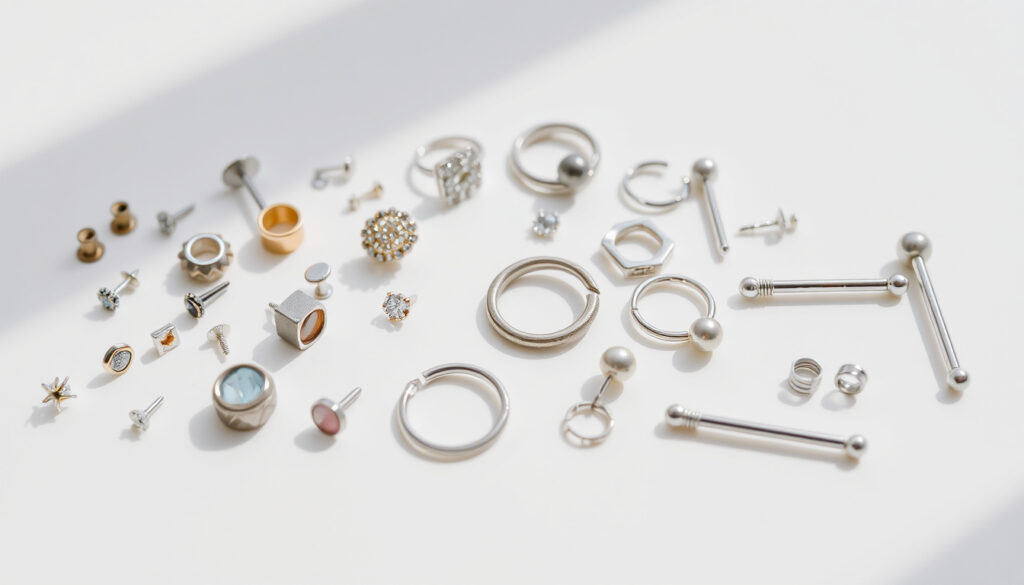
Types of Ear Piercings: Pain, Rules, and Style
That first ear piercing is usually a low-stakes memory. But the second, third, or fourth comes with more questions—which hurts most, what heals fastest, and whether that daith piercing everyone talks about actually does anything for anxiety.
Number of common ear piercing types: 10+ ·
Pain scale (1-10) for lobe piercing: 2/10 ·
Healing time for cartilage piercings: 6–12 months ·
Rejection rate for surface piercings: Up to 50%
Quick snapshot
- Lobe piercings heal in 6–8 weeks (Cleveland Clinic)
- Cartilage piercings take 6–12 months to heal (Cleveland Clinic)
- Needles cause less tissue damage than piercing guns (Cleveland Clinic)
- Whether daith piercings reduce anxiety is not proven (Cleveland Clinic)
- Pain rankings vary by individual tolerance (Healthline)
- Exact rejection rates depend on anatomy and aftercare (WebMD)
- Lobe: 6–8 weeks initial heal (Michigan Medicine)
- Cartilage: 3–12 months to full heal (Healthline)
- Jewelry changes possible after 6 weeks (lobe) or 12 weeks (cartilage) (Blomdahl)
- Curated ear styling (3–5 piercings per ear) is the dominant trend (Cleveland Clinic)
- Matching jewelry sets and symmetrical placement define “classy” aesthetics (Healthline)
The pattern across all ear piercings: cartilage placements ask for more time and tolerance than lobe placements.
| Attribute | Lobe | Helix | Tragus | Daith | Rook | Conch | Industrial | Flat |
|---|---|---|---|---|---|---|---|---|
| Pain (1-10) | 2/10 | 4-5/10 | 5/10 | 6-7/10 | 7/10 | 5-6/10 | 7/10 | 5/10 |
| Healing time | 6–8 weeks | 6–12 months | 6–12 months | 6–12 months | 6–12 months | 4–12 months | 9–12 months | 6–12 months |
| Rejection risk | Very low (<5%) | Low | Low | Low | Low | Low | Moderate | Low |
What is the most painful piercing in your ear?
For anyone considering cartilage piercings, the trade-off is straightforward: higher pain for a short moment, but a longer healing window. The daith and rook consistently top pain charts, while the lobe remains the gentlest entry point.
Top 3 most painful ear piercings
- Daith: Rated 6–7/10 on pain scales. The inner cartilage fold is dense with nerve endings (Zen Skin Care).
- Rook: Rated 7/10. The thickest cartilage fold in the ear requires more pressure to pierce (Zen Skin Care).
- Industrial: Rated 7/10. Two puncture sites connected by a barbell double the trauma (Zen Skin Care).
Pain scale comparison by placement
Standard lobe piercings sit at a comfortable 2/10, while cartilage placements like helix and tragus register 4–5/10 (Zen Skin Care). Most ear piercing pain and soreness typically lasts from a day or two to around a week (Zen Skin Care).
The implication: pain is brief, but the commitment to healing is long — choose accordingly.
What is the 2/3 rule for piercings?
The 2/3 rule and its variation, the 3/2 rule, are guidelines for visual balance on the ear—not medical requirements. They help avoid a cluttered look when stacking multiple piercings.
What is the 3/2 piercing rule?
- 2/3 rule: Place piercings in a ratio of two small to one large stud or hoop, or vice versa, spacing them so the ear doesn’t look overloaded (Healthline).
- 3/2 rule: A variation focusing on spacing—three piercings on one part of the ear and two on another, maintaining a 3:2 proportion (Healthline).
How to apply the 2:3 ratio for a balanced look
Both rules aim to create visual balance on the ear without overcrowding. Stylists and piercers recommend starting with a lobe piercing, then adding a helix or tragus, and building up gradually (Healthline). The key is spacing: each piercing needs enough room to heal and stand out.
What is the anxiety piercing called?
The daith piercing has gained a reputation as the “anxiety piercing,” but the evidence base is thin. Anyone hoping for a quick fix for anxiety should weigh anecdotal claims against the lack of clinical proof.
Does daith piercing help with anxiety?
The daith piercing is commonly called the “anxiety piercing” because it passes through a point that, in acupuncture theory, corresponds to the vagus nerve. Anecdotal reports claim it may reduce anxiety, but no peer-reviewed evidence supports this (Cleveland Clinic). The theory involves pressure points similar to acupuncture, but studies remain inconclusive.
Scientific evidence behind the anxiety piercing
Cleveland Clinic notes that while some people report relief, the connection is not scientifically proven (Cleveland Clinic). The placebo effect is a strong confounding factor, and no clinical trials have measured daith piercing’s effect on anxiety diagnoses. What is confirmed: daith piercings carry the same risks as any cartilage piercing, including infection and prolonged healing.
What piercing rejects the most?
Surface piercings are the most likely to migrate and fail—up to half may be rejected over time. Ear cartilage piercings are far more stable, but still require careful aftercare.
Factors that cause piercing rejection
- Placement: Surface piercings (e.g., navel, eyebrow) have higher rejection rates than ear cartilage (WebMD).
- Jewelry material: Nickel, cheap metals, or improper sizing can trigger immune responses (WebMD).
- Aftercare: Failing to clean properly or touching with unwashed hands increases rejection risk (WebMD).
- Anatomy: Thinner skin flaps and areas with more movement are more prone to rejection (WebMD).
Ear piercings with highest rejection rates
Rejection is not common for ear placements, but industrial piercings have a moderate risk due to the barbell’s mechanical leverage on both exit points (WebMD). Surface piercings on the ear (e.g., anti-tragus, snug) risk rejection in up to 50% of cases (WebMD). Lobe piercings have a rejection rate below 5% (Zen Skin Care).
What are classy ear piercings?
“Classy” is subjective, but the consensus among stylists and piercers points to coordinated sets of 3–5 piercings with matching jewelry. Symmetry and spacing matter more than the number of holes.
How many ear piercings look classy?
- 3–5 per ear: Commonly considered elegant, with a mix of studs and small hoops (Healthline).
- Symmetry: Matching placements on both ears (e.g., lobe + helix on each) creates a balanced appearance (Healthline).
- Jewelry material: Gold, titanium, or surgical steel in consistent finishes enhance the look (Healthline).
Which ear piercing looks best?
Classic lobe piercings remain the most universally flattering, while helix and tragus additions lend a modern touch (Healthline). The “curated ear” trend—a planned constellation of piercings with coordinating jewelry—is the current gold standard for aesthetics.
Curated ear styling tips
Start with a lobe piercing as the anchor. Add a helix or tragus for balance. Use the 2/3 rule to guide spacing. Stick to one metal type and finish (gold, silver, or rose gold) across all piercings (Healthline). Avoid clutter: each piercing should have room to breathe.
Which is safer, a gun or a needle?
The choice between a piercing gun and a sterile needle isn’t cosmetic—it affects tissue damage, healing time, and infection risk. Professional piercers overwhelmingly recommend needles.
“Piercing guns cause more tissue trauma than needles because they force a blunt stud through the skin, creating a crush injury rather than a clean puncture.”
— Professional piercer, Association of Professional Piercers
Needles, used exclusively by professional piercers, create a clean channel that heals faster and with less scar tissue (Cleveland Clinic). Guns cannot be fully sterilized and are linked to higher rates of infection and improper placement. For any cartilage piercing, a needle is the only safe option.
Summary
Choosing a piercing type comes down to trade-offs between pain, healing time, rejection risk, and aesthetic goals. For the first-timer in the United States, the decision is clear: start with a lobe piercing for a low-commitment entry, or go straight to a daith or rook for maximum impact—but be prepared for 6–12 months of healing. For the style-conscious, a curated ear with 3–5 matched piercings delivers elegance without overcrowding. Ultimately, the safest path is a professional piercer using a needle, not a mall kiosk gun.
ubiehealth.com, doctar.in, anubis-tattoo.com, cgaa.org, wellwisp.com, media.freeola.com
For those considering a more daring look, our snake bite piercing guide covers pain levels and aftercare in detail.
Frequently asked questions
How long does an ear piercing take to heal?
Lobe piercings heal in 6–8 weeks, while cartilage piercings like helix, tragus, and daith take 6–12 months to fully heal (Cleveland Clinic).
Can I sleep on a new ear piercing?
Sleeping directly on a new piercing can cause irritation, migration, and infection. Professional piercers recommend using a travel pillow or sleeping on the opposite side (Healthline).
What jewelry material is best for initial piercings?
Surgical steel, titanium, and 14k+ gold are safest. Nickel-containing alloys and inexpensive metals increase rejection and infection risk (WebMD).
Do ear piercings close up if you remove the jewelry?
Fresh piercings can close within hours. Established piercings (worn for years) may close partially but can shrink over time. Lobe piercings close most slowly; cartilage may close faster (Blomdahl).
How should I clean a new ear piercing?
Use saline solution twice daily. Avoid alcohol or hydrogen peroxide, which damage tissue. Wash hands before touching the area (Cleveland Clinic).
What is the difference between a helix and a forward helix?
A helix is pierced through the outer upper cartilage rim. A forward helix is placed on the inner front fold of the ear, closer to the face. Both take 6–12 months to heal (Healthline).
Is it safe to get multiple ear piercings at once?
Getting 2–3 piercings in one session is generally safe for healthy adults, but the body’s healing capacity is limited. Professional piercers often recommend spacing them out by at least 4–6 weeks (Cleveland Clinic).
More related posts
 Our Lady’s Hospital Navan: Visiting Hours, Age Limit & More
 Man City vs Leeds United Standings: H2H Stats & Results
 Free Sports Streaming Sites: Legal Alternatives That Work
 Matt Beard Cause of Death: Inquest & Bullying Claims
 The Studio TV Series Guide: Episodes, Awards & More
 Maggie Q Movies and TV Shows: Full Filmography List
