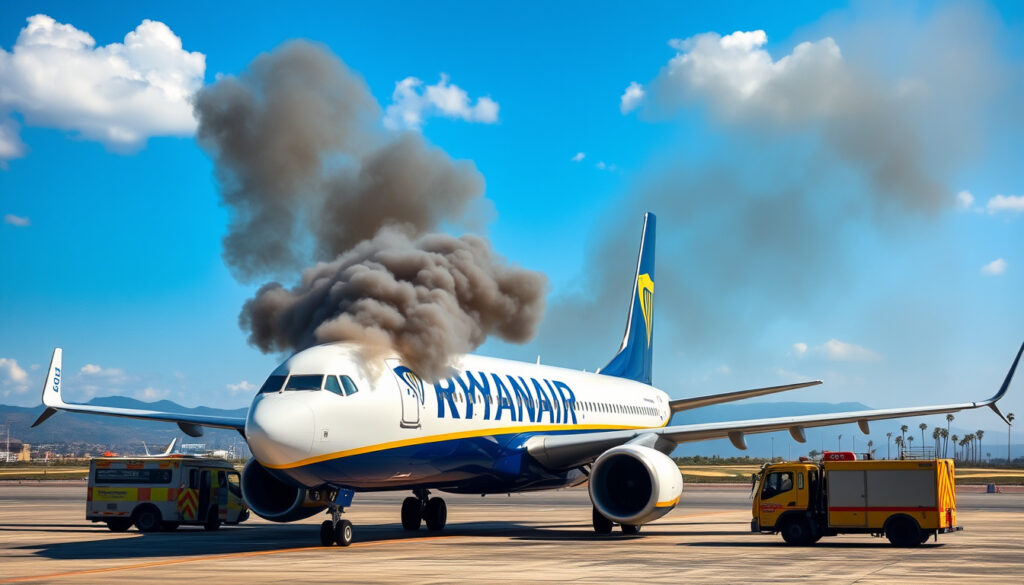
Ryanair Plane Fire Majorca: 18 Injured in False Alarm Panic
A false fire alarm on a Ryanair flight about to leave Palma de Mallorca sent 18 passengers to medical assistance — six to hospital — after panicked travellers leapt from the aircraft wing onto the tarmac. The aircraft, a Boeing 737-8AS registered G-RUKN, triggered an engine fire warning that proved groundless; firefighters and Civil Guard confirmed no fire at the scene.
Injured: 18 · Hospitalised: 6 · Date: July 5, 2025 · Location: Palma de Mallorca Airport (PMI) · Aircraft: G-RUKN
Quick snapshot
- False alarm, no fire found (AeroTime)
- 18 passengers injured (Straits Times)
- 6 hospitalised (ITV News)
- What triggered the false fire warning light
- Whether wing-jump injuries included fractures
- Official flight number confirmation
- Civil Guard technical inquiry into alarm cause
- Some passengers remained in Majorca until July 7
- Ryanair apologised for the disruption
The incident at Palma de Mallorca Airport produced a stark contrast: zero fire, 18 injuries, and an airline playing down the fallout while passengers described broken bones from wing jumps.
| Detail | Value |
|---|---|
| Date | July 5, 2025 |
| Airport | Palma de Mallorca (PMI) |
| Injuries | 18 total, 6 hospitalised |
| Aircraft Reg | G-RUKN |
| Alert Type | False engine fire warning |
| Replacement Departure | 07:05, July 5, 2025 |
| Flight Route | Palma to Manchester |
| Ambulances Sent | 4 (2 basic, 2 advanced) |
How many people died in the Ryanair crash?
No one died in the Majorca incident. The Ryanair flight that triggered a fire alert at Palma de Mallorca Airport on July 5, 2025 resulted in 18 injuries but zero fatalities. Authorities confirmed it was a false alarm — firefighters and Civil Guard personnel found no fire after arriving on the tarmac.
Ryanair Flight 4102 details
The aircraft involved was Boeing 737-8AS registered G-RUKN. The flight was preparing for departure from Palma to Manchester when the false fire warning activated. Ryanair described it as a “false fire warning light indication,” with passengers disembarked via inflatable slides before some opted to leave via the wing, roughly a 10-foot drop to the tarmac.
“This flight from Palma to Manchester (4 July) discontinued take-off due to a false fire warning light indication. We sincerely apologise to affected passengers for any inconvenience caused.”
— Ryanair statement, BreakingNews.ie
“We received an alert about a fire on a plane on the ground at Palma airport at 00.36am today. Eighteen people were injured and received medical assistance of whom six were taken to hospital. They were all minor.”
— Regional emergency response spokesman, ITV News
Ryanair has not recorded a fatal accident on a commercial passenger flight in its operating history, a safety record that the airline frequently highlights. The Majorca incident, while disruptive, reinforces the distinction between a technical malfunction and an actual safety catastrophe.
What is Ryanair’s 40 minute rule?
Ryanair’s 40-minute rule refers to the airline’s strict online check-in closure window. Passengers must complete online check-in between 4 days and 2 hours before their scheduled departure. After the 2-hour mark, the online check-in facility shuts — a policy that has generated complaints from travellers who miss the deadline.
The airline tightened this policy following EU border control incidents where passengers arrived at airports without proper documentation. Ryanair’s position is that this strict cutoff reduces airport crowding and speeds up the boarding process. Critics argue the narrow window creates anxiety for passengers with inconsistent internet access or unexpected travel disruptions.
Ryanair charges a fee for passengers who miss the check-in window and need to be processed at the airport desk — a revenue source the airline has no incentive to simplify.
Why does the Ryanair seat 11a have no window?
Seat 11A on certain Ryanair Boeing 737 aircraft falls in a section where the fuselage curvature reduces window alignment. Rather than a superstition or design flaw, it’s a consequence of the specific cabin layout Ryanair uses to maximise seat density — the airline fits 189 seats into a standard 737-800, and some window positions end up between rows.
Reasons to avoid seat 11A
- No direct window view for in-flight scenery
- Proximity to the exit row means more foot traffic during boarding
- Standard pitch applies — no extra legroom at this position
Travellers who prioritise natural light or window views generally fare better selecting rows further forward or at the rear, where the oval fuselage shape places windows more consistently centred over seats.
Why is there no Row 13 on Ryanair planes?
Row 13 is absent on Ryanair’s Boeing 737 fleet — and on many other airlines worldwide — due to superstitions rooted in Western cultural associations with the number 13. Airlines have historically omitted this row on commercial aircraft for the same reason many buildings skip a 13th floor.
Ryanair’s configuration skips directly from Row 12 to Row 14. The superstition around 13 is strong enough in passenger aviation that its removal is considered a minor passenger experience win, even if rationally the row number has no impact on flight safety. Ryanair also omits Row 1 in some configurations for similar superstitious or seat-spacing reasons.
What caused the Ryanair plane fire alarm at Majorca?
The exact cause of the false fire warning light on the Ryanair flight at Palma de Mallorca remains under investigation. Ryanair described the trigger as a “false fire warning light indication” with no fire present upon inspection. The Civil Guard has opened an inquiry to determine the technical source of the alert.
Evacuation sequence
The emergency alert was received at 00:36am on July 5, 2025. Four ambulances — two basic life support and two advanced life support — were dispatched alongside the AENA fire brigade. Passengers exited primarily via inflatable slides, though some passengers reportedly left via the wing after hearing a bang and panicking.
Injury details
Eighteen passengers sought medical assistance, with six requiring hospital transport. Three were taken to Clinica Rotger and three to Quirónsalud Palmaplanas Hospital. Ryanair characterised the injuries as “very minor” like ankle sprains, though some passenger reports — according to Travel Noire passenger accounts — mentioned broken bones from wing jumps, a discrepancy between the airline’s public framing and individual passenger accounts.
Timeline
- Aircraft preparing for takeoff at PMI
- Safety demonstrations underway
- False fire alarm triggers evacuation
- Emergency services dispatched
- 18 injuries reported, 6 hospitalised
- False alarm confirmed by firefighters
- Replacement aircraft departs Palma
The implication: multiple passengers required hospital transport to two separate clinics, suggesting injuries beyond the minor sprains Ryanair publicly described.
What is confirmed
- False fire alarm, no actual fire
- 18 injured passengers total
- 6 hospitalised across two clinics
- Evacuation on tarmac at PMI
- Emergency response within minutes
- No impact on airport operations
- G-RUKN Boeing 737-8AS involved
What remains unclear
- Technical cause of false warning light
- Severity of individual injuries
- Whether broken bones were sustained
- Official flight number
Ryanair’s description of “very minor” injuries sits uneasily beside six hospital admissions and passenger accounts of broken bones from wing jumps. The gap between the airline’s public minimisation and passenger experiences on the ground suggests the fallout was more consequential than the carrier initially acknowledged.
Related reading: Google Find My Phone · contact Booking.com
This Majorca incident echoes similar disruptions, like the recent Auckland Airport fire alarm evacuation that forced back-to-back terminal clearances and halted flights for hours.
Frequently asked questions
What happened during the Ryanair incident at Majorca?
A Ryanair aircraft preparing for departure from Palma de Mallorca Airport triggered a false fire warning on the evening of July 4, 2025. Crew ordered an evacuation. Passengers exited via inflatable slides and, in some cases, the wing. Emergency services attended immediately, and 18 people sought medical help, with six requiring hospital transport.
Was there an actual fire on the plane?
No. Firefighters and Civil Guard personnel found no fire upon inspection. Ryanair described it as a false fire warning light indication, and the AENA fire brigade confirmed the aircraft was safe.
How did passengers get injured?
Most injuries reportedly stemmed from the evacuation process itself. Some passengers jumped from the wing — roughly a 10-foot drop — onto the tarmac rather than waiting for the slides, leading to ankle injuries and, reportedly in some cases, broken bones.
What aircraft was involved in the Majorca alarm?
Boeing 737-8AS registered G-RUKN. The aircraft was the original plane scheduled for the Palma-to-Manchester sector before the incident grounded it for the technical inquiry.
Has Ryanair had fatal crashes?
No fatalities have been recorded on a scheduled Ryanair commercial passenger flight. The airline points to this safety record as a key differentiator, though critics note that operational incidents — like the Majorca false alarm — still carry real consequences for passengers even without deaths.
What is the status of the flight after the alarm?
The original aircraft was unable to continue its scheduled departure. A replacement aircraft was dispatched and departed Palma de Mallorca at 07:05 on July 5, 2025, completing the route to Manchester.
Why did passengers jump from the wing?
Panic appears to have driven the decision. With an emergency alert sounding and smoke or fire procedures activated, some passengers opted for what seemed like the fastest exit — climbing onto the wing and stepping down to the tarmac — rather than waiting for orderly slide evacuation. The height difference — approximately 10 feet — caused injuries when passengers landed.
More related posts
 Calories in a Pint of Guinness: Complete Guide
 Samsung Galaxy Z Fold 7 Review: Price, Camera & Irish Deals
 World of Wonder Clonmel: Hours, Locations, and Top Toys 2026
 Things to Do in Westport, Ireland: Family, Couples & More
 Is Poland in the EU? Membership, Currency & Schengen
 Types of Ear Piercings: Pain, Rules, and Style
 How to Stop Grinding Teeth in Sleep: Causes, Remedies & Treatment
