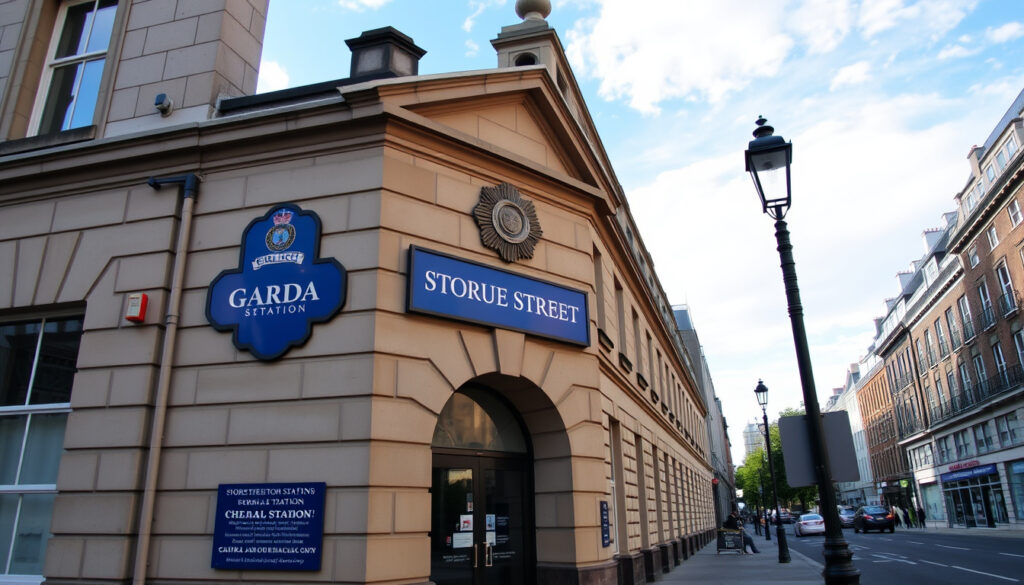
Store Street Garda Station: Location, Contact & Legal Rights
The official directory information for Store Street Garda Station — the address, the phone number, the hours — is a matter of public record. But for anyone who has stood outside a Garda station wondering about their rights, the legal context around filming, refusing a name, or recording a conversation shapes a visit far more than the street address does.
Address: 4-6 Store Street, Dublin 1, D01 W773 ·
Non-Emergency Phone: +353 1 666 8000 ·
Emergency Number: 999 or 112 ·
Public Office Hours: 8:00 am to 2:00 am daily ·
Total Garda Stations in Ireland: Over 560 ·
Station Status: District Headquarters, Dublin North Central
Quick snapshot
- Address: 4–6 Store Street, Dublin 1, D01 W773 (An Garda Síochána)
- Phone: +353 1 666 8000 (An Garda Síochána)
- Public hours: 8:00 am to 2:00 am daily (An Garda Síochána)
- One-party consent for recording conversations in Ireland (Data Protection Commission)
- Precise Supreme Court precedent on filming Garda station exteriors is reportedly undecided (ICCL guidance suggests untested)
- Admissibility of secret recordings in civil family cases is highly discretionary (DPC notes judicial discretion)
- Exact footfall statistics to definitively rank the “busiest” Garda station (anecdotal reports only) (ICCL guidance suggests untested)
- Total number of Garda stations in Dublin is not officially published (ICCL guidance suggests untested)
- Precise legal basis for demanding a name in non-traffic situations is subject to interpretation (ICCL guidance suggests untested)
- 1939: Offences Against the State Act passes (eISB)
- 1983: Postal and Telecommunications Services Act passes (eISB)
- 2018: GDPR enhances privacy rights for recordings (Data Protection Commission)
- Know the difference between a walk-in report and an emergency call.
- Understand your right to film and record in public.
- Prepare for traffic stops by knowing your duty to give your name.
Six entries that cut through directory noise, focusing on the details that matter most for a visit or a call.
| Detail | Value |
|---|---|
| Full Address | 4-6 Store Street, Dublin 1, D01 W773 |
| Telephone | +353 1 666 8000 |
| District | Dublin North Central Division |
| Public Office Hours | 8:00 am to 2:00 am, 7 days a week |
| Total Garda Stations in Ireland | Over 560 |
| Store Street Status | District Headquarters |
Where is Store Street Garda station?
What is the address of Store Street Garda station?
- Address: 4–6 Store Street, Dublin 1, D01 W773. This places it in the heart of Dublin’s north inner city, close to the IFSC and Connolly Station.
- Contact Number: +353 1 666 8000, with a dedicated community engagement line at +353 1 666 8025 under Superintendent Jonathan Hayes. Source: An Garda Síochána (Ireland’s national police service)
What are the opening hours of Store Street Garda station?
- The public office is open 8:00 am to 2:00 am daily. It is not a 24-hour station, meaning for emergencies between 2am and 8am, callers should dial 999 or 112. Source: An Garda Síochána
- Nearby stations open during different windows include Pearse Street (24 hours) and Fitzgibbon Street (8am–2am).
If you walk up to Store Street at 3am seeking help, the door is locked. 999 or 112 is the only response path for immediate threats outside of public hours.
The implication: Store Street runs a longer public counter than many Dublin stations, but the 2am–8am gap means every regular visitor should have a backup plan.
How many Garda stations are there?
What is the busiest Garda station in Ireland?
- The Republic of Ireland has over 560 Garda stations. Dublin has the highest concentration, including Store Street, Pearse Street, Fitzgibbon Street, and Irishtown. Source: Wikipedia (the collaborative encyclopedia)
- Pearse Street and Store Street are frequently cited as the busiest stations due to their central city locations and high volume of incidents. The Garda Síochána has undergone a rationalisation program, reducing the total number of stations while maintaining district headquarters.
How many Garda stations are there in Dublin?
The Dublin region hosts the network’s densest cluster of stations. Dublin North Central Division alone covers multiple stations including Store Street, Fitzgibbon Street, Ballymun, and Santry.
Centralising resources at stations like Store Street and Pearse Street strengthens specialist units but forces longer travel times for residents in the outer suburbs of Dublin.
The pattern: Store Street and Pearse Street dominate Dublin’s policing hub, but the overall station count has fallen due to rationalisation — meaning residents outside the city centre face longer travel times to a public counter.
Can I just walk into a Garda station?
What services does a Garda station front counter provide?
- Garda stations with public offices accept walk-in reports, queries, and lost property claims. Store Street Station is not open 24 hours; its public office hours are 8am to 2am. Source: An Garda Síochána
- For immediate emergencies, always call 999 or 112 rather than walking into a station. You can walk into a Garda station to report theft, assault, or to provide information as a witness.
How to interact with a Garda station effectively
- Assess urgency: Emergency? Call 999 or 112. Non-urgent? Proceed to station.
- Prepare: Have your identification, any relevant documentation, and a clear statement of your purpose.
- At the station: Approach the public counter. Be ready to provide the core details of the incident.
- Know your rights: You can request a solicitor at any point. If detained, a solicitor consultation must take place where Gardaí cannot hear what is being said. Source: Citizens Information (the official Irish public services information portal)
The catch: Walking into Store Street works for non-urgent reports, but the 8am-2am window is a hard boundary. For anything time-sensitive, the emergency number is the only reliable option.
Is it illegal to film a Garda station in Ireland?
Can you film Gardaí in public in Ireland?
- Filming Garda stations or Gardaí in a public place is not generally illegal in Ireland. The Offences Against the State Acts can restrict photography of specific military or government installations, but this standardly does not apply to public filming of station exteriors. Source: Irish Council for Civil Liberties (ICCL) (Ireland’s leading civil liberties watchdog)
- Intentionally harassing Gardaí or obstructing them in their duties through filming could lead to charges under the Criminal Justice Acts 2006. Filming from public property (streets, footpaths) is usually within your legal rights. Source: Electronic Irish Statute Book (eISB) (the official legislation database)
The Offences Against the State Acts 1939 allow restrictions near state installations, but a routine filming of a Garda station exterior from a public footpath rarely triggers this power — though individual Gardaí may test the boundary.
What this means: Your phone camera is generally lawful on Irish public streets, even aimed at a Garda station — but the moment it becomes “harassment” or “obstruction”, the legal line shifts against you.
Can you refuse to give your name to a Garda?
When must you give your name to Gardaí?
- You are generally not legally required to provide your name, date of birth, or address to a Garda unless they have reasonable suspicion you have committed an offence. Under road traffic law, a driver must provide their name and address to a Garda when stopped. Source: Citizens Information (the official Irish public services information portal)
- Under Section 30 of the Offences Against the State Act 1939, you must provide your name and address if demanded in a prescribed area. Refusing your name in a relevant traffic stop can be an offence. Source: Electronic Irish Statute Book (eISB) (the official legislation database)
Can a Garda search your phone without a warrant in Ireland?
- Gardaí cannot look through your phone, access its data, or demand your password without a warrant or your consent, except under specific search powers at the time of arrest. The Criminal Justice (Search Warrants) Act 2012 governs these search powers. Source: Electronic Irish Statute Book (eISB) (the official legislation database)
The asymmetry is sharp: in a normal street encounter in Ireland, silence is your right; in a traffic stop, you must speak; and after arrest, your phone is not an open book without a warrant.
Can I record a conversation on my phone in Ireland?
Do I have to tell someone I’m recording them in Ireland?
- Ireland operates under a single-party consent rule for recording conversations you are a participant in. You are not legally required to inform the other party. Source: Data Protection Commission (DPC) (Ireland’s privacy regulator)
- Recording a conversation you are not a part of is a criminal offence under the Postal and Telecommunications Services Act 1983. Using a secret recording as evidence in court is complex; it may be admissible but faces judicial discretion and hearsay challenges. Source: Electronic Irish Statute Book (eISB) (the official legislation database)
- Signs your phone might be recording include: unexpected data usage, battery drain, unusual background noise or echo, and the presence of unknown recording apps.
How do I know if my phone is recording me?
You can stop your phone from recording by reviewing app permissions, checking microphone access in settings, and running a security scan. If you believe someone is secretly recording you, you can sue them if the recording constitutes an invasion of privacy under the Data Protection Acts or the constitution.
Single-party consent gives you a powerful tool for personal documentation, but using that recording in court — or against someone who hasn’t consented — carries heavy judicial risks.
The verdict: single-party consent gives you documentation power, but the evidentiary path to actually using that recording in a legal setting is narrow and uncertain.
Three stations serve Dublin’s north-east city core within a 2 km radius, and each has a subtly different operational profile.
| Feature | Store Street | Pearse Street | Fitzgibbon Street |
|---|---|---|---|
| Address | 4–6 Store St, D1 | Pearse St, D2 | Mountjoy Sq, D1 |
| Phone | 01 666 8000 | 01 666 9000 | 01 666 8600 |
| Public Hours | 8am–2am | 24 hours | 8am–2am |
| District Role | Headquarters | District Station | District Station |
Source: An Garda Síochána (Store Street), An Garda Síochána (Pearse Street), An Garda Síochána (Fitzgibbon Street)
The pattern: store street is the district nerve centre, Pearse Street offers true 24-hour access, and Fitzgibbon Street mirrors Store Street’s hours for the north-east inner city.
Dublin North Central Division covers a dense urban area; here are its primary stations.
| Station | Division | Role |
|---|---|---|
| Store Street | Dublin North Central | District Headquarters |
| Fitzgibbon Street | Dublin North Central | District Station |
| Ballymun | Dublin North Central | District Station |
| Santry | Dublin North Central | District Station |
| Whitehall | Dublin North Central | District Station |
Upsides of visiting Store Street Garda Station
- Central Dublin location easily accessible by public transport.
- District headquarters status means more resources and specialist staff.
- Dedicated community engagement officer (Supt. Jonathan Hayes).
- Reliable public office hours from 8am to 2am daily.
Downsides of visiting Store Street Garda Station
- Not a 24-hour public counter (closed between 2am and 8am).
- Can experience wait times due to district HQ administrative demands.
- Limited weekend capacity for complex non-emergency reports.
Legal timeline: Garda powers and citizen rights
Five legal milestones frame the current balance between Garda powers and citizen rights in Ireland.
- 1939 – Offences Against the State Act passed, providing broad state security powers regarding filming and photography near installations. (eISB)
- 1983 – Postal and Telecommunications Services Act prohibits unauthorized interception of phone calls and conversations. (eISB)
- 2006 – Criminal Justice Act updates harassment laws, impacting persistent filming of Gardaí. (eISB)
- 2012 – Criminal Justice (Search Warrants) Act updates Garda powers of search, affecting digital device searches. (eISB)
- 2018 – General Data Protection Regulation (GDPR) enhances privacy rights, impacting secret recordings and data retention. (Data Protection Commission)
These five acts define the boundaries between state power and individual rights in Ireland.
Clarity: Confirmed vs Unclear facts
Confirmed facts
- Exact address and phone number of Store Street Garda station. (An Garda Síochána)
- Public office opening hours (8am-2am daily). (An Garda Síochána)
- One-party consent for private recording in Ireland. (Data Protection Commission)
- General right to film in public places. (Irish Council for Civil Liberties)
- Legal requirement to provide name during a traffic stop. (Citizens Information)
What’s unclear
- The precise legal precedent regarding filming the exterior of Garda stations versus Gardaí performing duties reportedly remains untested at the Supreme Court level, so lawyers often advise restraint if Gardaí specifically object.
- The extent to which a secret recording is admissible as evidence in civil family law cases is reportedly “highly discretionary”, according to legal analysts.
- Exact public footfall statistics for Store Street vs Pearse Street to definitively crown the “busiest” are not formally published.
This breakdown helps readers separate verified facts from areas of legal uncertainty.
Store Street Garda Station serves as the district headquarters for the Dublin North Central Division. The official contact number is +353 1 666 8000 and the public office is open from 8am to 2am daily.
— An Garda Síochána
A person in custody has the right to consult a solicitor before interview. A solicitor consultation must take place where Gardaí cannot hear what is being said.
— Citizens Information
Filming Gardaí in public is generally a lawful exercise of your rights, provided it does not amount to harassment or obstruction under the Criminal Justice Acts.
— Irish Council for Civil Liberties (ICCL)
Summary: Bottom line for the public in Ireland
Frequently asked questions
What is a Garda detective’s salary?
Garda detective salaries vary by rank and service length, starting at approximately €35,000 and rising to over €60,000 for experienced detectives, excluding allowances.
What to do if someone is secretly recording you?
If you believe someone is secretly recording you in Ireland, you can report it to the Gardaí as a potential breach of privacy under the Data Protection Acts and the Postal and Telecommunications Services Act 1983.
Can a Garda stop me for a traffic violation and demand my name?
Yes. Under road traffic law, a driver must provide their name and address to a Garda when stopped for a traffic violation. Failure to do so is an offence.
Is it legal for an employer to record conversations in the workplace in Ireland?
Employers must have a clear data protection rationale and usually must inform employees that recording is taking place. Covert recording is highly restricted under GDPR and Data Protection law.
How long can Gardaí detain you without charge?
Maximum initial detention without charge in Ireland is generally 24 hours, extendable by court order. Specific terrorism or organised crime offences allow longer detention under warrant.
Can I use a secret recording as evidence in court in Ireland?
It is possible but subject to judicial discretion. The court will weigh privacy rights, the manner of the recording, and its relevance. It is not automatically admissible.
How do I report a crime online if I can’t walk into a Garda station?
An Garda Síochána provides an online crime reporting portal for certain non-emergency crimes. For immediate threats, dial 999 or 112.
Related reading: Marks & Spencer Grafton Street: Hours, Phone & Dublin Guide · Michael Gaine Search Kenmare: Disappearance and Arrest
More related posts
 Euro Dollar Exchange Rate Today: EUR/USD Rate & Forecast
 Sandos Papagayo Beach Resort: 2026 All-Inclusive Review
 What Is Dubai Chocolate? Ingredients, Price & Where to Buy
 Types of Ear Piercings: Pain, Rules, and Style
 Cast of Barbie (2023) – Full Actors and Characters List
 Tide Times Dunmore East: Today’s High Tide, Low Tide Chart
 Ireland v Czech Republic 2026: Match Report & Travel Guide
