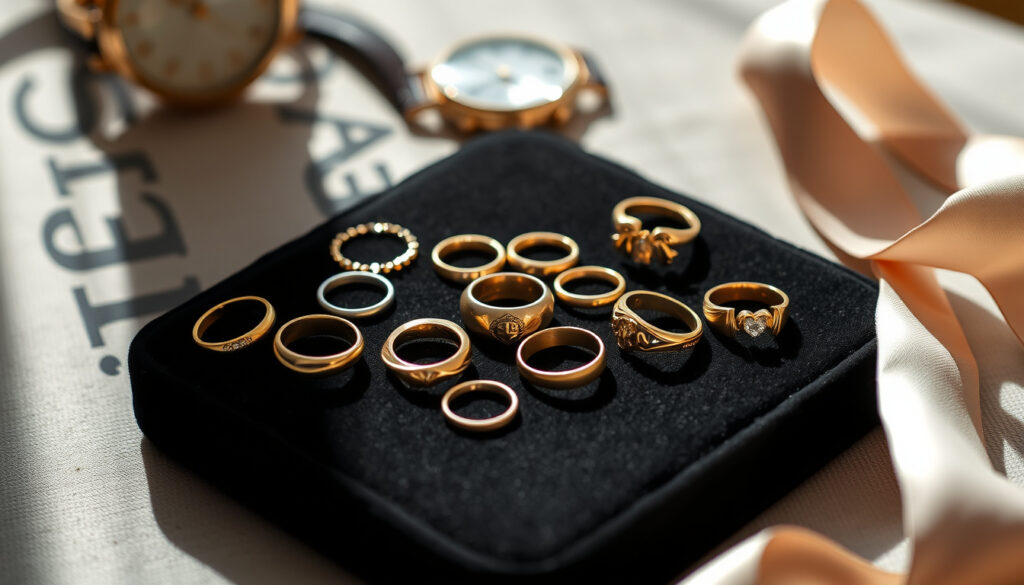
Gold Rings for Women: Complete Guide to Style & Rules
Shopping for a gold ring feels simple until you’re staring at karat stamps, finger etiquette, and age-old traditions — whether you’re after a Claddagh ring with 17th-century Galway symbolism or a plain gold band that follows Irish hallmarking law. This guide cuts through the noise with verified facts on spending guidelines, the four rings every woman should own, and the finger positions that send clear signals.
Traditional engagement ring spending rule: 2–3 months of salary ·
Number of rings in a complete set: 4 ·
Claddagh ring symbolism: Love, Loyalty, Friendship
Quick snapshot
- All precious-metal jewelry in Ireland must carry a compulsory hallmark (Dublin Assay Office)
- Claddagh ring symbols: heart (love), crown (loyalty), hands (friendship) (Claddagh Rings)
- Exact origin of the 3-month salary rule is not historically documented
- Whether wearing a ring on the index finger brings bad luck varies by regional superstition
- What counts as “classy” in ring stacking depends on personal style and occasion
- Engagement ring traditionally worn on the left ring finger
- Four essential rings: engagement, wedding band, eternity, cocktail ring
- 1477: First diamond engagement ring — Archduke Maximilian to Mary of Burgundy
- 1940s: De Beers’ “A Diamond is Forever” campaign reshapes engagement ring culture
- 1700s: Claddagh ring emerges in Galway, Ireland (Claddagh Rings)
- Mix-and-match stacking rings continue trending into the 2020s
- Demand for ethically sourced Irish gold influences purchasing decisions
- Online buyers face customs and hallmark verification requirements for imports
Irish ring buyers face an unusual advantage: compulsory hallmarking means every gold piece sold legally in the country carries a verified stamp of authenticity. The Dublin Assay Office enforces this without weight exemptions, making it one of the strictest systems in Europe.
What are the 4 rings a woman should have?
The idea that a woman’s ring collection should include four distinct pieces comes from a blend of tradition, occasion, and practicality. According to established etiquette, the four rings every woman should own are an engagement ring, a wedding band, an eternity ring, and a cocktail ring.
| Ring | Purpose | Typical finger |
|---|---|---|
| Engagement ring | Symbol of betrothal | Left ring finger |
| Wedding band | Matrimonial commitment | Left ring finger (under or above engagement ring) |
| Eternity ring | Milestone gift (often anniversary or childbirth) | Left ring finger (stacked) or right hand |
| Cocktail ring | Statement piece for social occasions | Right hand, often index or middle finger |
Four rings, one pattern: each marks a different life stage or social function, not a rigid dress code. An engagement ring signals intent; a wedding band seals the promise; an eternity ring rewards longevity; a cocktail ring exists purely for visual impact.
The implication: invest in variety rather than duplication. A single gold band that does duty for every occasion isn’t the goal — building a small collection that spans everyday wear and ceremonial moments is what lets the reader move through life with the right ring for the right moment.
How many rings look classy?
Jewellery stylists generally agree that two to three rings per hand strike the right balance between elegant and overdone. Stacking rings allows personalisation without crossing into cluttered territory. The key is proportional sizing: a chunky cocktail ring on one finger and a delicate band on the next creates visual contrast. Thin bands layered on the same finger work well, but mixing gold karats (e.g., 9ct yellow with 18ct rose) can look intentional if kept to a two-tone palette.
What is the 3 month rule for rings?
The so-called 3-month rule suggests spending three months of your salary on an engagement ring — a guideline that originated not from jewellers but from a marketing campaign. The rule has no documented historical source and is widely regarded as a convention rather than a requirement.
Three rules, one pattern: the “3 month,” “3 ring,” and “2 months salary” variants all serve as loose anchors, not ironclad commitments. A buyer on a €50,000 annual salary following the 2-month guideline would budget around €8,333; someone opting for the 3-month version would target €12,500. In practice, data suggests many Irish couples spend less, especially when prioritising plain gold bands over centre stones.
The only real rule is affordability. Ireland’s compulsory hallmarking ensures quality regardless of spend — a €300 9ct gold ring carries the same legal certification as a €3,000 diamond piece. The Dublin Assay Office (Ireland’s statutory hallmarking authority) verifies every piece, so budget does not equal trust.
What is the 3 ring rule?
The 3 ring rule refers to the three ring types traditionally considered essential: the engagement ring, the wedding band, and the eternity ring. This trio covers the lifecycle of a romantic partnership — betrothal, marriage, and long-term commitment. Some variations include a fourth “push present” ring awarded after childbirth.
Which finger is not good for a gold ring?
Finger superstitions vary across cultures, but one of the most persistent warnings concerns the index finger. Some traditions advise against wearing a gold ring on the index finger, claiming it may attract negativity or interfere with personal energy. This belief has no scientific basis and appears in regional folklore rather than universal etiquette.
One superstition, one contrast: the index finger’s supposed bad luck sits opposite the ring finger’s universally accepted romantic symbolism. Ireland, like most of Europe, uses the left ring finger for engagement and wedding rings — a tradition rooted in the ancient Roman belief that the “vena amoris” (vein of love) ran directly from that finger to the heart.
| Finger | Common meaning | Superstition / caution |
|---|---|---|
| Left ring finger | Engaged or married | None — the universal romantic finger |
| Right ring finger | Single / available in some contexts | Occasionally mistaken for marriage in different cultures |
| Index finger | Power, authority (signet ring tradition) | Some superstitions advise against gold on this finger |
| Middle finger | Balance, individuality | No major taboos; often used for statement rings |
| Thumb | Uncommon, statement of confidence | May interfere with grip or daily activities |
The implication: choose your ring finger based on the message you intend to send, not fear of superstition. The index finger caution is rooted in folklore, not verified harm — and many Irish women happily wear signet rings there without issue.
Which finger ring means single?
Wearing a ring on the right ring finger can indicate single status in some social contexts. This is not a universal code, but it is recognised in parts of Europe and among younger generations. In Ireland, the Claddagh ring has its own protocol: worn on the right hand with the heart facing outward, it signals the wearer is single and open to relationship; worn with the heart facing inward, it means the wearer is in a committed relationship.
What finger should you never wear a ring on?
No finger is universally forbidden. The thumb is sometimes advised against for practical reasons — rings can interfere with grip and may be uncomfortable for extended wear. The index finger’s caution is regional and not endorsed by any major jewellery or cultural institution. For most Irish women, the choice comes down to comfort and the message they wish to project.
How much should you spend on an engagement ring if you make 100k?
Earning €100,000 places a buyer in the higher income bracket, where the traditional 2-3 month guideline suggests a budget between €16,666 and €25,000. However, as noted, the guideline originated from a marketing campaign by De Beers in the mid-20th century, not from any industry standard or consumer protection body.
One salary, two realities: a €100k earner could comfortably afford a high-end ring, but many choose to spend less — especially in Ireland’s current housing market, where deposit savings often compete with jewellery budgets. A 9ct gold engagement ring from an Irish retailer typically costs between €200 and €1,000; a diamond centre stone adds €2,000 to €10,000 depending on carat and clarity.
Imported rings bought online for delivery to Ireland may attract customs duties and VAT at the point of entry. The Dublin Assay Office requires hallmarks even on imported pieces sold within the state — a ring ordered from abroad without a valid hallmark may not be legally saleable in Ireland.
How long before engagement should you go ring shopping?
Start ring shopping 3 to 6 months before the proposal. This timeline allows for choosing a design, confirming the gold karat (9ct, 14ct, or 18ct are the most common in Ireland), resizing, and inscription. Custom orders, especially for Claddagh or Celtic knot designs, may take six to eight weeks alone.
What ring do Irish girls wear?
The most culturally significant ring for Irish women is the Claddagh ring, a traditional design featuring two hands clasping a heart topped with a crown. Its symbolism is specific: the heart represents love, the crown represents loyalty, and the hands represent friendship. According to the Claddagh Rings (traditional jewellery retailer based in Galway), the design has been associated with the west of Ireland since the 17th century.
One ring, three messages: the Claddagh’s wearing protocol communicates relationship status without words. On the right hand, heart facing out = single; on the right hand, heart facing in = in a relationship; on the left hand (any orientation) = engaged or married. This makes it a versatile decor piece that serves as both heritage symbol and social signal.
History and symbolism of the Claddagh ring
The Claddagh design originated in the fishing village of Claddagh, just outside Galway city, in the 17th century. While the exact origin story involves a Galway silversmith named Richard Joyce, the ring’s modern popularity stems from its adoption by Irish diaspora communities worldwide. The symbols — heart, crown, hands — are believed to derive from the fusion of local folklore and heraldic imagery.
Other traditional Irish ring designs include the Trinity knot (representing the Holy Trinity or the tripartite nature of life), the triskele (an ancient Celtic spiral symbol), and the Celtic knot. These alternatives appeal to women who want Irish heritage without the romantic connotations of the Claddagh.
The pattern: Irish women often own a Claddagh ring, a plain gold band, and a dress ring — covering tradition, daily wear, and social occasions. A ring collection that includes at least one piece with Irish symbolism is a common choice among residents and the diaspora alike.
How to wear a Claddagh ring correctly
- Single and open to relationship: right hand, heart facing outward
- In a relationship: right hand, heart facing inward (toward the body)
- Engaged or married: left hand (heart facing either direction)
- As a friendship symbol: often worn on the right hand regardless of orientation
“The Claddagh ring is one of the most recognisable symbols of Irish heritage worldwide. Its power lies in the fact that a single piece of jewellery can communicate love, loyalty, friendship, and relationship status all at once.”
— Curator at EPIC Museum, Dublin
Why this matters: the Claddagh’s dual role as tradition bearer and social signal makes it a uniquely practical piece for Irish women. Unlike a plain gold band, it carries cultural weight; unlike a diamond solitaire, it does not require a specific occasion. A Claddagh ring on the right hand with heart outward tells everyone you are single and proud of your heritage — a subtle but powerful social tool.
“Modern buyers are increasingly seeking engagement and wedding rings that reflect their personal style rather than following the old salary-percentage rule. We see more couples choosing 9ct gold Claddagh sets over traditional diamond solitaires.”
— Spokesperson from Fields Jewellers, Dublin
The trade-off: women who wear the Claddagh ring often find themselves explaining its meaning to international friends. If you travel frequently, be prepared for the “what does your ring mean?” conversation. For those who prefer anonymity, a plain gold band or a Celtic knot ring offers heritage without the storytelling requirement.
“The evolution of the engagement ring from a single diamond to a stackable, mix-and-match collection mirrors wider shifts in how women define commitment. The ring no longer has to be a traditional solitaire — it can be any ring that carries personal meaning.”
— Jewellery historian, University of the Arts London
Irish women have access to some of the strictest gold purity standards in the world, yet many still buy rings from uncertified international sellers. The Dublin Assay Office provides free hallmark verification — a resource that remains underused by consumers who assume any gold ring sold online is legitimate.
The solution: always verify hallmarks before purchase, and buy from a certified Irish jeweller.
enterprise.gov.ie, psitsvintage.co.uk, deepreport.uk, assay.ie, irishtimes.com, myirishjeweler.com, irishtraditions.org, mediagriduk.uk, irelandmediahub.com
Frequently asked questions
What is a push present ring?
A push present ring is a gift given to a woman after childbirth, typically from her partner. It often takes the form of an eternity ring or a birthstone-set band, symbolising the couple’s new chapter as parents. The tradition gained popularity in the early 2000s but is not rooted in any historical custom.
Can I wear a gold ring on my thumb?
Yes, but thumb rings require careful sizing because the thumb joint is wider than the base. A thumb ring should be loose enough to slide over the knuckle but snug enough not to rotate. In Ireland, signet rings are occasionally worn on the thumb as a statement piece, but it is not a dominant trend.
What is the best way to clean a gold ring?
Soak the ring in warm water with a few drops of mild dish soap for 15-20 minutes, then gently brush with a soft toothbrush. Rinse and dry with a lint-free cloth. Avoid ultrasonic cleaners for rings with gemstones unless confirmed safe by the jeweller. Hallmarked gold from the Dublin Assay Office can withstand routine cleaning without damage to the metal.
Is it okay to wear a gold ring every day?
Yes, gold is durable enough for daily wear, but the karat matters: 9ct gold (375 hallmark) is harder and more scratch-resistant than 18ct gold (750 hallmark) because it contains more alloy metals. For rings worn daily — wedding bands, Claddagh rings — 9ct or 14ct gold offers the best balance of durability and value in Ireland.
What does wearing a ring on the middle finger symbolize?
The middle finger is associated with balance and individuality. Rings worn here are often statement pieces with personal or artistic significance. There are no strong cultural taboos linked to the middle finger in Irish or European tradition, and it is a popular choice for cocktail rings and family heirloom pieces.
How do I choose the right gold karat for a ring?
Ireland’s legal fineness standards for gold include 375 (9ct), 417 (10ct), 585 (14ct), 750 (18ct), 916 (22ct), and 999 (24ct). For everyday rings, 9ct or 14ct gold offers the best wear resistance. For occasional wear or heirloom pieces, 18ct or 22ct provides richer colour but requires more care. The Hallmarking Convention profile for Ireland (international regulatory body) lists all permitted fineness marks.
Are there any taboos about wearing gold jewelry while sleeping?
No cultural taboos exist, but practical considerations matter: rings with raised gemstones or intricate Celtic knot patterns can snag on bedding or press into the skin overnight. Many Irish women remove their rings before sleep to preserve the metal and prevent accidental damage. A plain gold band is generally safe to keep on.
Related reading
- Dublin Assay Office — Hallmarking Legislation (Ireland’s regulatory body for precious-metal verification)
- Department of Enterprise, Trade and Employment — Hallmarking Act 1981 (Irish government legislation on gold marking)
- Hallmarking Convention — Ireland Country Profile (International standards for gold purity in Ireland)
- Claddagh Rings — Claddagh Wedding Ring Guide (Traditional Galway-based jewellery house)
For Irish women building a ring collection, the choice between tradition and personal style is not a trade-off: compulsory hallmarks guarantee every piece’s purity, the Claddagh ring provides heritage and communication in one design, and the 3-month spending rule is a marketing relic rather than a financial requirement. The recommendation for a buyer on any budget: buy from a hallmarked Irish jeweller, start with three rings (engagement or statement stack, wedding band or plain band, and a Claddagh or Celtic design), and let the ring finger communicate what you want the world to know. For the woman in the Irish market, the decision is clear: a 9ct gold Claddagh band from a Dublin Assay Office-certified retailer offers tradition, legal assurance, and daily wear durability — or a 14ct plain band for those who prefer minimalist heritage without the folklore.
More related posts
 Hotels in Dublin City Centre: Best, Cheap, Luxury & More
 Shampoo for Hair Loss: Best Ingredients & Effectiveness
 Rose of Tralee 2025 winner Katelyn Cummins: age, deaf, prize
 Dogs for Sale in Galway – 2025 Guide
 Vegetarian Protein-Packed Meals – Easy Recipes for 20-30g Protein
 Bantry Bay Golf Club: Green Fees, Tee Times, Reviews & Location
 Power City Near Me: Store Locator & Hours (2025)
 Jackpot108 Slot Review: Games, Login, and Play Guide
